


The 3 Non-Negotiable Rules of Personal Boundaries and Self-Respect
Navigating modern relationships—whether friendships, romantic partnerships, or professional connections—requires clarity about what you will and will not tolerate. Without clear personal boundaries, it is easy to fall into dynamics where honesty is compromised, energy is exploited, or unsaid resentment lingers. Setting non-negotiable standards isn’t about pushing people away; it’s about establishing mutual respect and protecting your mental well-being.
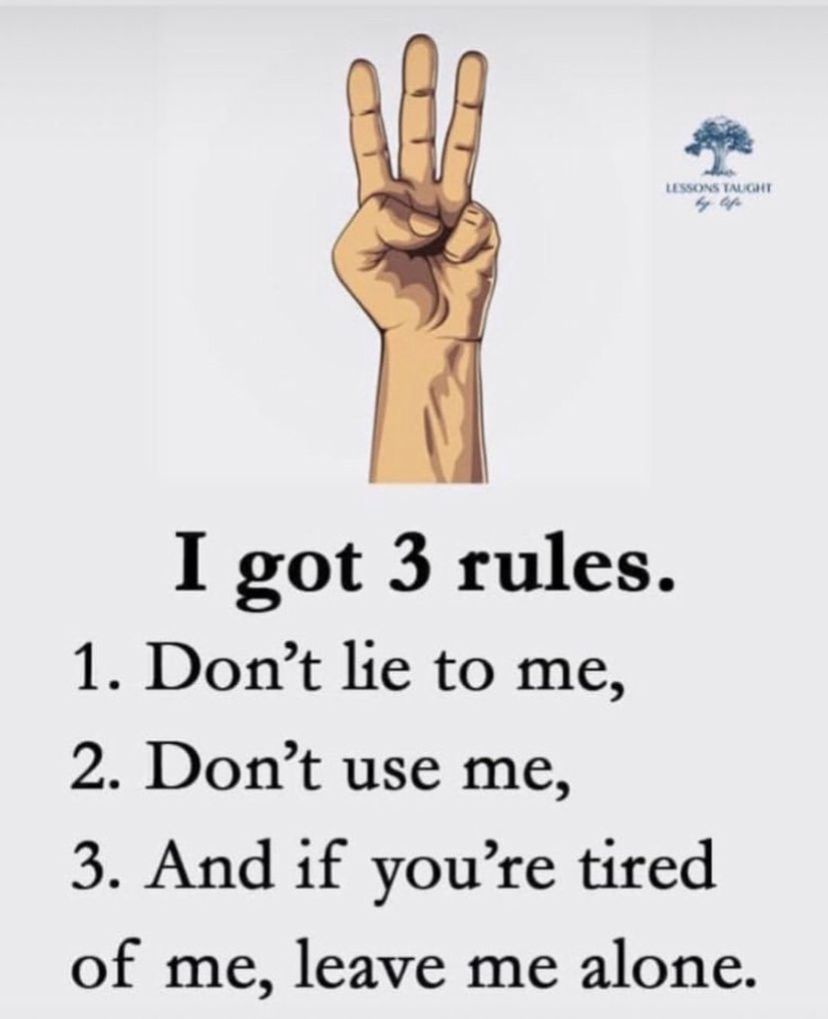
A striking, direct viral illustration shared by Lessons Taught by Life encapsulates this mindset under a raised hand holding up three fingers:
“I got 3 rules.
1. Don’t lie to me,
2. Don’t use me,
3. And if you’re tired of me, leave me alone.”
This straightforward list cuts through the noise of complex relationship dynamics to highlight three fundamental pillars of integrity: truth, mutual value, and honest departure.
In this guide, we break down the visual and thematic principles behind these 3 rules, explore the psychology of personal boundaries, and share practical ways to uphold your standards without conflict.
Deconstructing the Image: The Anatomy of Self-Respect
What makes this straightforward graphic so popular across social media platforms?
                     [ THE 3 PILLARS OF BOUNDARIES ]
                                    |
      --------------------------------------------------------------
     |                              |                               |
 [ 1. INTEGRITY (TRUTH) ]     [ 2. RESPECT (RECIPROCITY) ]    [ 3. FREEDOM (HONESTY) ]
 • "Don't lie to me"          • "Don't use me"               • "Leave me alone"
 • Rejects deceit & games     • Rejects one-sided dynamics   • Prefers clean separation
 • Builds unshakeable trust   • Protects personal energy     • Eliminates passive aggression
1. Rule 1: “Don’t Lie to Me” (Honesty)
Deceit destroys the foundation of any relationship. Whether it’s white lies or major betrayals, dishonesty undermines safety and trust. Demanding honesty ensures that you are engaging with reality rather than a false pretense.
2. Rule 2: “Don’t Use Me” (Reciprocity)
Relationships should be built on mutual support and authentic connection, not transactional convenience. Setting the boundary against being used prevents opportunistic individuals from exploiting your kindness, time, or resources for their own gain.
3. Rule 3: “If You’re Tired of Me, Leave Me Alone” (Directness)
People change, dynamics shift, and feelings naturally evolve over time. This rule emphasizes that if someone no longer values your presence, a clean, honest exit is vastly preferable to mixed signals, ghosting, or passive-aggressive behavior.
Comparative Breakdown: Boundaryless Living vs. Enforcing Clear Rules
| Metric | Boundaryless Relationships | Standard-Driven Relationships |
| Trust Level | Constant paranoia, double-guessing motives | High security, open communication, & clarity |
| Energy Distribution | One-sided effort; feeling drained and taken for granted | Balanced reciprocity; mutual encouragement |
| Conflict Resolution | Passive-aggressive behavior, manipulation, and resentments | Direct, honest conversations or peaceful exits |
| Self-Esteem | Low self-worth from compromising core values | Strong self-respect and unshakeable inner peace |
The Psychology of Setting Non-Negotiable Standards
Why is defining your personal “rules” essential for personal growth and mental health?
1. The Cost of Boundary Violations
Psychologically, failing to set and uphold clear standards signals to your subconscious mind that your feelings and peace are less important than pleasing others. Over time, allowing deceit or exploitation leads to chronic stress, resentment, and decreased self-worth.
2. The Power of Direct Communication
Clear boundaries eliminate ambiguity. By establishing what you expect (honesty and respect) and what you accept when a relationship ends (direct space), you create an environment where high-integrity connections can thrive without drama.
Practical Ways to Uphold Your Personal Rules
-
Enforce Consequences Quietly: Boundaries aren’t threats; they are personal decisions. If someone breaks a core standard (like lying or taking advantage), step back gracefully rather than engaging in endless debates.
-
Value Action Over Words: Pay attention to how people treat you over time rather than what they promise. True respect is demonstrated through consistent, transparent behavior.
-
Normalize Clean Exits: Accept that not every connection is meant to last forever. If a relationship has run its course, allow it to end with dignity instead of holding on to toxic dynamic loops.
Conclusion
The takeaway from “I got 3 rules” is a empowering reminder of self-worth: you deserve honesty, genuine appreciation, and respect in every interaction. By holding firm to these three simple standards, you protect your energy, attract authentic people, and cultivate lasting peace of mind.
Frequently Asked Questions (FAQ)
What are the 3 rules for healthy personal boundaries?
-
Require complete truthfulness and transparency.
-
Refuse to let people exploit your kindness or resources.
-
Encourage direct, clean separation if a connection is no longer working.
How can I enforce personal boundaries without feeling guilty?
Remember that setting standards is an act of self-respect, not aggression. You are not responsible for managing how others react when you choose to protect your peace.