

“Teacher: The Test Isn’t That Confusing” Meme & M.C. Escher Waterfall Illusion Explained
Relatable school memes paired with impossible geometry optical illusions are a staple of viral social media content. They capture the overwhelming feeling of encountering a contradictory exam question by comparing it to physical paradoxes that defy the laws of spatial geometry and physics.
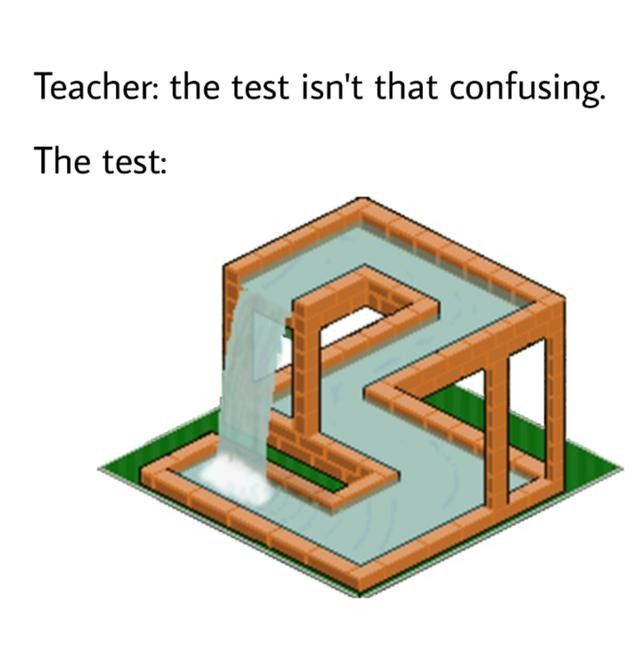
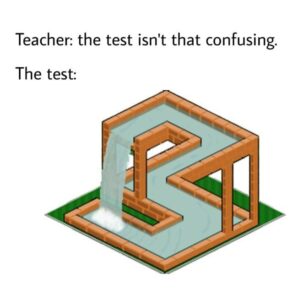
A widely shared meme features a pixelated, isometric rendering of a brick canal structure with a classic caption:
“Teacher: the test isn’t that confusing.”
“The test:”
Below the caption sits an isometric pixel-art adaptation of M.C. Escher’s famous 1961 lithograph, “Waterfall.” Water appears to flow downward through a flat channel, turn three 90-degree corners, and somehow end up at the top of a tower to plunge down as a waterfall in a perpetual loop.
In this guide, we analyze the structure of this impossible illusion, explain the mathematical geometry behind it, and detail why this meme resonates so strongly with students and puzzle enthusiasts.
Deconstructing the Impossible Waterfall Structure
The image relies on isometric projection to trick the visual brain into perceiving a 3D structure that cannot exist in real physical space:
                  [ ISOMETRIC PARADOX BREAKDOWN ]
                                 |
      -------------------------------------------------------
     |                                                       |
 [ THE WATER CANAL LOOP ]                        [ THE VERTICAL WATERFALL ]
 • Horizontal zigzag channel                     • Water drops from top level
 • Appears flat/downward-sloping                 • Lands into bottom reservoir
 • Connects back to upper starting point         • Feeds back into same canal loop
Key Visual & Spatial Elements:
-
The Impossible Triangle Foundation: The structure is built using overlapping isometric angles inspired by the Penrose triangle (an impossible object consisting of three straight beams of square cross-section which meet pairwise at right angles).
-
False Elevation Perception: Each corner of the brick aqueduct looks like a standard 90-degree turn on a flat plane. However, because isometric drawing lacks perspective foreshortening, the visual cortex interprets distant elevated points as being on the same plane as closer lower points.
-
Perpetual Motion Loop: The water seems to flow naturally away from the viewer along the aqueduct, yet the final corner places the channel directly above the starting pool, creating a self-sustaining waterfall loop that violates thermodynamics.
Structural Elements Analysis Table
| Element | Visual Appearance | Mathematical / Geometric Reality |
| Aqueduct Channel | Water flowing downhill along a flat path | Impossible 3D loop combining conflicting depth cues |
| Brick Columns | Vertical supports holding up upper levels | Spatial overlap trick where background column acts as foreground support |
| Waterfall Drop | Water cascading from top tier to bottom reservoir | Illusion created by merging two different height elevations at one point |
| Pixel Art Style | Retro video-game / isometric grid graphic | Clean 2D line art hiding 3D spatial contradictions |
The Meaning Behind the Meme
The contrast between the teacher’s reassuring words and the mind-bending visual creates instant humorous resonance:
-
Exam Disconnect: Students often encounter test questions that seem logically self-contradictory, overly complex, or poorly phrased—much like an aqueduct where water flows uphill while going downhill.
-
Overwhelming Complexity: The visual of a perpetual paradox perfectly mirrors the mental overload of trying to solve a problem with circular logic.
The Origin: M.C. Escher’s “Waterfall”
The illustration in the meme is a digital pixel-art adaptation of Waterfall (1961) by Dutch artist M.C. Escher. Escher was renowned for exploring mathematical concepts, tessellations, and impossible architecture. His original work used two towers topped with polyhedra (a triakis icosahedron and a stellation of the rhombic dodecahedron) to emphasize the mathematical nature of the spatial paradox.
Conclusion
The meme “Teacher: the test isn’t that confusing” uses M.C. Escher’s impossible waterfall paradox to perfectly illustrate academic confusion. By blending retro isometric pixel art with impossible geometry, it turns a classic mathematical illusion into a relatable joke about complex exam questions!
Frequently Asked Questions (FAQ)
What artwork is the “confusing test” meme based on?
The image is a pixel-art version of M.C. Escher’s famous 1961 lithograph, “Waterfall.”
Why is the structure in the image physically impossible?
It uses isometric geometry and false spatial overlapping (based on Penrose triangles) to create a circular loop where water appears to flow downhill while continuously returning to the top of the waterfall.