


How to Solve the 9-Dot Puzzle: The Origin of “Thinking Outside the Box”
Brain teasers and lateral thinking puzzles enjoy immense popularity on social media because they challenge visual perception and problem-solving habits. By setting simple constraints that seem impossible at first glance, these riddles encourage readers to pause, test solutions, and share their results in the comments.
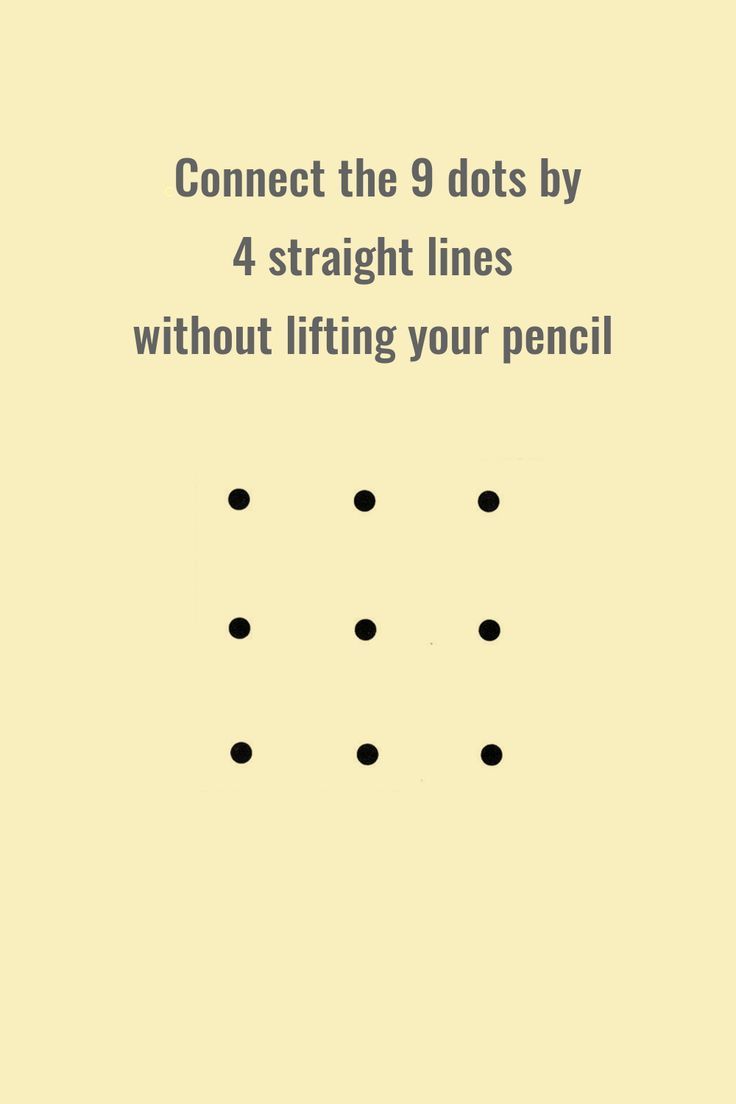
A classic puzzle image presents a 3×3 grid of black dots under a simple challenge:
“Connect the 9 dots by 4 straight lines without lifting your pencil”
While most people attempt to draw lines strictly within the imaginary square boundary formed by the dots, the actual solution requires extending your lines beyond the grid. In fact, this precise riddle is the literal origin of the famous phrase “thinking outside the box.”
In this guide, we break down the step-by-step solution to the 9-dot puzzle, explain the cognitive science behind why it tricks our brains, and explore the history of lateral thinking.
Step-by-Step Solution Guide
To solve the puzzle using a single continuous motion (4 connected straight lines without lifting your pen or pencil), label the 3×3 grid using standard coordinates:
  (1,1)   (1,2)   (1,3)  <-- Top Row
  (2,1)   (2,2)   (2,3)  <-- Middle Row
  (3,1)   (3,2)   (3,3)  <-- Bottom Row
The 4-Line Execution Path:
                    [ 9-DOT PUZZLE SOLUTION PATH ]
                                  |
      -----------------------------------------------------------
     |                                                           |
 [ LINE 1: DIAGONAL ]         [ LINE 2: OUTSIDE TOP ]     [ LINE 3: DOWN RIGHT ]
 • Start at bottom-left (3,1) • Go straight right past      • Cut diagonally down
 • Go diagonally up to top-     top-right (1,3) to an       through (2,2) and (3,1)
   right (1,3)                  imaginary point (1,4)       to start position
-
Line 1 (Diagonal): Start at the bottom-left dot (3,1) and draw a straight line diagonally up to the top-right dot (1,3).
-
Line 2 (Horizontal Extension): From (1,3), draw a horizontal line straight to the left across the top row (1,2) and (1,1), extending one step past the left boundary to an imaginary point outside the grid.
-
Line 3 (Angle Back Down): From that outside point, draw a line diagonally down through the middle-left dot (2,1) and bottom-middle dot (3,2), stopping at the bottom boundary.
-
Line 4 (Vertical Straight Up): From (3,2), draw a straight vertical line upward through (2,2) and back to (1,2), completing the connection of all 9 dots.
Technical & Conceptual Breakdown
| Element | Initial Assumption | Actual Puzzle Requirement |
| Grid Boundary | Invisible square box surrounding the 9 dots | No boundary exists; space outside the dots is fully usable |
| Line Limits | Exactly 4 straight connected lines | Exactly 4 straight connected lines (must not lift pencil) |
| Line Direction | Straight horizontal, vertical, or 45° diagonal | Extended diagonal angles penetrating beyond dot alignment |
| Cognitive Block | Self-imposed spatial boundary constraint | Overcome through lateral thinking and boundary extension |
Why Our Brains Get Stuck: Self-Imposed Boundaries
The 9-dot puzzle is a foundational example in cognitive psychology illustrating how human perception creates artificial constraints:
-
Gestalt Grouping: When human eyes see a symmetric array of dots, our brain automatically connects the outer dots to form an imaginary square.
-
Self-Imposed Constraints: Solvers assume they must stay inside the perimeter of the imaginary square, even though the instructions never state this restriction.
-
Origin of “Outside the Box”: Management consultants and psychologists in the 1970s used this puzzle in corporate training seminars to demonstrate how unexamined assumptions limit creative problem-solving—coining the phrase “think outside the box.”
Conclusion
The “9 Dots in 4 Lines” riddle remains one of the most effective visual demonstrations of lateral thinking. By breaking free from the self-imposed boundary of the grid, you can connect all nine dots in four effortless, continuous strokes!
Frequently Asked Questions (FAQ)
Is it possible to solve the 9-dot puzzle in 3 lines?
Yes! If you draw a line through the centers of the dots using a very thick marker or fold the paper so the dots align on a single plane, it can be solved in fewer lines. However, under standard drawing conditions on flat paper, 4 lines is the minimal mathematical solution.
Where did the phrase “think outside the box” originate?
The phrase originated directly from management and psychology tests centered on this 9-dot puzzle during the late 20th century.