
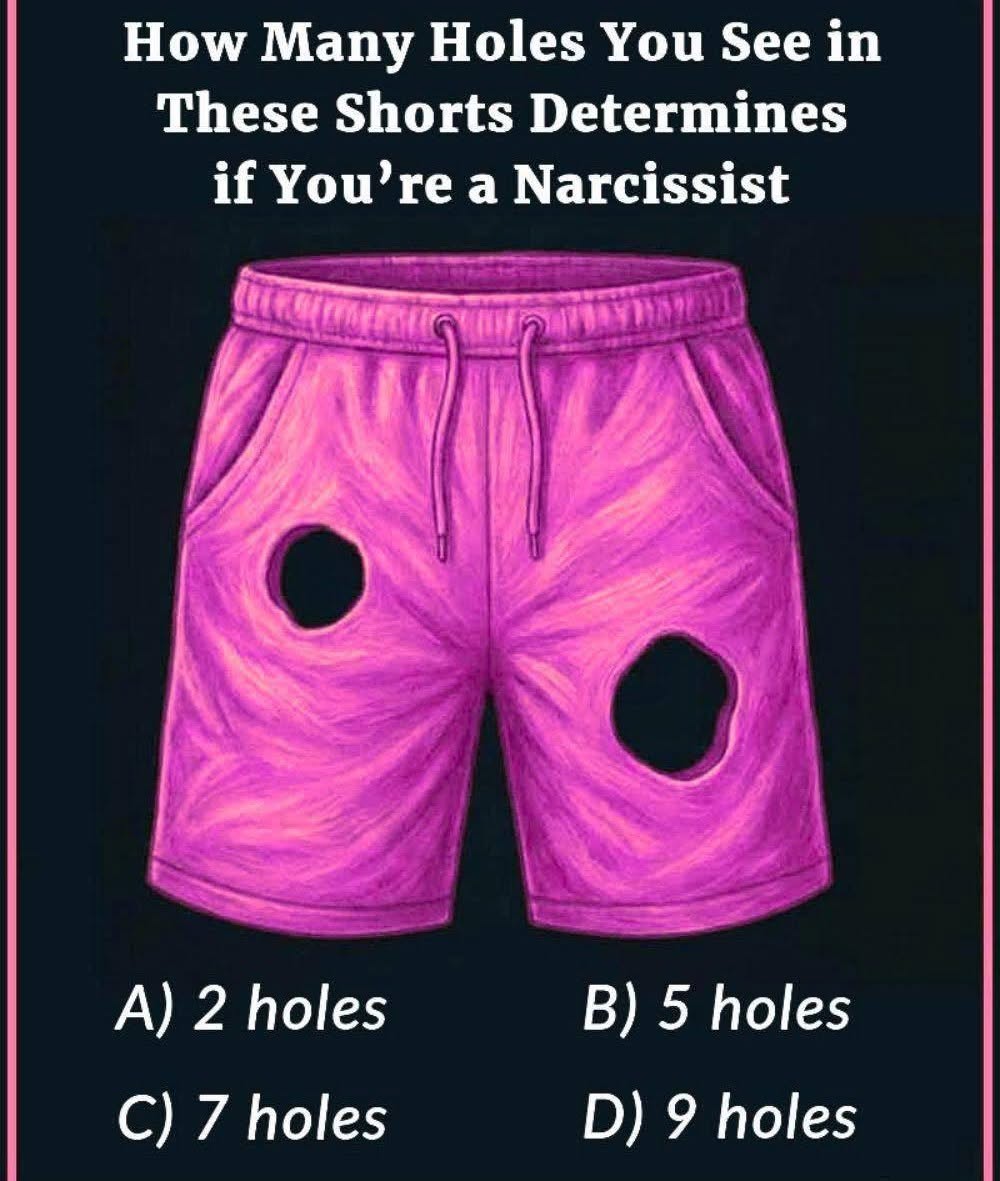


Viral riddles and visual puzzle tests frequently captivate social media, sparking debate over seemingly simple images. One popular puzzle showing a pair of pink shorts asks viewers a straightforward question: how many holes are in these shorts?
While clickbait captions often pair these images with exaggerated claims about personality traits or IQ, the puzzle itself is a fun exercise in spatial reasoning, geometry, and observation skills.
Below, we break down the logical count of holes in the shorts, explore the psychology behind visual perception puzzles, and discuss how mental exercises support cognitive sharpness.
The Complete Count: Breaking Down the Holes
To find the true total number of holes, you have to look beyond the obvious torn openings and consider the standard structural openings required for a pair of shorts to function.
1. Standard Structural Openings (4 Holes)
A standard pair of shorts naturally features four essential openings:
-
1 Waistband Opening (at the top)
-
2 Leg Holes (at the bottom)
-
1 Drawstring Exit Point/Eyelet Area (or pocket openings depending on construction)
2. The Torn Holes (4 or 5 Holes Depending on Perspective)
Looking at the fabric itself:
-
There are 2 large visible torn holes on the front of the shorts.
-
Because you can see completely through the shorts to the dark background, those 2 front holes must align with 2 corresponding holes on the back layer of the fabric (adding 2 more holes).
The Math Total
Combining the standard construction openings with the torn holes gives a logical total of 7 or 8 holes (with 7 holes being option C in the puzzle).
Visual Perception and How the Brain Solves Riddles
Visual riddles challenge how our visual cortex processes shapes and spatial relationships.
1. Selective Focus vs. Holism
When first viewing an image with obvious highlights—such as two large torn holes—the human brain naturally zeroes in on the anomalies first. Discerning the full picture requires shifting from immediate visual focus to a holistic analysis of object structure.
2. Spatial Mapping and Layering
Puzzles that show cutouts or tears force the brain to mentalize a three-dimensional object from a two-dimensional image. Recognizing that a hole passing straight through fabric implies openings on both the front and back layers requires basic spatial awareness and mental rotation.
Real-World Benefits of Critical Thinking and Logic Exercises
Engaging with brain teasers, spatial puzzles, and logic games provides lightweight mental stimulation that helps sharpen focus and attention to detail.
-
Attention to Detail: Training yourself to examine images carefully translates into better scrutiny when reviewing documents, analyzing data, or inspecting everyday physical items.
-
Problem-Solving Skills: Logic puzzles encourage evaluating problems from multiple angles rather than relying on initial surface-level assumptions.
-
Cognitive Fitness: Keeping the mind active with puzzles, reading, and problem-solving activities supports overall cognitive health and mental agility.
Practical Tips for Improving Observation Skills
If you enjoy solving visual teasers and hidden-object puzzles, here are a few simple ways to train your perception:
-
Count Systematically: Divide an image or object into sections or categories (e.g., structural elements vs. added features) before totaling your count.
-
Consider 3D Structure: Remember that flat images often represent 3D objects with front, back, and interior components.
-
Question First Impressions: Take a second look at your initial instinct to see if you missed subtle background elements or implied features.
Conclusion
While visual riddles on social media are entertaining games rather than diagnostic tests, they offer a fun way to test your observation skills. By counting both the functional garment openings and the front-and-back torn holes, the complete breakdown highlights how a second look can reveal details that aren’t immediately obvious.
Frequently Asked Questions (FAQ)
What is the correct answer to the shorts hole riddle?
Option C (7 holes) is the most widely accepted answer, accounting for the waistband, leg openings, and the front and back torn holes in the fabric.
Do social media puzzle choices reveal personality traits?
No. Captions linking visual riddle results to personality traits or psychological diagnoses are designed for entertainment and engagement rather than scientific assessment.
Why do people see different numbers of holes in the image?
Differences arise based on whether viewers count only the visible tears, include the standard leg and waist openings, or factor in the back fabric layer.