

How Many Cubes Are on the Trailer? 3D Spatial Puzzle Explained
Orthographic projection puzzles and spatial reasoning tests regularly go viral across social media platforms like Facebook. By presenting 3D block arrangements through 2D Side, Back, and Top views, these brain teasers challenge spatial visualization, geometry, and systematic counting skills.
A widely shared graphic asks:
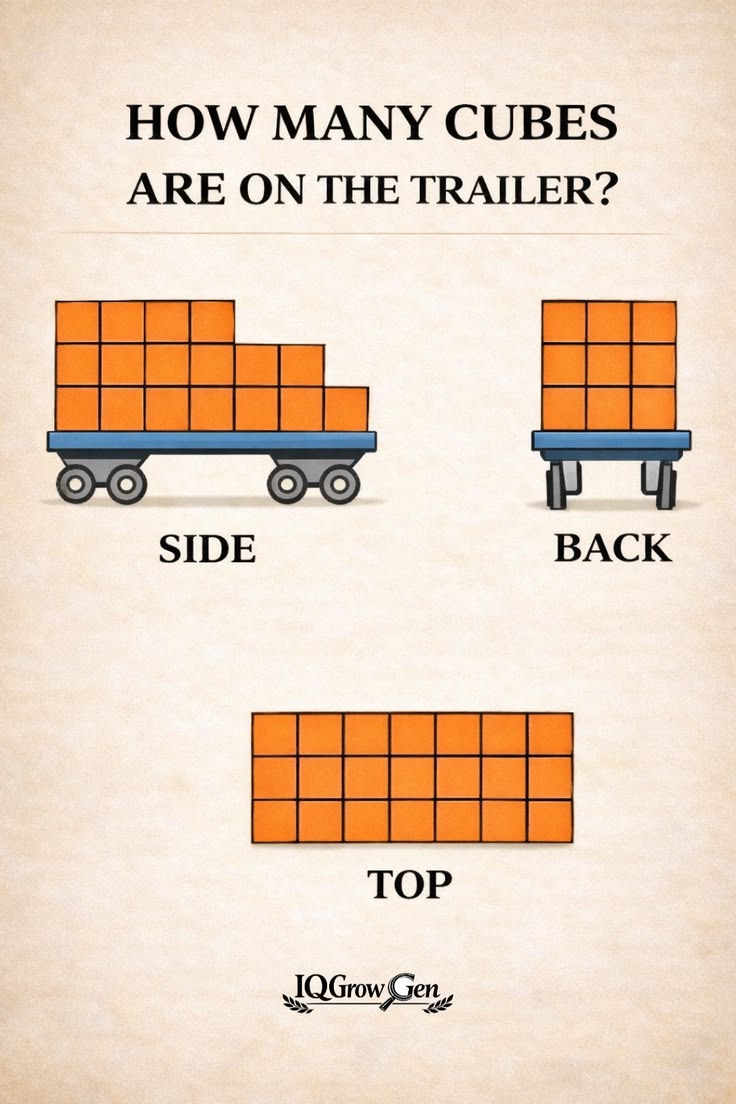
“HOW MANY CUBES ARE ON THE TRAILER?”
The graphic provides three distinct views of an orange block structure loaded onto a flatbed trailer:
-
SIDE View: Displays a profile that is 6 units long with step-down heights (heights of 3, 3, 3, 2, 2, and 1).
-
BACK View: Displays a grid that is 3 units wide and 3 units tall.
-
TOP View: Displays a complete $3 \times 6$ grid of filled positions with zero gaps.
In this guide, we break down the 3D geometry step-by-step, explain how to combine orthographic views, and reveal the exact number of cubes on the trailer.
Step-by-Step Geometry Breakdown
To solve orthographic block puzzles accurately, analyze each view systematically to determine the dimensions of the grid and the height of each column.
                       [ 3D ORTHOGRAPHIC PROJECTION ]
                                     |
      --------------------------------------------------------------
     |                                                              |
 [ TOP VIEW (Footprint) ]     [ SIDE VIEW (Heights) ]      [ BACK VIEW (Width) ]
 • Grid size: 3 x 6           • Column heights along length: • Full width of 3 units
 • Total grid positions = 18  • 3, 3, 3, 2, 2, 1             • Confirms uniform height across rows
1. Determining the Base Grid (Top View)
The TOP View shows a grid that is 3 rows wide and 6 columns long:
Because every square in the Top View is filled solid with no empty spaces, every single one of the 18 positions contains at least one cube.
2. Determining Column Heights (Side & Back Views)
The SIDE View shows the height profile from front to back across the 6 columns:
-
Columns 1, 2, and 3: Height of 3 cubes
-
Columns 4 and 5: Height of 2 cubes
-
Column 6: Height of 1 cube
The BACK View shows a $3 \times 3$ solid square face, confirming that each row across the width (all 3 rows) has the same height profile shown in the side view.
Calculating the Total Number of Cubes
Since each of the 3 rows across the trailer’s width repeats the identical 6-column side profile, calculate the cubes per row and multiply by 3:
-
Cubes in 1 Row (along the length):
-
Total Cubes across all 3 Rows:
Mathematical Summary Table
| Column Position | Height (Cubes) | Number of Rows | Total Cubes |
| Columns 1–3 | 3 high | 3 rows | $3 \times 3 \times 3 = 27$ |
| Columns 4–5 | 2 high | 3 rows | $2 \times 2 \times 3 = 12$ |
| Column 6 | 1 high | 3 rows | $1 \times 1 \times 3 = 3$ |
| TOTAL | — | — | 42 Cubes |
Conclusion
The correct total number of cubes on the trailer is 42. By multiplying the 14-cube side profile across the 3 rows shown in the Top and Back views, you get the exact 3D volume!
Frequently Asked Questions (FAQ)
What is the answer to “How many cubes are on the trailer?”
The correct answer is 42 cubes.
How do orthographic views work in block riddles?
Orthographic views show a 3D object from 2D perspectives (Top, Front/Side, Back). To calculate total volume, use the Top view to find the grid layout and the Side/Front views to determine the height of each stack.