


Screenshot
How Daily Consistency Shapes Your Future: The Stone Metaphor Explained
When tackling massive goals—whether learning a new skill, building a business, or transforming personal habits—the sheer weight of the task can feel overwhelming at the start. However, major growth rarely happens through sudden leaps; it is the result of persistent daily effort.
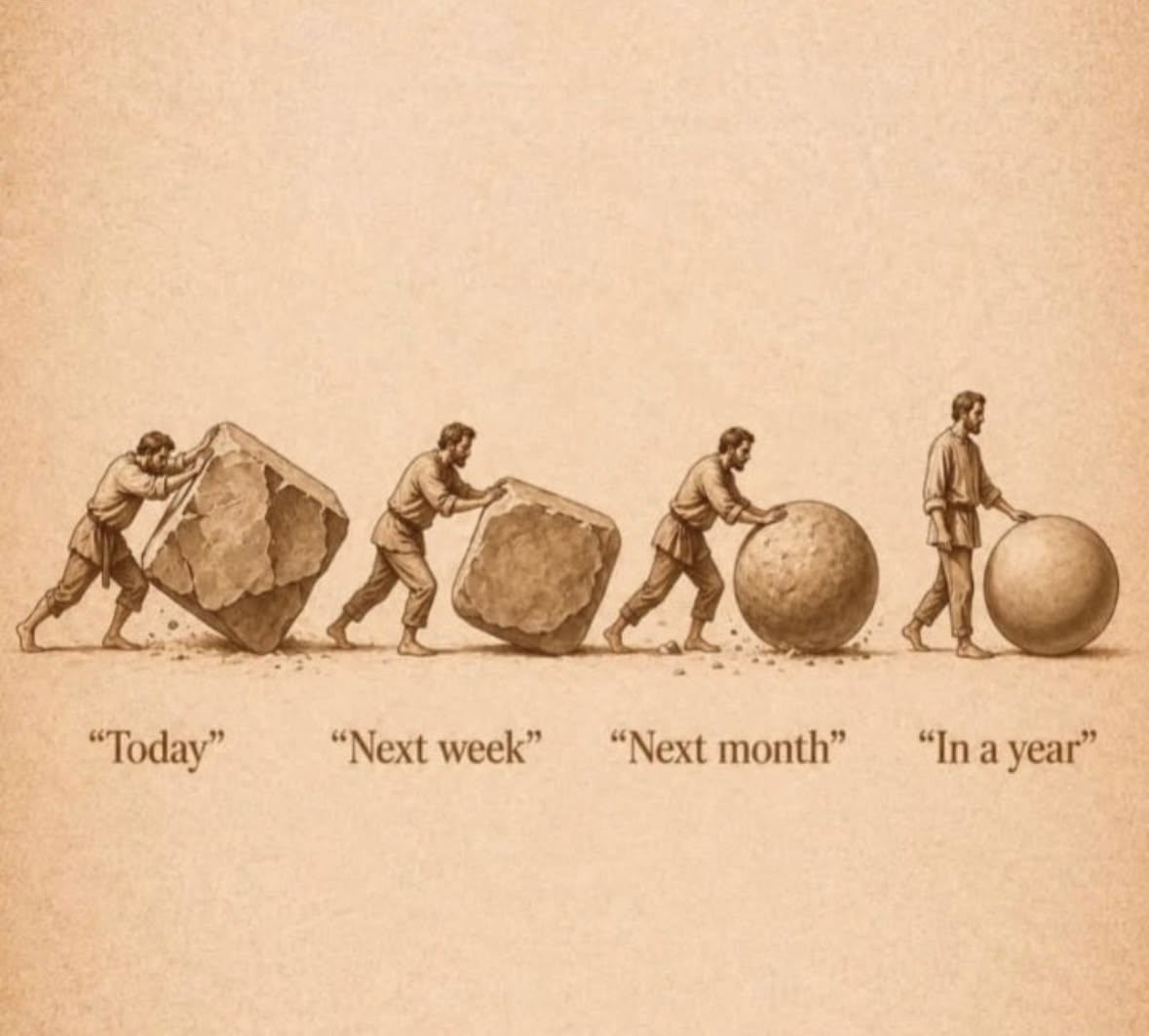
A powerful viral illustration depicts a man pushing a heavy stone across four stages of time:
-
“Today”: He struggles with immense effort to push a huge, rough cube of stone.
-
“Next week”: The block is noticeably smaller and smoother around the edges, making it slightly easier to move.
-
“Next month”: The stone has been carved into a rough sphere, rolling forward with far less friction.
-
“In a year”: The stone is a perfect, smooth sphere that he rolls along effortlessly with one hand.
This visual metaphor beautifully illustrates the concept of compound effort: what starts as a grueling, heavy burden eventually transforms into light, smooth momentum through consistent daily practice.
In this guide, we break down the deeper meaning of this visual graphic, explore the psychology of habit formation, and share actionable steps to build momentum in your daily life.
Deconstructing the Image: The Stages of Progress
What makes this visual progression so inspiring and memorable?
                      [ THE EVOLUTION OF EFFORT ]
                                   |
      -----------------------------------------------------------
     |                  |                  |                     |
 [ "TODAY" ]       [ "NEXT WEEK" ]    [ "NEXT MONTH" ]     [ "IN A YEAR" ]
 • Rough cube       • Smaller block    • Rough sphere       • Smooth sphere
 • Maximum effort   • Friction drops   • Rolling motion     • Minimal effort
 • High resistance  • Noticeable progress • High momentum   • Sustained mastery
1. The Initial Struggle (“Today”)
At the beginning, friction is at its peak. The object is a massive, angular cube with hard edges. Starting a new habit or project requires maximum willpower, raw effort, and persistence because momentum hasn’t been established yet.
2. The Power of Chipping Away (“Next Week” to “Next Month”)
As time passes, small daily actions gradually chip away the sharp corners and rough edges. The heavy cube transitions into a cylinder, then a rough sphere. Pushing the weight becomes progressively easier because the shape itself works with you instead of against you.
3. Effortless Mastery (“In a Year”)
After a year of daily dedication, the stone is fully rounded and polished. The man guides it casually with one hand. The task that once required grueling physical strain is now an effortless, automated habit.
Comparative Breakdown: Starting vs. Sustaining Habits
| Stage | Visual Representation | Required Effort | Psychological Focus |
| Day 1 (“Today”) | Massive, jagged square block | High | Willpower, discipline, overcoming initial friction |
| Week 1 (“Next week”) | Slightly smaller, rounded block | Moderate-High | Establishing routine, resisting early burnout |
| Month 1 (“Next month”) | Rough rolling sphere | Moderate | Building momentum, refining efficiency |
| Year 1 (“In a year”) | Perfect smooth sphere | Low (Automated) | Long-term consistency, effortless execution |
The Science of Habit Formation and Compound Growth
Why does consistent daily action feel so hard initially, yet become so natural over time?
1. Neuroplasticity and Neural Pathways
When learning a new behavior, the brain has to build new neural pathways from scratch. At first, this requires high cognitive energy and intense focus (like pushing a square block). Over time, repeated practice coats these pathways in myelin, allowing signals to pass rapidly and automatically (like rolling a smooth sphere).
2. The Compound Effect
Progress compounds exponentially rather than linearly. Small, 1% daily improvements may seem invisible during the first few days, but over 365 days, those tiny adjustments result in a radical transformation of capability and workload.
Practical Ways to Build Long-Term Momentum
-
Focus on the Process, Not the Weight: Don’t obsess over how large the block is today. Focus solely on making a single push every single day.
-
Reduce Initial Friction: Start with tiny, manageable steps (e.g., studying for 10 minutes or exercising for 15 minutes) to get the stone moving without burning out.
-
Embrace the “Chipping” Phase: Realize that discomfort during the first few weeks is completely normal. Every rough edge you chip off now makes tomorrow’s push easier.
Conclusion
The journey from a heavy, immovable cube to a smooth, effortless sphere takes time, patience, and repetition. The graphic serves as a timeless reminder: don’t give up during the heavy lifting of “Today”—your smooth momentum “In a Year” is being built right now.
Frequently Asked Questions (FAQ)
What is the core message of the “Today vs In a year” stone meme?
The visual illustrates how consistent daily effort chips away at hard problems, gradually turning heavy, difficult tasks into smooth, effortless habits over time.
How long does it actually take for a habit to become effortless?
While popular myth suggests 21 days, research indicates that forming a strong, automated habit typically takes anywhere from 66 days to a full year depending on complexity and consistency.