

Brain Test: Can You Find the Single Person Hidden in the Grid?
Visual search puzzles and odd-one-out brain teasers are a popular way to test attention to detail, visual processing speed, and pattern recognition. By filling an image with repetitive shapes and silhouettes, these visual tests trick the brain into scanning right past subtle missing elements.
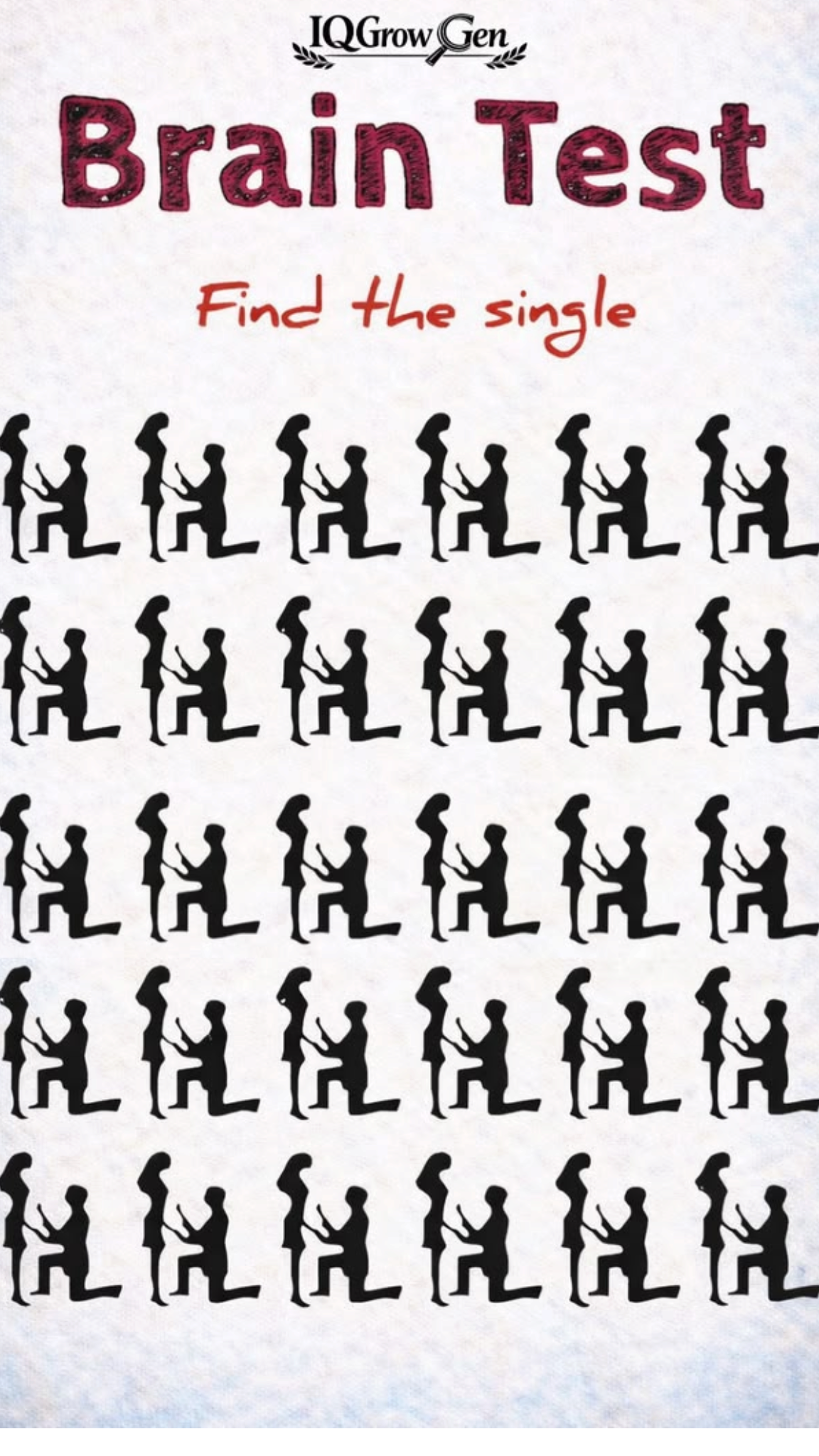
A viral brain teaser titled “Brain Test: Find the single” presents a simple yet tricky challenge:
“Find the single”
The image features a 5-row grid filled with silhouettes of couples where a man is kneeling on one knee proposing to a standing woman. However, one silhouette is completely single—lacking a partner entirely!
Below, we reveal the exact location of the single person and explore the visual processing science behind why our eyes tend to miss them at first glance!
Step-by-Step Breakdown: Where Is the Single Person?
To find the odd one out quickly, scan row by row along the edges:
1. The Standard Couple Silhouette
-
Each standard pair consists of a standing woman on the left and a man kneeling on one knee facing her on the right.
2. Finding the Anomaly
-
Row 1 to Row 3: Every position contains a complete couple (woman standing + man kneeling).
-
Row 4 (Far Left): Look at the very beginning (far-left edge) of the 4th row.
-
The Single: Positioned on the far left of Row 4 is a lone kneeling man proposing to empty space, with no woman standing in front of him!
Grid Layout & Location Matrix
| Row | Total Pairs / Figures | Description | Status |
| Row 1 | 6 Couples | Full standing woman & kneeling man pairs | Complete |
| Row 2 | 6 Couples | Full standing woman & kneeling man pairs | Complete |
| Row 3 | 6 Couples | Full standing woman & kneeling man pairs | Complete |
| Row 4 | 1 Single Man + 5 Couples | Lone kneeling man on the far left edge | Odd One Out |
| Row 5 | 6 Couples | Full standing woman & kneeling man pairs | Complete |
The Science of Visual Search & Grid Camouflage
Why is it easy to overlook the single figure on the first scan?
1. Pattern Completion (Gestalt Psychology)
When your brain sees several identical pairs lined up in uniform rows, it creates an expectation of regularity. Your visual cortex rapidly processes the repeating silhouette pattern and automatically “fills in” expected details unless you examine each figure individually.
2. Peripheral Blindness & Edge Distortion
Visual search studies show that people tend to focus their primary gaze near the center of a grid or image. Anomalies placed on the far outer edges—such as the far-left side of Row 4—are frequently missed during initial quick scans.
Conclusion
Grid-based odd-one-out puzzles demonstrate how easily our eyes can be tricked by uniform repetition. If you spotted the lonely kneeling man on the far left of Row 4 in under 5 seconds, your pattern recognition and visual acuity are exceptionally sharp!
Frequently Asked Questions (FAQ)
Where is the single person located in the brain test?
The single person is located at the far-left edge of the 4th row down. It is a man kneeling on one knee without a woman standing in front of him.
Why do visual search tests place anomalies along the edges?
Placing the odd figure on the outer border leverages natural eye-movement tendencies, as human visual scanning typically begins near the center of an image before moving to the periphery.