
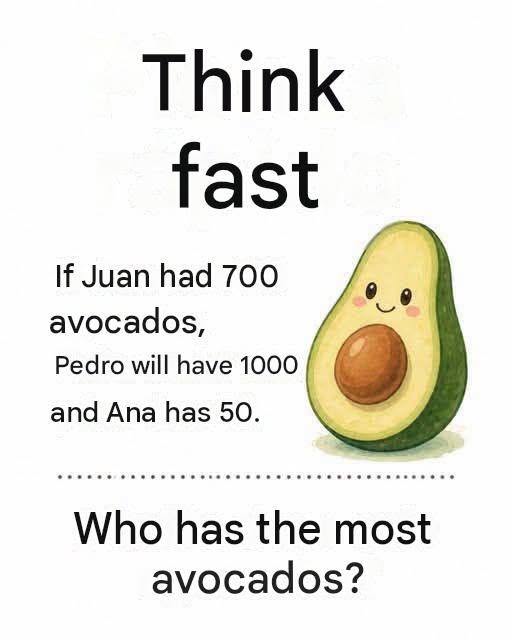


Brain teasers, logic riddles, and visual word puzzles have exploded in popularity across social media platforms like Facebook, Twitter, and TikTok. These engaging mental challenges do far more than just test our basic math skills—they play clever tricks on our cognitive processing, reading comprehension, and attention to detail. A classic example is the famous “avocado riddle,” where a subtle shift in verb tenses turns a seemingly simple math problem into a mind-bending linguistic test.
When faced with a rapid-fire riddle, our brains naturally attempt to process the numbers as quickly as possible. However, the true key to solving these word games lies not in calculating figures, but in carefully examining the precise grammar, verb tenses, and logical conditions embedded within the sentence structure.
Below, we break down the exact solution to this viral avocado riddle, explore the cognitive psychology behind why our brains get tricked, and share practical ways to sharpen your critical thinking skills.
The Avocado Riddle: Step-by-Step Logic Breakdown
To solve the riddle correctly, we must carefully analyze the exact wording used for each of the three individuals mentioned: Juan, Pedro, and Ana.
1. Juan’s Avocados (Past Hypothetical Tense)
The text states: “If Juan had 700 avocados…”
-
Grammar Analysis: The word “had” is in the past tense, and the sentence begins with a conditional “If.” This means Juan’s 700 avocados exist purely as a hypothetical past scenario. It does not state that Juan currently possesses 700 avocados today.
2. Pedro’s Avocados (Future Tense)
The text states: “Pedro will have 1000…”
-
Grammar Analysis: The phrase “will have” indicates the future tense. This describes a scenario that has not yet occurred. Pedro does not currently hold 1,000 avocados in the present moment; he may only acquire them at some point in the future.
3. Ana’s Avocados (Present Indicative Tense)
The text states: “…and Ana has 50.”
-
Grammar Analysis: The word “has” is the only verb written in the simple present tense. This is a direct, factual statement about the current moment. Out of everyone mentioned, Ana is the only person who definitively possesses avocados right now.
The Verdict: Who Has the Most Avocados?
If we are asking who currently possesses the most avocados in real-time, Ana is the correct answer with 50 avocados! While Pedro may have 1,000 in the future and Juan had 700 in a hypothetical past, Ana is the only one who actually holds real avocados in the present.
(Alternatively, if the riddle is treated purely as a numerical comparison regardless of tense, Pedro holds the highest hypothetical number at 1,000).
Why Brain Teasers Trick Our Cognitive Processing
Why do so many people answer “Pedro” instantly without hesitation? The answer lies in how human brains process visual and textual information under pressure.
Dual-Process Theory: System 1 vs. System 2 Thinking
In cognitive psychology, decision-making is often categorized into two primary modes of thought, popularized by psychologist Daniel Kahneman:
-
System 1 (Fast & Automatic): Operates automatically, rapidly, and with little to no conscious effort. When you see numbers like 700, 1000, and 50, System 1 quickly identifies 1000 as the largest quantity and leaps to a conclusion.
-
System 2 (Slow & Analytical): Allocates attention to effortful mental operations, including complex computations, logical deduction, and grammatical analysis.
Riddles titled “Think Fast” intentionally trigger your fast System 1 thinking, encouraging you to skip past reading the actual verb tenses so you fall right into the trap.
How Engaging in Riddles Boosts Brain Health and Focus
Regularly challenging your mind with logic games, lateral thinking puzzles, and language riddles provides tangible cognitive benefits that support lifelong mental agility.
1. Improves Working Memory and Attention to Detail
Solving complex word puzzles requires holding multiple pieces of conditional information in your mind simultaneously. This practice strengthens working memory and enhances your ability to spot micro-details in everyday tasks.
2. Enhances Critical Thinking and Reading Comprehension
In an era dominated by rapid skimmable online content, practicing slow, deliberate reading helps train your brain to analyze text critically rather than making snap assumptions.
3. Strengthens Problem-Solving Skills
Lateral thinking riddles force you to look at problems from unconventional angles, encouraging cognitive flexibility—a crucial skill for professional environments, academic research, and complex decision-making.
Financial, Legal, and Educational Value of Critical Reading
The ability to analyze language, detect subtle nuances, and catch tricky phrasing is not just useful for social media riddles—it is an essential life skill that impacts your personal finances, legal agreements, and career development.
-
Legal Contracts and Attorney Documents: Misreading a single word, condition, or timeline in a mortgage agreement, personal loan contract, or business liability policy can lead to costly mistakes. Paying close attention to detail protects your legal rights.
-
Investment and Financial Planning: Evaluating investment opportunities, retirement planning options, and credit offers requires careful analysis of terms, interest rates, and hidden conditions to ensure long-term wealth security.
-
Continuous Education: Sharpening your mind through logic training and active reading improves focus, boosting productivity across technology, business, and administrative leadership roles.
Practical Tips to Solve Lateral Thinking Puzzles
If you want to master logic riddles and avoid getting tricked by viral word games, keep these simple guidelines in mind:
-
Slow Down and Read Every Word: Ignore prompts that demand fast answers. System 2 thinking requires time to analyze structural details.
-
Pay Attention to Verbs and Tenses: Look for words like was, had, will be, might, or has. Grammar frequently holds the hidden key to logic problems.
-
Separate Numbers from Context: Do not just look at the highest numerical figure. Always evaluate what that number actually represents in the context of the story.
-
Question the Assumptions: Ask yourself what the riddle is specifically asking for. Is it asking about the present, the past, or a hypothetical future?
Fascinating Facts About Avocados and Language
-
Avocado Botany: Botanically speaking, an avocado is actually a single-seeded berry, not a vegetable!
-
Etymology: The word “avocado” comes from the Nahuatl (Aztec) word ahuacatl.
-
The Brain’s Reading Speed: The average human brain can read up to 250 to 300 words per minute, but comprehension drops significantly when forced to process conditional logic at high speeds.
Conclusion
The viral avocado riddle is a brilliant example of how human perception can be easily manipulated by subtle linguistic cues. By placing a large number in the future tense and a smaller number in the present tense, the puzzle cleverly traps our fast-thinking brain. Whether you answered Ana based on strict present-tense grammar or Pedro based on total volume, engaging with these fun mental exercises keeps your mind sharp, attentive, and ready to tackle complex challenges.
Frequently Asked Questions (FAQ)
What is the trick to solving “Think Fast” word riddles?
The trick is to ignore the urge to answer quickly! Read the text slowly, pay strict attention to verb tenses (past, present, future), and distinguish factual statements from hypothetical scenarios.
Why is Ana considered the correct answer by grammar experts?
Ana is the correct present-tense answer because “has” denotes immediate ownership in the present moment, whereas “had” refers to the past and “will have” refers to the future.
Can brain games and logic riddles improve cognitive reserve?
Yes! Engaging in regular mental workouts, reading, and problem-solving exercises helps build cognitive reserve, keeping your mind sharp and resilient as you age.