


A Man Has 9 Sons, Each Son Has a Sister: The Classic Family Riddle Solved
Classic word riddles, logic traps, and family counting puzzles are constant viral hits across social networks. They trick our brains into performing unnecessary multiplication, creating hilarious debates in the comment section over what seems like simple arithmetic.
A widely shared handwritten riddle asks a straightforward question:
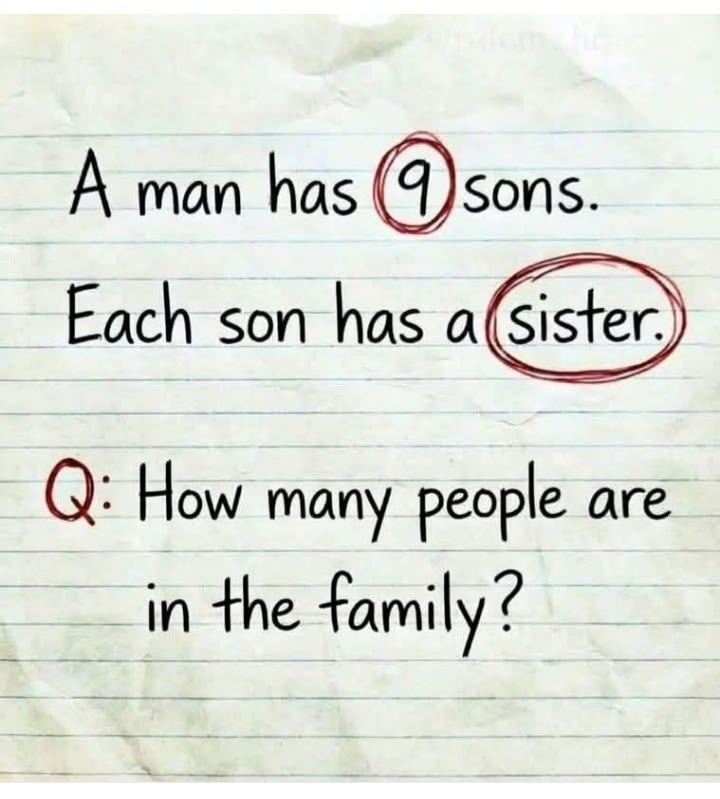
“A man has 9 sons. Each son has a sister. Q: How many people are in the family?”
At first glance, many people quickly multiply $9 \times 2$ or add 9 sisters to the 9 sons, reaching totals of 18 or 20. However, once you break down family relationships logically, the correct answer becomes completely clear.
In this full guide, we reveal the correct answer, show the step-by-step counting breakdown, explain why our brains fall for word traps, and share tips for mastering lateral thinking riddles.
Deconstructing the Riddle: Step-by-Step Breakdown
To solve this riddle accurately, let’s tally every individual in the immediate family step-by-step.
                  [ THE MAN (FATHER) ]
                            |
   +---+---+---+---+---+----+---+---+---+
   |   |   |   |   |   |    |   |   |   |
  S1  S2  S3  S4  S5  S6   S7  S8  S9  [ 1 SHARED SISTER ]
1. The Father
-
The prompt begins with “A man…”, which means we start our count with 1 person (the father).
2. The 9 Sons
-
The man has 9 sons. That adds 9 people to our tally.
3. The Sister
-
Here is where the trick lies: “Each son has a sister.”
-
Since all 9 sons are brothers in the same family, they all share the exact same sister. You do not need 9 separate sisters for each son to have a sister—just 1 daughter satisfies the condition for all 9 brothers!
Calculating the Grand Total
Depending on whether you include the mother (who is implied in a traditional family structure but not explicitly mentioned in the text), there are two standard ways to state the final count:
Option A: Strictly Based on Explicitly Mentioned Text (Total: 11)
Counting only the individuals directly stated in the prompt:
Option B: Including the Mother (Total: 12)
If you assume a standard biological/household family unit that includes the mother:
Both 11 (strict textual interpretation) and 12 (inclusive family interpretation) are recognized as correct answers, with 11 being the standard literal solution to the text puzzle.
Comparing Common Mistakes vs. Correct Logic
| Method | Calculation | Result | Status |
| Overthinking / Multiplication | $9 \text{ sons} + (9 \text{ sons} \times 1 \text{ sister each}) + 1 \text{ father}$ | 19 | Incorrect (Assumes 9 distinct sisters) |
| Simple Addition Misstep | $9 \text{ sons} + 9 \text{ sisters}$ | 18 | Incorrect (Ignores shared sibling relationship) |
| Strict Textual Logic | $1 \text{ man} + 9 \text{ sons} + 1 \text{ shared sister}$ | 11 | Correct (Literal) |
| Full Household Logic | $1 \text{ father} + 1 \text{ mother} + 9 \text{ sons} + 1 \text{ shared sister}$ | 12 | Correct (Household) |
Why Our Brains Fall for Sibling Riddles
Language-based math riddles exploit a cognitive shortcut known as semantic misdirection:
-
Independent vs. Shared Sets: When we hear “Each son has a sister,” our linguistic processing defaults to treating “a sister” as an independent item for each unit, rather than a single shared entity across a set.
-
Speed Over Verification: We rush to calculate $9 + 9 = 18$ before stopping to visualize the actual family dynamics.
Practical Tips to Solve Lateral Thinking Riddles
-
Draw or Diagram the Group: Sketching out relationships (or listing individuals) helps immediately catch shared connections.
-
Look for Shared Elements: Whenever a prompt uses words like each, every, or all, check if the object mentioned can be shared among the group.
-
Count the Narrator / Primary Subject: Always remember to include the person introduced at the beginning of the sentence (e.g., “A man has…”).
Conclusion
The answer to the riddle “A man has 9 sons. Each son has a sister. How many people are in the family?” is 11 people (or 12 if you count the mother).
Because all 9 brothers share the same single sister, you only need one girl in the family for every son to have a sister!
Frequently Asked Questions (FAQ)
What is the exact answer to the 9 sons riddle?
The strict literal answer is 11 people (1 father + 9 sons + 1 shared sister). If including the mother, the answer is 12.
Why isn’t the answer 19 or 20?
Because the sons are brothers, they share the same sister. You do not need 9 individual sisters.
Is the mother included in the count?
Most puzzle formats accept 11 as the strict text answer, but 12 is equally valid if considering a standard complete family unit.