

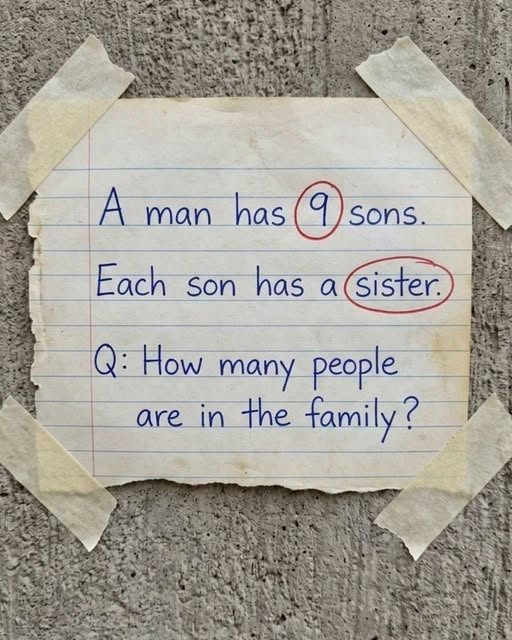

Linguistic logic puzzles written on handwritten notes or signs are designed to generate high volume in social media comment sections. Featuring a handwritten note taped to a wall stating: “A man has 9 sons. Each son has a sister. Q: How many people are in the ?”, this classic word puzzle relies on semantic interpretation and basic set theory to trick readers into overcounting.
SocialSciences
While many commenters quickly add nine individual sisters to nine sons, solving the riddle correctly requires applying logical set relationships to structures.
In this comprehensive guide, we deconstruct the mathematical set dynamics, evaluate the linguistic nuances that create ambiguity, and establish the definitive headcount answers based on common family assumptions.
Deconstructing the Family Set: Shared Relations vs. Cumulative Counting
Understanding how shared sibling relationships operate mathematically clarifies why the phrase “each son has a sister” does not imply nine distinct female children: