

From “I’m Gonna” to “I Did”: Why Execution Trumps Intention Every Time
Motivational artwork and productivity illustrations perform exceptionally well across social media platforms like Facebook. By using tangible objects to represent abstract psychological concepts—like action, effort, and execution—these posts inspire readers to evaluate their habits, overcome procrastination, and focus on real-world results.
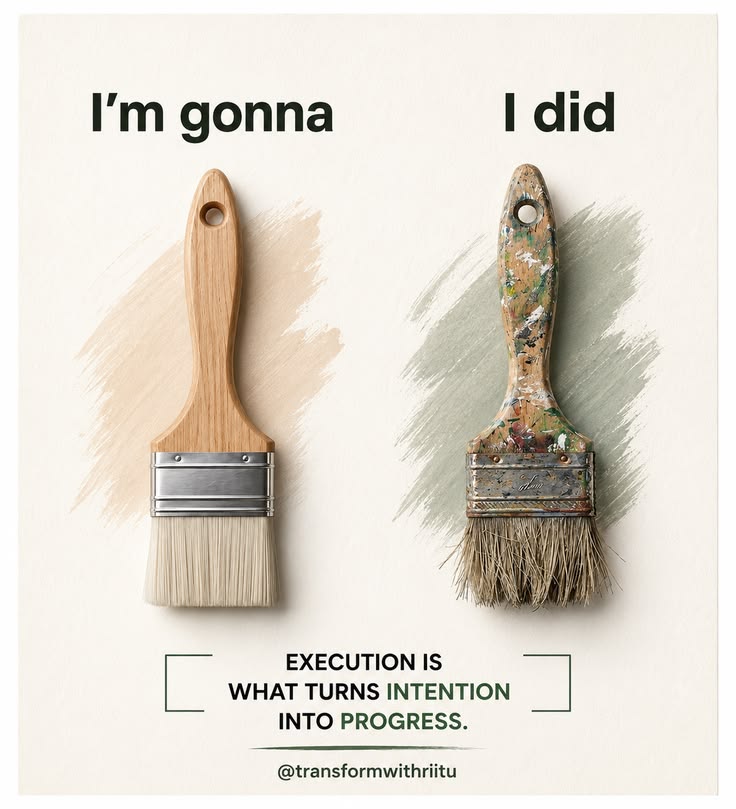
A striking graphic displays two paintbrushes placed side-by-side on a neutral canvas:
-
The Pristine Brush (“I’m gonna”): A brand-new, completely clean wooden paintbrush resting against a light beige background.
-
The Used Brush (“I did”): A worn, paint-splattered, frayed paintbrush resting against a muted green background.
-
The Core Message: “EXECUTION IS WHAT TURNS INTENTION INTO PROGRESS.”
In this guide, we break down the mental framework behind this visual metaphor, examine why bridge-building between planning and action is crucial for success, and share actionable strategies to start executing today.
Visual Metaphor Breakdown
The image contrasts theoretical potential with practical experience:
                      [ INTENTION VS. EXECUTION ]
                                     |
      --------------------------------------------------------------
     |                                                              |
 [ THE CLEAN BRUSH ("I'M GONNA") ]                [ THE USED BRUSH ("I DID") ]
 • Pristine, unused, & comfortable                 • Splattered, frayed, & experienced
 • Represents goals, plans, & intentions           • Represents effort, learning, & completion
 • Unproven potential with zero output             • Tangible progress through real action
1. The Pristine Brush (“I’m gonna”)
The clean paintbrush represents pure intention. It looks perfect, organized, and ready for work, but it hasn’t actually created anything. Many people spend months or years stuck in this stage—planning, researching, and talking about what they intend to accomplish without ever taking the first messy step.
2. The Used Brush (“I did”)
The paint-covered, frayed brush represents execution. It isn’t perfect; it carries splatters, wear, and tear. However, those marks are proof of active engagement, trial, error, and actual work completed. Progress requires getting dirty, making mistakes, and pushing through resistance.
Intention vs. Execution Comparison
Understanding the gap between intending to do something and taking action is key to personal growth:
| Dimension | Intention (“I’m gonna”) | Execution (“I did”) |
| Primary Focus | Planning, daydreaming, and preparation | Action, consistency, and problem-solving |
| Comfort Level | High (safe from failure or criticism) | Low (requires effort and stepping into the unknown) |
| Measurable Result | Zero tangible output | Concrete progress, skills, and real-world results |
3 Steps to Move From Intention to Action
-
Shrink the First Step: Big goals cause paralysis. Break your “I’m gonna” project down until the first action is so small it requires minimal effort to start (e.g., writing one paragraph instead of a full chapter).
-
Embrace the “Messy Middle”: Understand that execution is rarely neat. The frayed bristles on the used brush show that real work involves mistakes, adjustments, and messiness along the way.
-
Set Action-Oriented Deadlines: Replace vague statements like “I’m gonna do this soon” with specific execution targets like “I will complete this by Friday at 3 PM.”
Conclusion
The statement “Execution is what turns intention into progress” serves as a vital reminder that ideas alone are not enough. A flawed action taken today will always yield more growth, experience, and momentum than a perfect plan that never leaves your head.
Frequently Asked Questions (FAQ)
Why do people get stuck in the “I’m gonna” phase?
Fear of failure, perfectionism, and over-analysis often keep people trapped in the planning phase. Planning feels safe because it provides the psychological comfort of productivity without the risk of real execution.
How can I build better execution habits?
Focus on building consistency over perfection. Establish daily execution routines, track your outputs rather than your hours spent thinking, and hold yourself accountable to small daily actions.