

Your Mind Is Your Real Enemy: The Iron and Rust Metaphor Explained
Mindset graphics and motivational visual quotes perform exceptionally well across social media platforms like Facebook. By linking physical, everyday phenomena—such as corrosion and structural degradation—to human psychology, these posts prompt readers to evaluate their internal state and thought patterns.
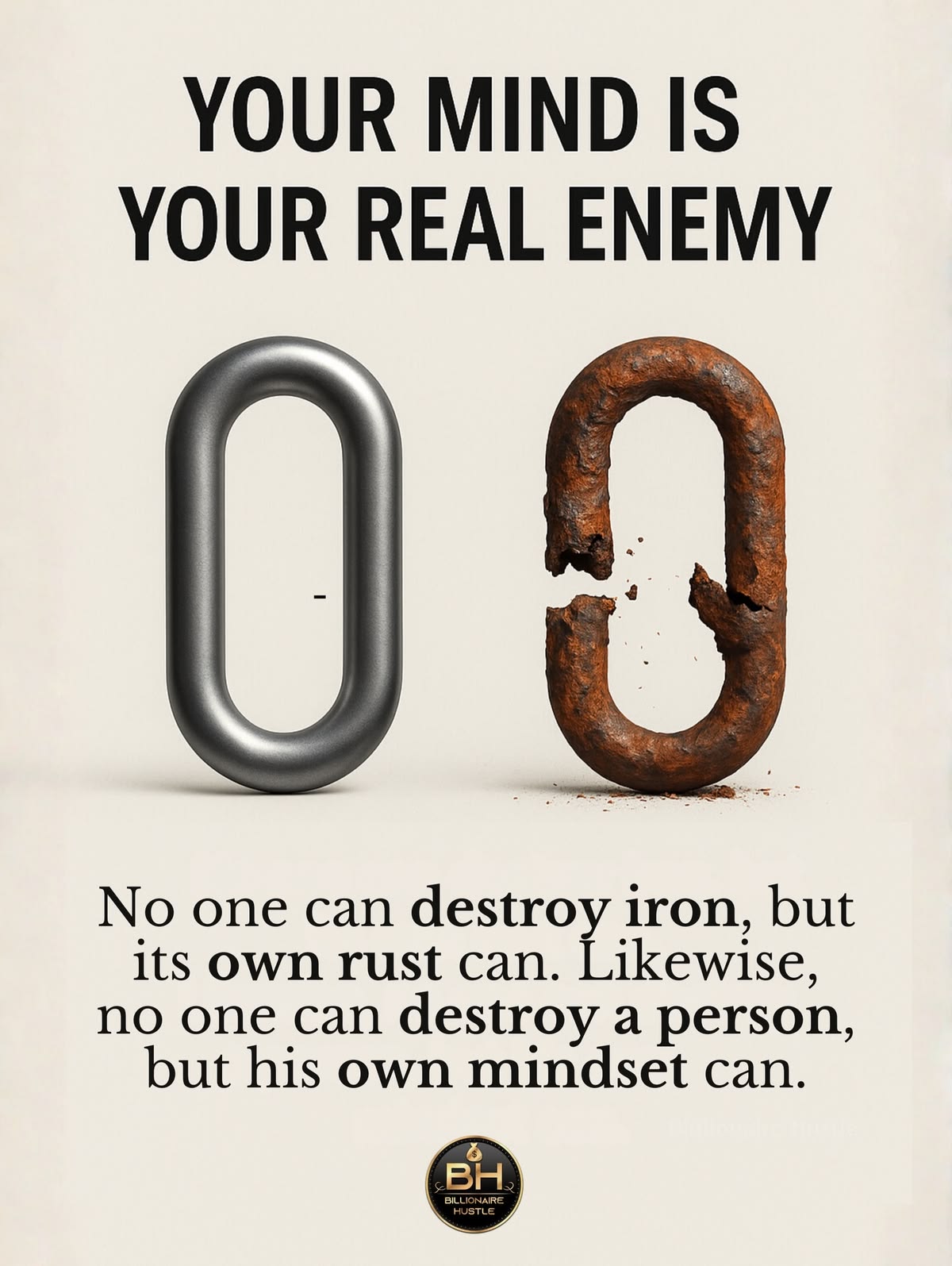
A widely shared graphic credit to BILLIONAIRE HUSTLE presents a polished metal chain link on the left alongside a heavily rusted, broken chain link on the right, accompanied by the headline and text:
“YOUR MIND IS YOUR REAL ENEMY”
“No one can destroy iron, but its own rust can. Likewise, no one can destroy a person, but his own mindset can.”
This thought-provoking message—often associated with Indian industrialist Ratan Tata—highlights a core psychological truth: external forces rarely break us down as effectively or completely as our own internal corrosion.
In this guide, we break down the symbolism behind this visual metaphor, explore the science of internal cognitive erosion, and share practical strategies to build mental resilience.
Visual Metaphor Breakdown
The image uses metallurgy to illustrate how internal decay weakens structural integrity:
                       [ THE IRON & RUST METAPHOR ]
                                     |
      --------------------------------------------------------------
     |                                                              |
 [ POLISHED IRON LINK ]                                [ RUSTED & BROKEN LINK ]
 • Strong, solid, & resistant to external force        • Internal oxidation causes structural collapse
 • Represents potential & positive mindset              • Represents self-doubt, fear, & negativity
 • Requires active care & protection                   • Spreads from within if left unchecked
1. The Polished Iron Link (Strength & Resilience)
Iron is renowned for its strength and durability. In its clean, well-maintained state, it can withstand immense external weight and pressure. This represents a person equipped with self-belief, emotional resilience, and a constructive mindset.
2. The Rusted Link (Internal Oxidation)
Rust occurs when iron reacts with oxygen and moisture, creating an internal chemical reaction that gradually weakens the metal from within until it crumbles under slight pressure. This represents negative self-talk, unaddressed fear, chronic stress, and limiting beliefs that quietly destroy a person’s capability from the inside out.
External Opposition vs. Internal Mindset
Understanding the difference between external challenges and internal mindset determines how we handle adversity:
| Challenge Type | External Force (External Opposition) | Internal Corrosion (Negative Mindset) |
| Origin | Criticism, market changes, unexpected setbacks | Self-doubt, imposter syndrome, chronic negativity |
| Impact | Temporary obstacle that can be navigated | Permanent internal erosion that halts progress |
| Control Level | Often outside direct control | Fully within our capacity to observe and reform |
3 Ways to Protect Your Mindset From “Rust”
-
Practice Cognitive Reframing: Whenever negative thoughts arise (“I can’t do this” or “This is impossible”), actively challenge them with evidence-based alternatives (“I haven’t mastered this yet, but I am learning”).
-
Audit Your Emotional Exposure: Just as moisture accelerates rust, constant exposure to toxic environments, doomscrolling, and cynical commentary accelerates negative thinking. Limit exposure to sources that drain your optimism.
-
Build Daily Mental Habits: Engage in daily practices like journaling, meditation, or physical exercise to keep your mind sharp and clear away accumulated stress before it turns into chronic self-doubt.
Conclusion
The statement “No one can destroy iron, but its own rust can” is a timeless reminder that our primary battles take place in our own minds. By taking control of your thoughts and practicing mental discipline, you protect your potential and build a foundation that no external force can break.
Frequently Asked Questions (FAQ)
What does the quote “No one can destroy iron, but its own rust can” mean?
It means that external forces rarely have the power to ruin a person’s life or career; rather, it is one’s own internal attitude, self-limiting thoughts, and negative behaviors that cause failure or breakdown.
Who originally said the quote about iron and rust?
This famous philosophical quote is widely attributed to the renowned Indian businessman and former chairman of Tata Sons, Ratan Tata