

Trust Can Be Repaired, But It Will Never Be the Same: The Psychology of Rebuilding Relationships
Relationship insights and philosophical thought experiments generate tremendous resonance on social media platforms like Facebook. By using visual metaphors to explore delicate topics—such as forgiveness, betrayal, and emotional healing—these posts invite readers to reflect on personal experiences and emotional growth.
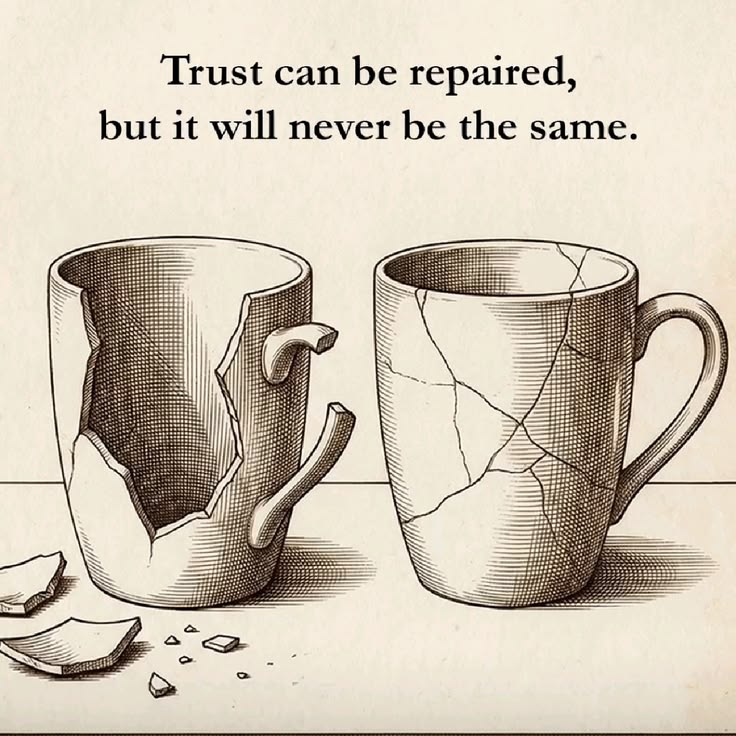
A widely shared vintage-style illustration depicts two ceramic mugs resting on a surface:
“Trust can be repaired, but it will never be the same.”
-
The Left Mug: Shattered into multiple broken fragments, missing a wall and a handle segment.
-
The Right Mug: Carefully pieced back together, holding its original functional shape but showing clear, permanent crack lines across its entire surface.
In this guide, we break down the psychological meaning behind this visual metaphor, explore the dynamics of post-betrayal recovery, and outline how relationships adapt after trust is broken.
Visual Metaphor Breakdown
The side-by-side comparison of the broken mug versus the pieced-together mug illustrates the multi-stage journey of rebuilding broken trust:
                        [ REPAIRING TRUST METAPHOR ]
                                     |
      --------------------------------------------------------------
     |                                                              |
 [ THE SHATTERED MUG ]                                  [ THE REPAIRED MUG ]
 • Represents initial betrayal or conflict              • Represents reconciliation & effort
 • Loss of structure & utility                         • Functional, yet visibly marked by history
 • Highlights emotional damage                          • Demonstrates resilience over perfection
1. The Shattered State (The Left Mug)
When trust is severely broken in a relationship—whether through dishonesty, unfaithfulness, or broken promises—the foundation collapses completely. Like a shattered ceramic mug with loose shards on the counter, the relationship temporarily loses its capacity to hold emotional safety or intimacy.
2. The Restored State (The Right Mug)
With time, accountability, and sincere effort, the relationship can be put back together. However, just as glued ceramic reveals distinct fracture lines, restored trust carries the visible history of the break. The mug can still hold liquid, but both individuals remain conscious of where it was once fragile.
The Art of Kintsugi: Finding Beauty in Brokenness
This visual metaphor closely parallels the ancient Japanese art of Kintsugi (“golden joinery”), where broken pottery is repaired using lacquer mixed with powdered gold, silver, or platinum.
| Concept | Traditional View of Damage | Kintsugi & Trust Repair View |
| Flaws / Cracks | Imperfections to hide or discard | Unique history to acknowledge and respect |
| Structural Integrity | Fragile and forever compromised | Stronger through intentional restoration |
| Relationship Dynamic | Trying to pretend the breach never happened | Accepting a “new normal” built on realistic boundaries |
Instead of attempting to disguise the damage, Kintsugi treats repair as part of the object’s history. Similarly, in human relationships, repaired trust does not mean erasing the past; it means creating a stronger, more honest connection moving forward.
3 Essential Steps to Rebuild Broken Trust
-
Radical Transparency & Accountability: The party who broke trust must take full ownership without deflection, offering consistent transparency to ease uncertainty.
-
Accepting the “New Normal”: Rebuilding trust requires letting go of the expectation that the relationship will return to its exact pre-conflict state. Acknowledge that the dynamic has evolved.
-
Patience with the Healing Process: Emotional cracks take time to set. Re-establishing safety requires consistent actions over an extended period rather than quick verbal promises.
Conclusion
The quote “Trust can be repaired, but it will never be the same” is not a message of despair, but one of realism. While a repaired relationship may carry visible crack lines, those very lines prove that both people cared enough to pick up the pieces and do the hard work of piecing them back together.
Frequently Asked Questions (FAQ)
Is it possible to truly trust someone again after a major betrayal?
Yes, trust can be rebuilt, but it requires genuine remorse, consistent behavioral changes, and open communication from both partners over time.
Why does repaired trust feel different than original trust?
Original trust is often based on naive assumption, whereas repaired trust is built on conscious choice, heightened awareness, and proven boundary enforcement.