

Struggle Now or Struggle Later: The Power of Delayed Gratification
Motivational diagrams and personal growth visual metaphors drive exceptional engagement across social media platforms like Facebook. By illustrating complex life choices through simple, memorable graphics, these posts encourage individuals to evaluate their habits and long-term goals.
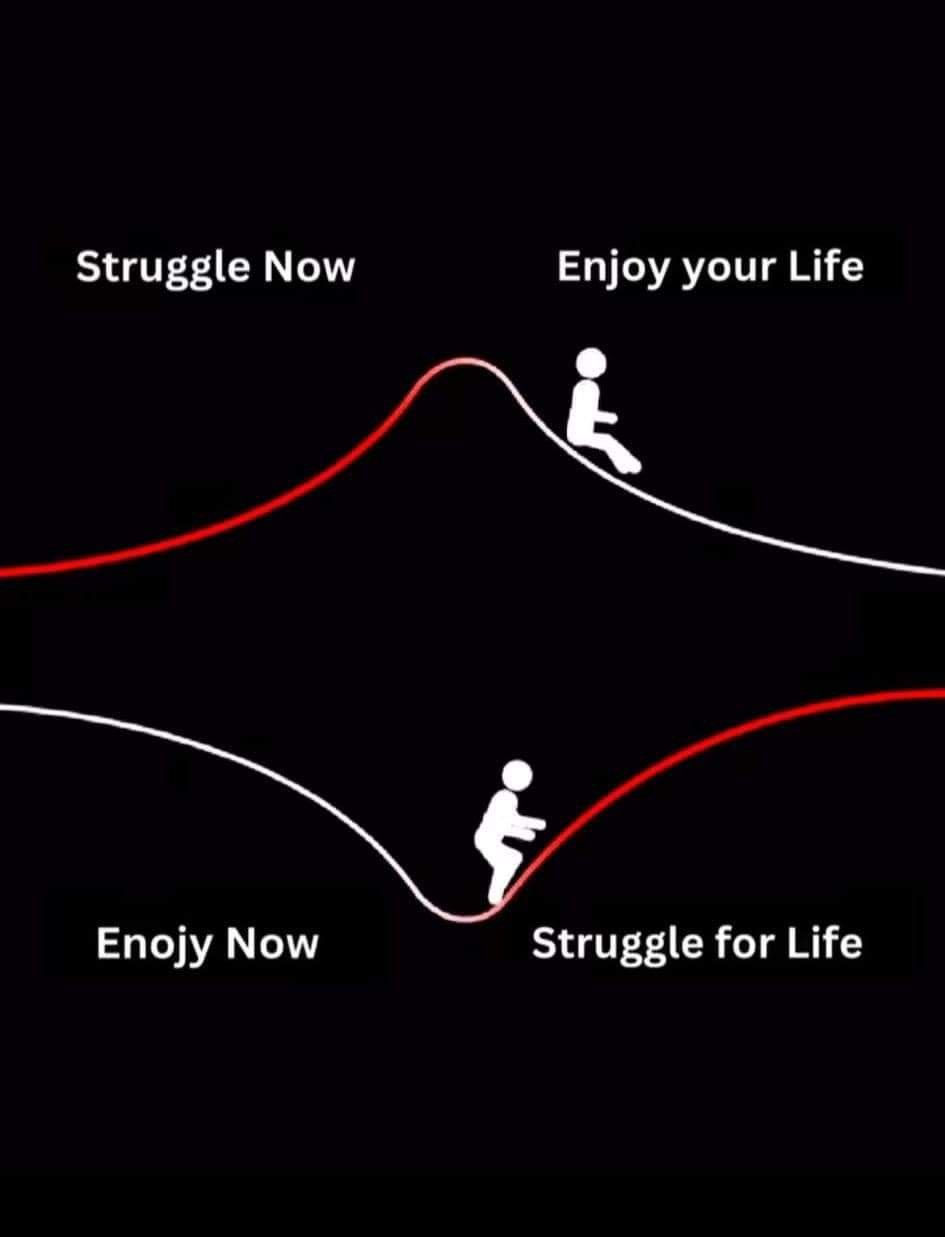
A striking minimalist graphic set against a dark background contrasts two distinct life paths:
Top Section: “Struggle Now” $\rightarrow$ “Enjoy your Life”
Bottom Section: “Enjoy Now” $\rightarrow$ “Struggle for Life”
The top visual shows a person climbing an uphill slope before comfortably sliding down a smooth, effortless path. The bottom visual shows a person coasting down an easy slope first, only to face an arduous, steep upward climb later in life.
In this guide, we break down the visual metaphor, examine the psychological principle of delayed gratification, and provide practical strategies to build long-term success.
Breakdown of the Visual Metaphor
The graphic uses curved pathways and hill dynamics to illustrate the trade-off between discipline and indulgence:
                     [ DUAL LIFE PATHWAY ANALYSIS ]
                                    |
      --------------------------------------------------------------
     |                                                              |
 [ PATH A: DELAYED GRATIFICATION ]            [ PATH B: INSTANT GRATIFICATION ]
 • Early uphill climb (Hard work/discipline)  • Early downhill coast (Ease/comfort)
 • Peak achievement (Reaching the top)        • Rock bottom (Depleted options)
 • Long downhill slide (Rest and freedom)     • Late uphill struggle (Hard labor)
Key Symbolic Elements:
-
The Uphill Climb: Represents focus, skill development, financial saving, and disciplined execution. It requires energy and perseverance upfront.
-
The Crest of the Hill: Represents reaching financial independence, mastery, or stability.
-
The Downhill Slide: Symbolizes the reward—freedom, peace of mind, and the ability to enjoy life without overwhelming financial or personal strain.
-
The Reversed Slope: Coasting early (“Enjoy Now”) feels effortless initially, but inevitably bottoms out into a long, difficult upward battle when time and resources are depleted.
Life Path Comparison: Struggle Now vs. Enjoy Now
| Life Dimension | “Struggle Now, Enjoy Later” Approach | “Enjoy Now, Struggle Later” Approach |
| Short-Term Focus | Discipline, education, saving, heavy effort | Entertainment, immediate comfort, spending |
| Long-Term Result | Stability, independence, passive rewards | Financial stress, limited options, hard ongoing labor |
| Control & Freedom | High; choices expand over time | Low; circumstances dictate future choices |
| Core Principle | Delayed Gratification | Instant Gratification |
How to Apply “Struggle Now” Discipline in Daily Life
1. Master Small Daily Sacrifices
Delayed gratification does not mean denying yourself all happiness. It means prioritizing long-term goals over fleeting temptations—such as investing extra time into learning a skill rather than hours of passive entertainment.
2. Automate Financial and Personal Habits
Set up automatic savings, investments, or daily study schedules. Eliminating the constant need for willpower makes pushing “uphill” a structured routine.
3. Keep the “Peak” in Sight
When early struggles feel overwhelming, remind yourself that the effort is finite. Building strong foundations early creates a smooth slide into future stability.
Conclusion
The “Struggle Now, Enjoy Your Life” diagram serves as a powerful reminder that everyone must face a struggle at some point—the only choice is whether to face it early on your own terms or face it later out of necessity. By choosing discipline today, you secure freedom and ease for tomorrow.
Frequently Asked Questions (FAQ)
What is delayed gratification?
Delayed gratification is the ability to resist the temptation of an immediate reward in preference for a larger, more meaningful reward later on.
Is it wrong to enjoy life in the present moment?
Not at all. Balanced living involves enjoying the present while simultaneously building security for the future. The visual warns against complete neglect of future needs in pursuit of instant pleasure.