

The Cornsweet Illusion Solved: How Your Brain Tricks Your Eyes
Interactive optical illusions are among the most engaging formats on social media platforms. They invite readers to participate directly on their screens, demonstrating how the human visual system interprets light, shade, and contrast in 3D environments.
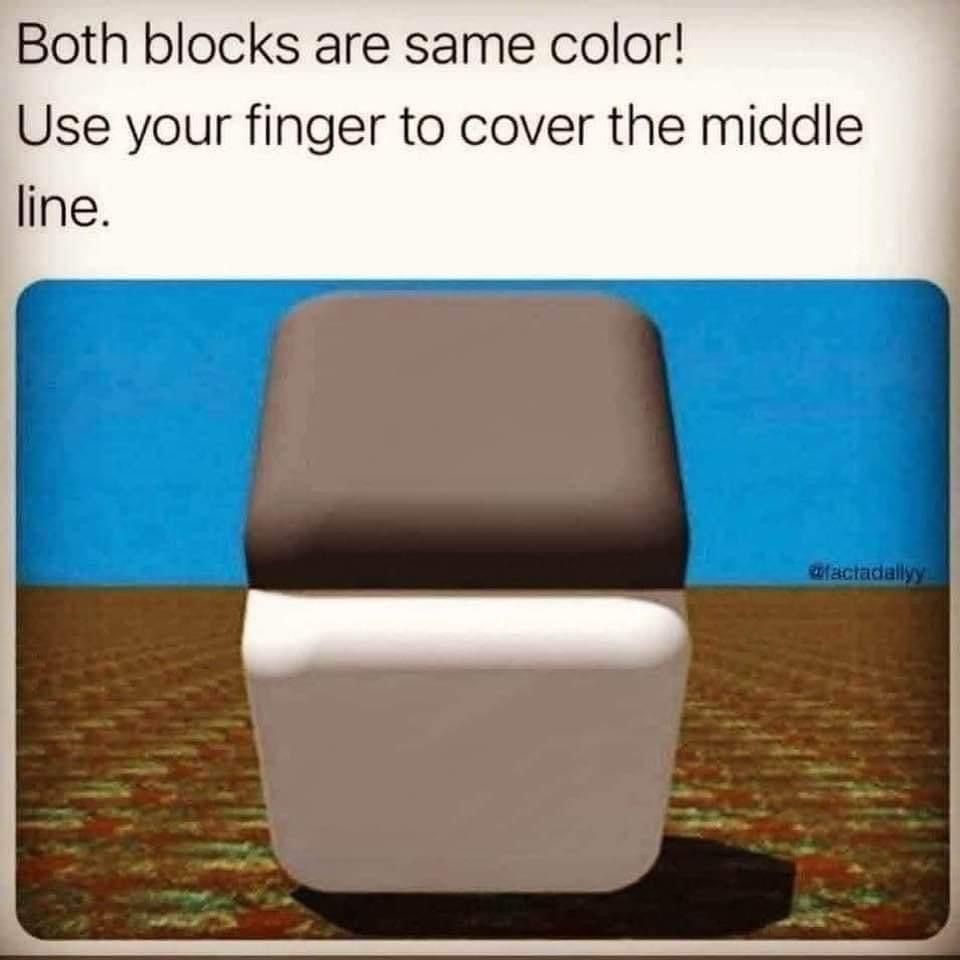
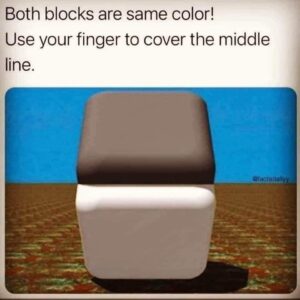
A widely shared graphic features a 3D block rendered with instructions:
“Both blocks are same color!”
“Use your finger to cover the middle line.”
When you look at the image normally, the top block appears dark grey, while the bottom block appears bright white. However, covering the central seam reveals that both blocks share the exact same shade of grey.
In this guide, we break down the famous Cornsweet Illusion, explain how local contrast triggers visual trickery, and explore the neurobiology of perception.
Deconstructing the Optical Trick: Step-by-Step
To experience the illusion and see why it works, follow these steps:
                    [ CORNSWEET ILLUSION MECHANICS ]
                                   |
      -----------------------------------------------------------
     |                                                           |
 [ 1. UNCOVERED VIEW ]       [ 2. FINGER COVER TEST ]     [ 3. BRAIN REPRETATION ]
 • Top block = Dark grey     • Place finger horizontally   • Contrast edge removed
 • Bottom block = White        over the middle seam        • True identical shade
 • Edge gradient tricks eye  • Blocks match completely      revealed
1. How to Test It:
-
Look at the graphic normally: the top section looks significantly darker than the bottom section.
-
Hold your finger horizontally directly over the boundary line/seam where the two blocks meet.
-
Once the edge gradient is covered, the illusion breaks down immediately—revealing that the flat surface areas of both blocks are identical shades of grey!
Visual & Physiological Mechanism Breakdown Table
| Optical Component | Visual Element | Biological & Neuromorphic Effect |
| Top Edge Gradient | Dark gradient along bottom edge of top block | Signals a surface cast in deep shadow |
| Bottom Edge Gradient | Light gradient along top edge of bottom block | Signals a brightly illuminated surface |
| Central Seam | Sharp transition line separating the two gradients | Triggers edge-detection mechanisms in visual cortex |
| Lateral Inhibition | Retinal ganglion cell response | Enhances edge contrast at the expense of absolute brightness accuracy |
The Science: The Cornsweet Illusion & Visual Perception
This phenomenon is a classic example of the Cornsweet Illusion (first described by psychologist Tom Cornsweet):
-
Lateral Inhibition: The human eye relies on specialized retinal cells that highlight contrast along edges to quickly detect shapes and boundaries. When two regions meet at a sharp gradient edge (dark on top, light on bottom), the visual cortex assumes the dark side is darker throughout and the light side is lighter throughout.
-
Lighting and Shadow Deduction: The brain does not simply measure the raw RGB pixels or physical light coming off a screen; it interprets surrounding contextual clues. Because of the subtle shadow gradients, your visual cortex automatically corrects for what it perceives to be a light source from above, misinterpreting identical grey surfaces as separate dark and light materials.
Why Interactive Illusion Memes Go Viral
-
Immediate Touch Interaction: Unlike static text or images, this post forces the viewer to physically interact with their screen by covering the center line.
-
Shocking Disproof: Viewers are skeptical that the blocks are the same color, creating a strong “aha!” moment when placing their finger over the line proves the text correct. This leads to massive shareability and comment engagement.
Conclusion
The “cover the middle line” block illusion demonstrates how human vision prioritizes edge contrast and inferred 3D lighting over raw color accuracy. By blocking out the central gradient seam, the brain stops assuming a shadow exists and reveals the two identical grey surfaces underneath!
Frequently Asked Questions (FAQ)
Are the top and bottom blocks really the exact same color?
Yes! Both blocks share the exact same shade of grey across their main surface areas. The perceived difference in brightness is caused entirely by the contrast gradient along the middle seam.
What is the name of this optical illusion?
This visual illusion is known as the Cornsweet Illusion (or Craik-O’Brien-Cornsweet effect), which demonstrates how edge gradients influence overall surface perception.