


In the End, You Only Have Yourself: The Ultimate Art of Self-Reliance
Throughout life, we build connections, lean on friends, and seek validation from family, partners, and colleagues. While external support systems are essential, reliance on others for our core emotional stability can leave us vulnerable when life takes unexpected turns. True independence begins when you realize that the person responsible for your healing, growth, and comfort is staring back at you in the mirror.
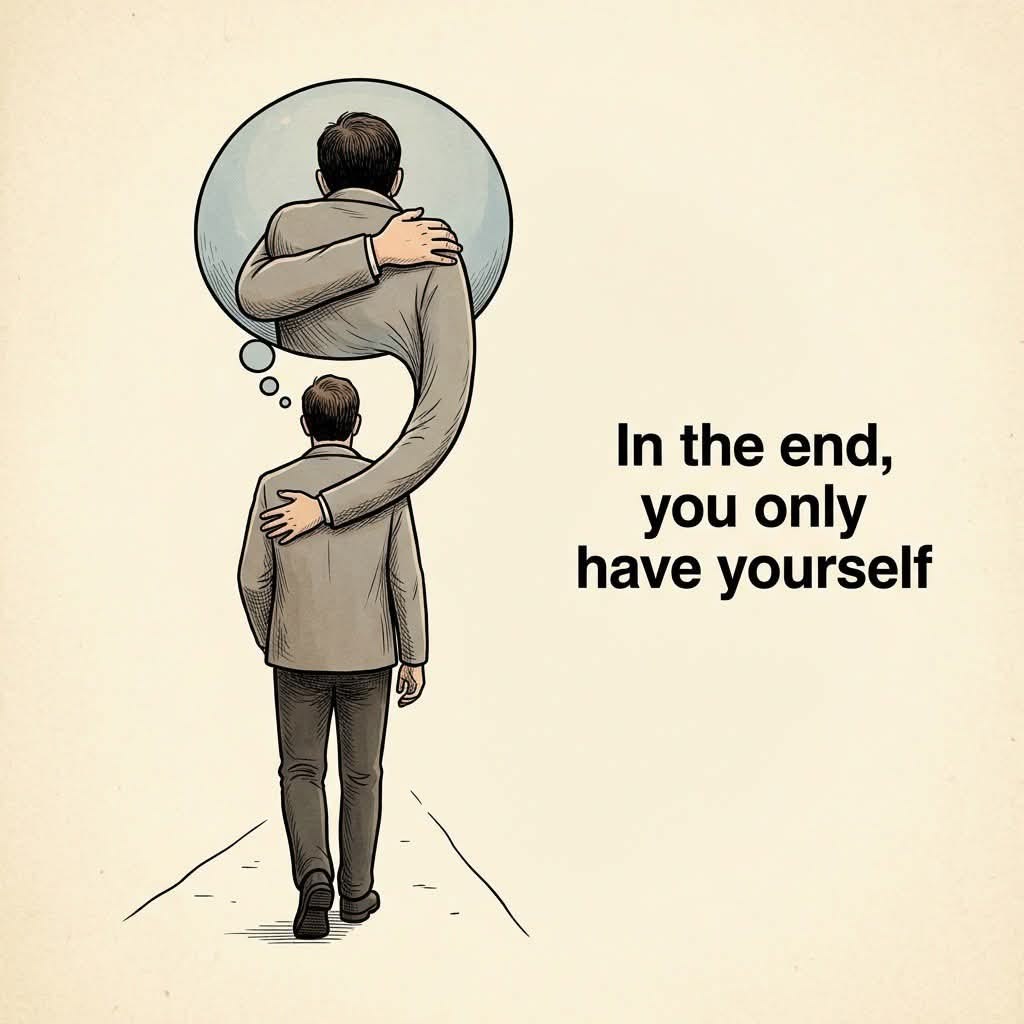
A poignant viral illustration captures this realization under a simple, powerful caption:
“In the end, you only have yourself”
The artwork shows a man walking forward along a path, viewed from behind. Above his head, a thought bubble extends downward, curving into a large arm that gently wraps around his own shoulders, offering a supportive embrace.
This visual metaphor serves as a touching reminder: self-compassion, self-trust, and internal resilience are the ultimate anchors in a changing world.
In this guide, we break down the visual symbolism of this illustration, explore the psychology of self-reliance, and share practical ways to become your own strongest ally.
Deconstructing the Image: The Self-Embrace Metaphor
What makes this visual metaphor so resonant and deeply comforting across social media?
                     [ THE SELF-SUPPORT ARCHITECTURE ]
                                     |
      ---------------------------------------------------------------
     |                                                               |
 [ THE SOLITARY WALK ]                                [ THE THOUGHT BUBBLE EMBRACE ]
 • Represents personal journey                       • Originates from inner mindset
 • Facing forward into uncertainty                   • Curving arm offering comfort
 • Independence & responsibility                     • Self-directed compassion & validation
1. The Solitary Walk (Individual Journey)
Walking alone along a path symbolizes personal responsibility. No matter how many people surround you, your decisions, emotional processing, and internal growth are ultimately yours to navigate. Embracing this reality isn’t isolating—it’s empowering.
2. The Thought-Bubble Embrace (Internal Comfort)
The arm offering comfort doesn’t come from an outside figure; it emerges directly from the man’s own thoughts. This detail highlights that self-validation and self-compassion are internal skills. Learning to comfort yourself in difficult moments builds an unshakeable inner foundation.
Comparative Breakdown: Seeking External Validation vs. Building Self-Reliance
| Dimension | External Dependence | Internal Self-Reliance |
| Emotional Stability | Vulnerable to others’ opinions & availability | Grounded in self-awareness & internal peace |
| Validation Source | Approval from peers, social media, or status | Alignment with core personal values |
| Response to Hardship | Panic, feeling abandoned, seeking rescue | Self-soothing, problem-solving, taking action |
| Relationship Quality | Needy, anxious, or codependent dynamics | Interdependent, healthy, & balanced connections |
The Psychology: Why Self-Reliance Drives True Peace
Why is cultivating a strong relationship with yourself essential for long-term well-being?
1. The Shift from External to Internal Locus of Control
Psychology highlights the concept of the locus of control. Individuals who rely purely on external circumstances or people for happiness feel helpless when faced with adversity. Developing self-reliance builds an internal locus of control, reinforcing the belief that you have the agency to influence your life’s direction.
2. Radical Self-Compassion
We are often far harsher on ourselves than we would ever be to a friend. Treating yourself with the same empathy, patience, and encouragement that you extend to others lowers stress, reduces anxiety, and builds genuine emotional security.
Practical Ways to Become Your Own Ally
-
Practice Self-Soothing: When facing stress or disappointment, take a moment to pause, breathe, and speak to yourself with kindness instead of harsh self-criticism.
-
Validate Your Own Achievements: Don’t wait for external applause to feel proud of your progress. Acknowledge your small wins and celebrate your personal growth quietly.
-
Build Solitude Comfort: Spend quality time alone without digital distractions. Engaging in solo hobbies, journaling, or walking helps build comfort within your own presence.
Conclusion
The message behind “In the end, you only have yourself” is not about isolation or rejecting relationships—it is about self-empowerment. When you learn to support, respect, and care for yourself first, you walk through life with confidence, knowing you carry your strongest ally wherever you go.
Frequently Asked Questions (FAQ)
What does “In the end, you only have yourself” mean?
It means that while friends, family, and partners add value to life, your ultimate peace, emotional stability, and self-worth depend on your internal relationship with yourself.
How can I practice self-compassion when things go wrong?
Talk to yourself as you would to a close friend in distress. Replace critical internal commentary with supportive, constructive self-talk and action.