

Your Situation Is Nothing, Your Response Is Everything: The Power of Perspective
We often assume that our stress, anxiety, or feelings of being overwhelmed are caused directly by the external events in our lives. A sudden setback, a tight deadline, or an unexpected change in plans can instantly make us feel like we are drowning. However, two people placed in the exact same scenario can have entirely different experiences based on one crucial factor: their internal response.
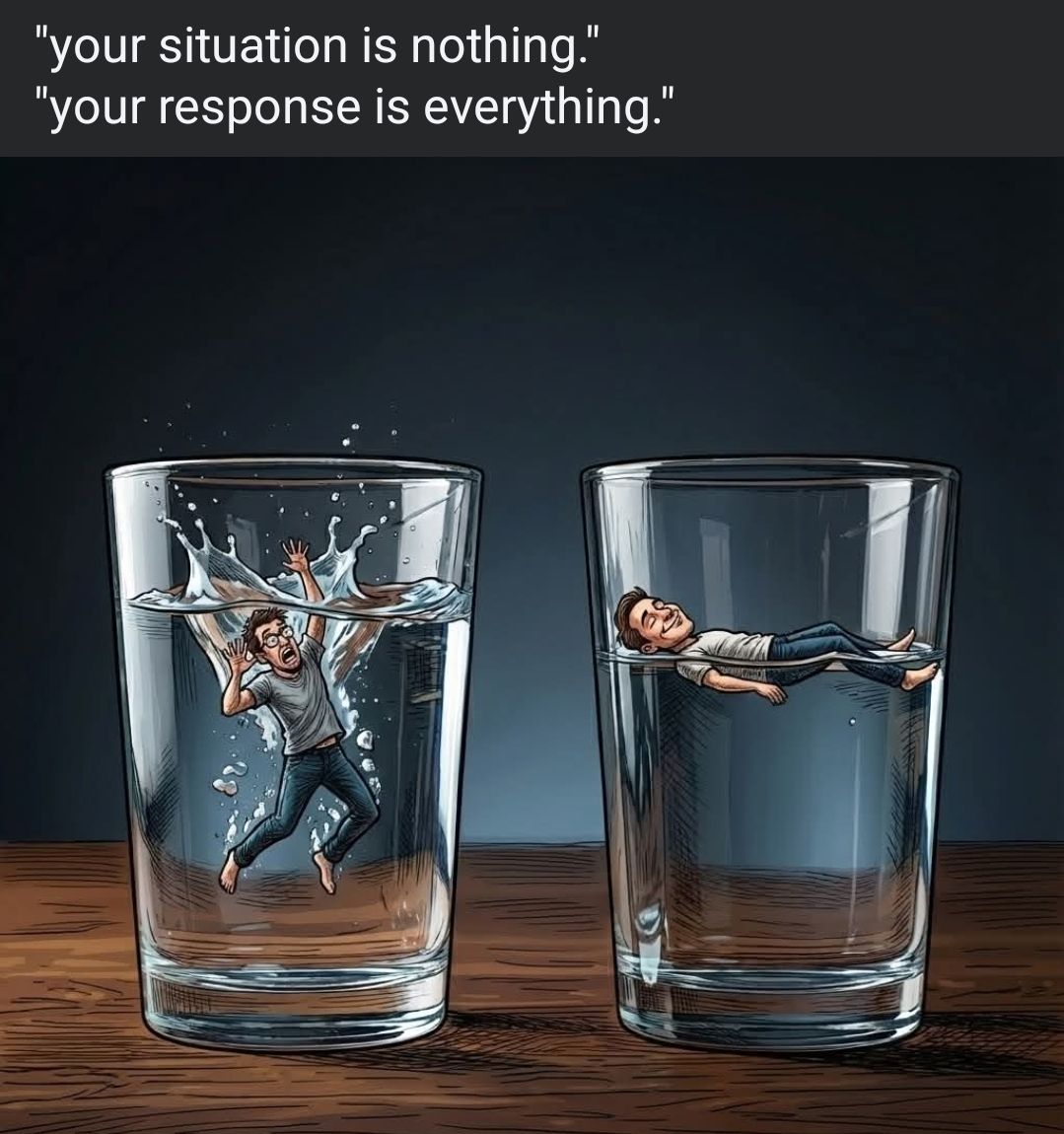
A striking viral illustration captures this core principle of Stoicism with a clear, parallel visual under a simple two-line caption:
“your situation is nothing.”
“your response is everything.”
The image features two side-by-side glasses filled with the exact same level of water:
-
The Left Glass (Panic): A person thrashes violently under the surface, flailing arms in terror, creating chaotic splashes as they sink and drown in the water.
-
The Right Glass (Peace): In the identical amount of water, another person floats calmly on their back with a serene expression, completely relaxed and supported by the surface.
This vivid metaphor highlights a profound truth: it is rarely the volume of water (the problem) that drowns us, but how we choose to move through it.
In this guide, we break down the visual symbolism of this illustration, explore the psychology of emotional regulation, and share practical steps to shift from panicking to floating when challenges arise.
Deconstructing the Image: Thrashing vs. Floating
What makes this visual comparison so powerful and universally relatable?
                     [ THE WATER GLASS METAPHOR ]
                                  |
      ----------------------------------------------------------
     |                                                          |
 [ THE LEFT GLASS (PANIC) ]                    [ THE RIGHT GLASS (PEACE) ]
 • Identical water volume                      • Identical water volume
 • Wild splashing & fight                       • Calm lie-back position
 • Resistance creates sinking                   • Acceptance creates buoyancy
 • Driven by fear & reaction                    • Driven by breath & composure
1. Thrashing Against the Water (The Reaction Cycle)
When faced with adversity, our immediate instinct is often to fight, panic, or resist reality. In a liquid medium, frantic thrashing breaks surface tension, expends vital energy, and ultimately pulls you under. Symbolically, panicking over a situation amplifies the problem and turns a manageable obstacle into a crisis.
2. Floating on the Surface (The Response Cycle)
By relaxing the body and lying back, the second figure works with physics rather than against it. Water naturally supports a body that stops fighting it. In life, remaining calm, breathing deeply, and accepting the reality of a situation allows you to regain clarity, keep your head above water, and navigate forward.
Comparative Breakdown: Panicking vs. Floating
| Aspect | The Panic Response (Left Glass) | The Floating Response (Right Glass) |
| Mindset | “Why is this happening to me? I can’t handle this!” | “This is the reality right now. How can I adapt?” |
| Physical State | High cortisol, shallow breathing, muscle tension | Controlled breathing, relaxed posture, clear mind |
| Energy Consumption | Rapidly exhausting; drains problem-solving capacity | Preserves energy for calm, deliberate action |
| Outcome | Sinking deeper into stress and feeling overwhelmed | Staying afloat, keeping perspective, finding solutions |
The Psychology: Why Response Trumps Circumstance
Why does shifting your focus from the situation to your response change everything?
1. The Stoic Dichotomy of Control
As the Stoic philosopher Epictetus famously wrote: “Men are disturbed not by things, but by the view which they take of them.” You rarely have total control over external circumstances—traffic, market shifts, or other people’s actions. However, you retain complete authority over your thoughts, choices, and emotional responses.
2. The Amygdala Hijack vs. Executive Function
When a crisis strikes, your brain’s fear center (the amygdala) activates fight-or-flight mode, pushing you to “thrash.” If you allow this instinct to dictate your actions, logic is bypassed. Pausing to take a deep breath engages the prefrontal cortex—the seat of executive function—allowing you to respond with calm, reasoned strategy instead of blind panic.
Practical Ways to “Float” When Life Gets Overwhelming
-
Pause Before Reacting (The 5-Second Rule): When hit with bad news or sudden stress, freeze for five seconds before acting or speaking. Don’t let your immediate reflex control your next move.
-
Control Your Breath: Slow, deep breathing signals your nervous system that you are safe, lowering heart rate and stopping the physiological impulse to “thrash.”
-
Separate Fact from Narrative: Strip away the dramatic story your mind invents about the event. Focus strictly on objective facts: “What actually happened, and what is the single next logical step?”
Conclusion
The takeaway from “Your situation is nothing; your response is everything” is a liberating realization: you don’t need a perfect, trouble-free environment to experience peace. The water level may remain the same, but by mastering your internal state, you turn what could have drowned you into a surface you can calmly float upon.
Frequently Asked Questions (FAQ)
What does “Your situation is nothing, your response is everything” mean?
It means that external circumstances do not dictate your well-being or success as much as your internal attitude, emotional control, and chosen actions do.
How can I stop panicking when unexpected problems happen?
Practice taking immediate physical pauses, breathing deeply to calm your nervous system, and focusing exclusively on what is within your direct control rather than catastrophizing.