

I Have Six Eggs: The Classic Riddle Solved Step-by-Step
Word riddles, math traps, and linguistic puzzles frequently spark heated debates across social media feeds. Designed to trick our brains through grammatical ambiguity and sequential misdirection, these prompts encourage rapid comments from people eager to prove their logic.
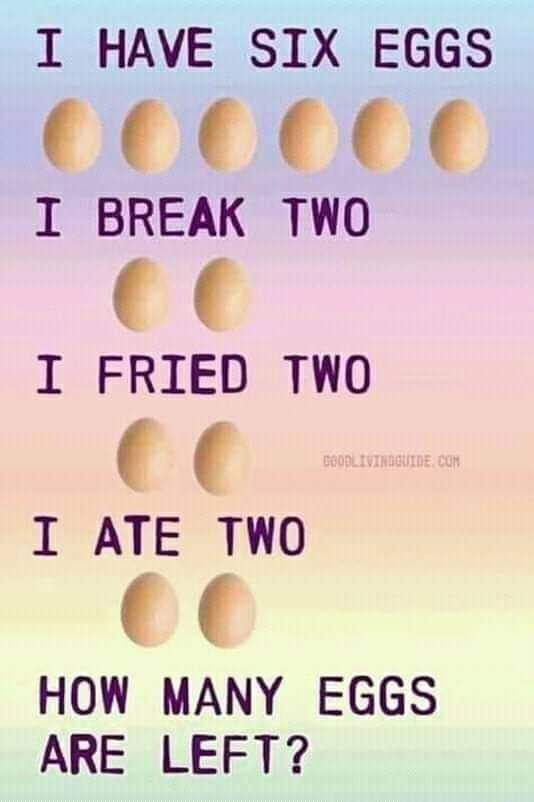
One widely shared colorful riddle image presents a straightforward premise:
“I HAVE SIX EGGS
I BREAK TWO
I FRIED TWO
I ATE TWO
HOW MANY EGGS ARE LEFT?”
At first glance, many people perform continuous subtraction ($6 – 2 – 2 – 2 = 0$) and guess that zero eggs remain. However, once you examine the sequence of actions and the past tense verbs, the real answer becomes crystal clear.
In this full guide, we break down the logic behind the “6 Eggs” riddle, examine why our brains fall for sequential traps, and reveal the correct answer.
Deconstructing the Sequence: Step-by-Step Logic
To solve this riddle accurately, we must look at how the actions relate to the exact same pair of eggs rather than separate batches.
       [ 6 TOTAL EGGS ]
              |
      Step 1: Break 2 eggs
              |
      Step 2: Fry those SAME 2 eggs
              |
      Step 3: Eat those SAME 2 eggs
              |
    [ RESULT: 4 Intact Eggs Remain ]
1. Starting Count: 6 Eggs
-
You begin with a total batch of 6 eggs.
2. The Sequential Action Loop
-
“I break two”: You cracked open 2 eggs to prepare them for cooking.
-
“I fried two”: You cooked those exact same 2 eggs that you just broke open.
-
“I ate two”: You ate those exact same 2 eggs that you broke and fried.
Because breaking, frying, and eating are sequential steps involved in preparing a single meal, you only used 2 eggs in total for the entire process!
Calculating the Final Answer
Now we perform simple subtraction on the remaining intact eggs:
There are 4 intact eggs left untouched in your carton or basket.
Comparing Misinterpretations vs. Correct Logic
| Approach | Interpretation | Calculation | Final Result | Status |
| Cumulative Subtraction Trap | Assumes 3 separate sets of 2 eggs (2 broken, 2 distinct fried, 2 distinct eaten). | $6 – 2 – 2 – 2$ | 0 | Incorrect |
| Past Tense Distraction | Confuses present tense (“I break”) with past events (“I fried, I ate”). | Varies | Unclear | Misleading |
| Sequential Meal Logic | Recognizes 1 pair of eggs going through 3 preparation steps. | $6 – 2$ | 4 | Correct |
The Grammar and Psychology Behind the Riddle
Why do so many people jump to “0” as their first answer?
1. Grammatical Misdirection
The prompt lists three separate statements line by line (“I break two / I fried two / I ate two”). Because each line repeats the phrase “two,” our brain’s default pattern recognition assumes three distinct quantities rather than three progressive steps applied to the same two objects.
2. Fast vs. Slow Thinking
In cognitive psychology, System 1 thinking relies on rapid intuition, prompting us to quickly add $2 + 2 + 2 = 6$ and subtract that from 6. System 2 thinking requires us to slow down, analyze the cause-and-effect relationship of cooking an egg, and realize that you must break an egg before you fry and eat it.
Conclusion
The correct answer to the riddle “I have six eggs. I break two, I fried two, I ate two. How many eggs are left?” is 4 eggs.
You simply cracked, fried, and ate 2 eggs, leaving the other 4 eggs completely intact!
Frequently Asked Questions (FAQ)
What is the correct answer to the 6 eggs riddle?
The correct answer is 4 eggs. You processed 1 pair of eggs (broke them, fried them, and ate them), leaving 4 eggs untouched.
Why isn’t the answer 0?
The answer would only be 0 if you broke 2 raw eggs, fried 2 different whole eggs with shells on, and ate 2 other raw whole eggs—which makes no sense when cooking!
Is there any other interpretation of the riddle?
Some people interpret “How many are left?” as asking about state (e.g., “4 raw eggs left, 0 cooked eggs left”), but numerically, 4 is the universally accepted solution.