

There Is a Word Written in This Image: The Famous Mental Challenge Solved
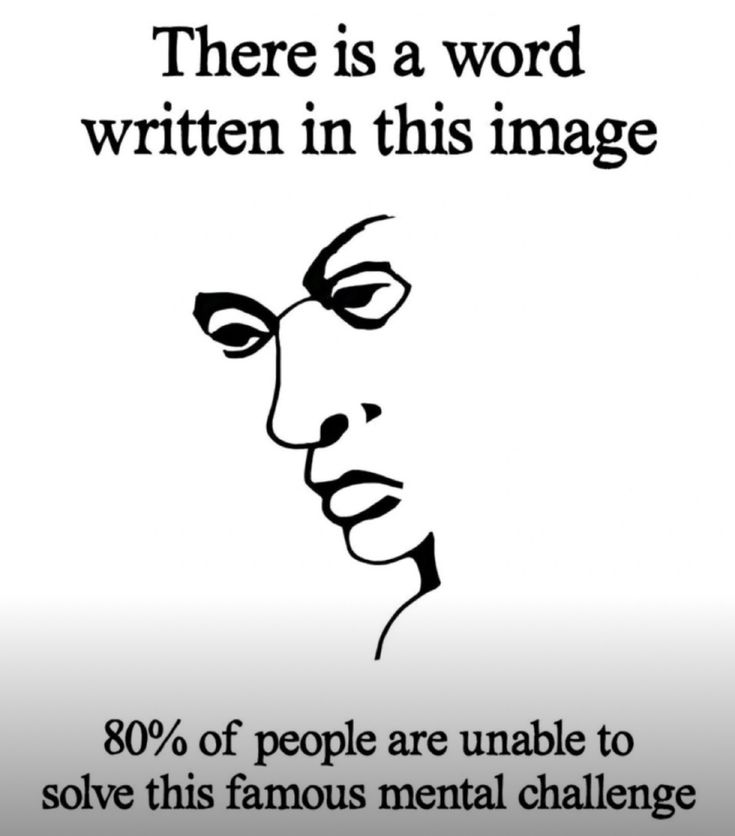
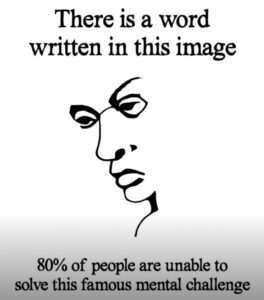
Visual word puzzles, optical illusions, and hidden-figure artwork have a knack for stopping social media scrollers in their tracks. A single black-and-white sketch can spark widespread curiosity, leaving thousands of viewers scanning back and forth to see what their eyes might have missed. One of the most famous classic visual illusions in this genre features a minimalist sketch of a man’s face wearing glasses, accompanied by a bold claim:
“There is a word written in this image. 80% of people are unable to solve this famous mental challenge.”
At first glance, your visual processing system instantly categorizes the line work as a man’s facial features—eyes, glasses, nose, lips, and jawline. However, if you tilt your head or rotate the image 90 degrees clockwise, the entire portrait transforms into a clearly stylized cursive word.
In this ultimate solution guide, we reveal the hidden word, break down the visual perception mechanics behind why your brain gets tricked, offer observation techniques for optical puzzles, and explore how daily mental exercises support long-term cognitive agility.
Deconstructing the Image: The Hidden Word Revealed
If you have been tilting your screen or struggling to untangle the lines, here is the exact breakdown to reveal the hidden text:
The Secret Word: “Liar”
To see the word instantly:
-
Tilt your head or turn the image 90 degrees to the right (clockwise).
-
The facial features will now read horizontally from left to right as the cursive word “Liar”.
Letter-by-Letter Visual Mapping
-
‘L’ (Capital L): Formed by the outline of the right eye and the arch of the eyebrow.
-
‘i’: Represented by the left eye, where the eye pupil serves as the dot over the letter ‘i’.
-
‘a’: Formed by the outline of the nose and the cheek contour.
-
‘r’: Created by the curve of the lips, mouth, and chin line at the bottom of the face.
The Science of Visual Perception: Why the Brain Gets Tricked
Why is it so difficult for most people to see the word on their first try? The answer lies in how our brain prioritizes visual information.
Pareidolia and Top-Down Processing
Our brains are hardwired for top-down visual processing. When looking at an object, your visual cortex relies on past experiences and contextual expectations to make sense of what you see:
-
Facial Recognition Dominance: Humans possess a specialized brain area called the Fusiform Face Area (FFA). Because identifying human faces is crucial for social interaction and survival, the FFA instantly interprets two oval shapes, a central vertical ridge, and horizontal curves as a human face looking down to the left.
-
Orientation Bias: Our brain reads text horizontally from left to right. When the word is oriented vertically (disguised as facial features), your visual system categorizes the entire image as art rather than text, preventing you from recognizing the letter shapes.
Comparing Cognitive Health Practices
Engaging in perceptual puzzles and cognitive exercises provides a great mental workout. The table below compares different brain-training practices and their benefits:
| Cognitive Activity | Primary Focus | Key Benefit |
| Optical Illusions & Hidden Text | Pattern recognition & perspective shifting | Enhances visual flexibility and mental adaptability |
| Logic Puzzles & Sudoku | Deductive reasoning & working memory | Improves structured problem-solving skills |
| Crosswords & Word Search | Language processing & semantic recall | Builds vocabulary and memory retrieval |
| Physical Aerobic Exercise | Increased cerebral blood flow | Promotes neuroplasticity and brain health |
Practical Tips for Solving Hidden-Word Illusions
If you want to solve visual riddles and hidden-text images much faster in the future, apply these simple scanning strategies:
1. Rotate Your Viewpoint
When an image claims to hide text or a second figure, try turning your phone or tilting your head 90 to 180 degrees. Changing the spatial orientation breaks the brain’s initial interpretation and lets you recognize hidden letters.
2. Focus on Negative and Positive Line Work
Instead of trying to see the overall image, look specifically at individual stroke curves. Notice whether a curve resembles an ‘e’, an ‘a’, or an ‘s’. Isolate single lines from the broader picture.
3. Adjust Your Distance and Focus
Leaning back from your screen or squinting slightly reduces fine visual details, allowing your brain to process broad geometric outlines where text often hides.
Holistic Habits for Sharp Focus and Mental Clarity
Challenging your mind with creative visual teasers is a fun element of daily cognitive care. However, long-term mental performance relies on a well-rounded lifestyle approach:
-
Prioritize Restful Sleep: Deep sleep allows the brain to clear metabolic waste and consolidate memory, ensuring sharp focus for complex tasks.
-
Nourish Neural Pathways: Consuming a diet rich in omega-3 fatty acids, antioxidants, and proper hydration supports healthy cognitive function.
-
Protect Long-Term Peace of Mind: Reducing stress through practical life planning—such as managing personal health, maintaining financial stability, and securing family protection—frees up mental energy for creative and intellectual pursuits.
Conclusion
The famous “There is a word written in this image” mental challenge is a brilliant demonstration of visual illusion and human perception. By turning the drawing 90 degrees, the portrait of a man’s face reveals its secret identity: the cursive word “Liar”.
Taking a moment for daily brain teasers like this one offers an enjoyable way to test your observation skills, challenge your perception, and keep your mind sharp!
Frequently Asked Questions (FAQ)
What is the hidden word in this face image?
The hidden word is “Liar”, written in stylized cursive text.
How do you see the word in the picture?
Rotate the image 90 degrees clockwise (to the right). The eyes, nose, lips, and chin line up horizontally to spell out “Liar”.
Why couldn’t I see the word right away?
Your brain’s visual cortex naturally prioritizes facial recognition over vertical text. Because the features closely resemble a human portrait, your visual system registers a face before it looks for readable words.