

Visual Puzzle Challenge: Can You Find the Cat Hidden Among the Owls?
Hidden-object visual teasers and camouflage puzzles are a fun way to test attention to detail, visual processing speed, and pattern recognition. By crowding an image with repetitive shapes, textures, and features, these visual tests challenge the brain to filter out visual “noise” and spot subtle anomalies.
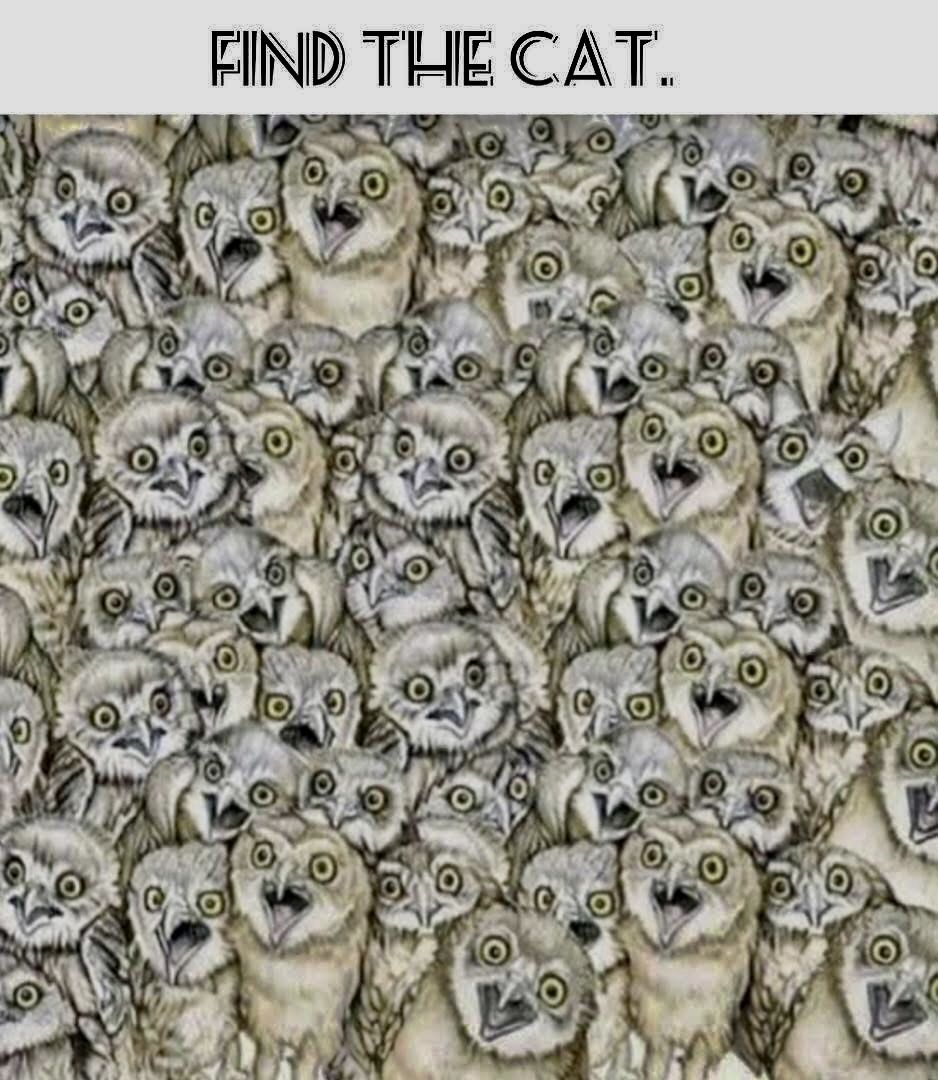
A viral brain teaser created by artist Gergely Dudás (Dudolf) presents a straightforward challenge:
“FIND THE CAT.”
The illustration is filled to the brim with dozens of screeching, wide-eyed owls with yellow eyes and sharp beaks. However, one sneaky feline has blended seamlessly into the flock!
Below, we reveal exactly where the cat is hiding and explore the visual cognitive science behind why this puzzle is so tricky!
Step-by-Step Breakdown: Where Is the Cat?
To locate the hidden cat quickly, scan the image by focusing on key facial features rather than looking at the whole picture at once:
1. Key Facial Features to Look For
-
Beak vs. Snout: Every owl in the picture features a pointed beak (or open beak). The cat lacks a beak entirely, possessing a small feline nose/snout instead.
-
Ears vs. Tufts: While many owls have rounded heads, the cat features distinct, pointed cat ears sticking up.
2. Location Reveal
-
Quadrant: Look in the upper-right section of the image.
-
Exact Position: About three rows down from the top right edge, nestled between several owls, you will find the cat face. It shares the same yellow eyes as the owls, but its small triangular nose and pointed ears give it away!
Puzzle Breakdown & Visual Comparison
| Feature | The Owls | The Hidden Cat |
| Mouth / Nose | Pointed downward or wide-open beak | Small feline nose and mouth outline |
| Ears / Head | Round heads or feather tufts | Pointed triangular cat ears |
| Eye Style | Circular yellow target-style eyes | Identical circular yellow eyes (Camouflage) |
| Location | Everywhere across the image | Upper-Right Area |
The Science of Visual Search & Visual Homogeneity
Why is it so hard to spot the cat right away?
1. Visual Homogeneity
When an image is composed of identical colors (pale brownish-grey and yellow) and repeating patterns (round eyes and feathers), the brain groups all elements into a single visual texture. This makes individual differences difficult to detect without careful, systematic scanning.
2. Feature-Integration Theory
According to visual search theories, our visual system processes basic features (like color and shape) automatically. However, when an object shares almost all features with its background (same color scheme, same eye shape), your brain must perform a serial search—checking each figure one by one until the anomaly is found.
Conclusion
Camouflage puzzles like this illustrate how easily our eyes can be deceived by repetitive patterns. If you managed to spot the cat in under 10 seconds, your visual processing and detail perception are top-notch!
Frequently Asked Questions (FAQ)
Where is the cat in the owl picture?
The cat is hidden in the upper-right region of the image, three rows down from the top right corner. It looks identical to the owls except it has pointed cat ears and a feline nose instead of a beak.
Why do visual search puzzles feel addicting?
Solving visual search puzzles releases a small hit of dopamine when your brain successfully detects the hidden anomaly after a period of searching, making it both rewarding and mentally stimulating!