

IQ Test Breakdown: Which Chain Must Break for the Brick to Fall?
Physics riddles and mechanical puzzles offer a fun, practical way to test visual-spatial reasoning and problem-solving skills. By analyzing how forces like gravity, torque, and tension interact within a simple machine, these visual teasers challenge our intuitive understanding of basic mechanics.
A popular viral brain teaser asks a straight-forward structural question:
“Which Chain would break For the brick to fall?”
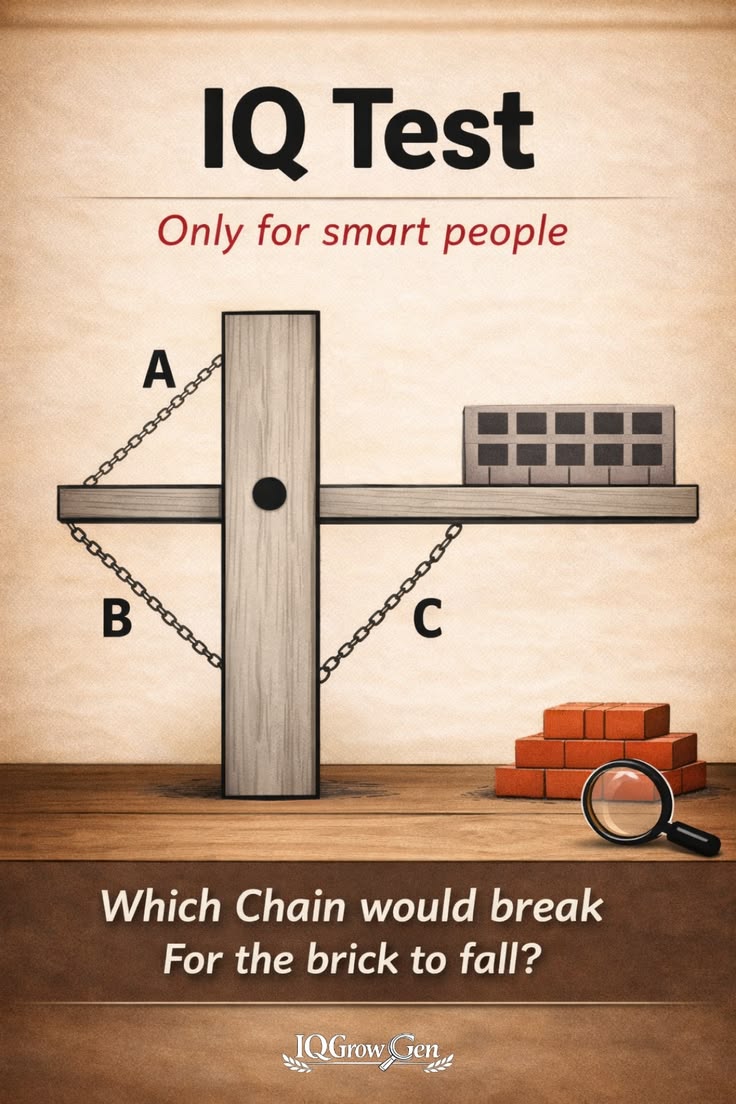
The illustration shows a central vertical post holding a horizontal crossbar with a pivot point in the middle. A heavy block resting on the right side exerts downward gravitational force. Three support chains are placed around the structure:
-
Chain A: Stretches from the upper section of the central post to the left arm of the crossbar.
-
Chain B: Connects the lower section of the central post to the left arm of the crossbar.
-
Chain C: Attaches beneath the right arm of the crossbar, extending to the lower central post.
Below, we break down the physics of levers, tension, and structural support to determine the correct answer!
Analyzing the Mechanical Forces (Leverage & Tension)
To understand which chain holds the load, let’s examine the direction of force around the central pivot:
1. The Gravity Load (Right Side)
The heavy brick sits on the right arm of the crossbar. Gravity pulls the brick downward, creating a clockwise rotational force (torque) around the central pivot point.
2. The Reaction of the Left Arm
As the right arm attempts to tip downward, the left arm of the crossbar is forced to rotate upward.
3. Role of Chain A (Tension Support)
Because the left arm tries to move upward, it pulls against Chain A, which is anchored to the top of the vertical post. Chain A goes into high tension, acting as the primary restraint holding the left arm down and keeping the right arm level.
4. Role of Chain B and Chain C (Slack / Compression)
-
Chain B: Since the left arm is pushing upward, the space between the lower post and the left tip expands, but Chain B pulls downward. More importantly, because Chain A already holds the tip down, Chain B remains in a secondary/slack state or shares tensile load depending on rigidity.
-
Chain C: The right arm is moving downward, meaning the distance between the right arm and the lower central post decreases. Flexible chains cannot withstand compression, meaning Chain C goes slack and provides zero structural support against the downward fall of the right arm.
Force & Tension Matrix
| Chain | Position | Force Direction | Tension Status | Role in Holding the Brick |
| A | Upper Post to Left Arm | Prevents left arm from rising | High Tension | Primary Load Support |
| B | Lower Post to Left Arm | Pulls left arm down | Low / Secondary Tension | Secondary |
| C | Lower Post to Right Arm | Right arm moves toward lower post | Slack (No Tension) | None (Chains compress) |
The Solution: Which Chain Snapping Causes the Fall?
The correct answer is Chain A.
Since the weight of the brick on the right arm forces the left arm to tilt upward, Chain A is the critical structural element counteracting that upward force. If Chain A snaps or breaks:
-
The left arm is freed to swing upward.
-
The right arm immediately tilts downward under the weight of the brick.
-
The brick slides or falls off the crossbar!
Conclusion
Understanding simple mechanics like lever arms and cable tension allows us to solve physics puzzles with confidence. By tracing how torque travels across a pivot point, it becomes clear that preventing the left arm from rising is the key to keeping the brick balanced!
Frequently Asked Questions (FAQ)
Why doesn’t Chain C hold up the right arm?
Chains only work under tension (pulling forces). When the right arm moves downward toward the center post, the space between the attachment points shrinks, causing Chain C to go slack rather than supporting the weight.
What type of simple machine is illustrated here?
The structure acts as a Class 1 Lever, where the fulcrum (pivot) is located in the middle, between the load (the brick) and the counteracting support force (Chain A).