

Who Deserves Your Seat? Analyzing the Ethics of Public Transit Dilemmas
Moral dilemmas and priority-based riddles are popular tools for exploring social ethics, empathy, and quick decision-making. By presenting scenarios where multiple individuals appear equally deserving of aid, these visual puzzles prompt meaningful discussions on how we weigh competing priorities.
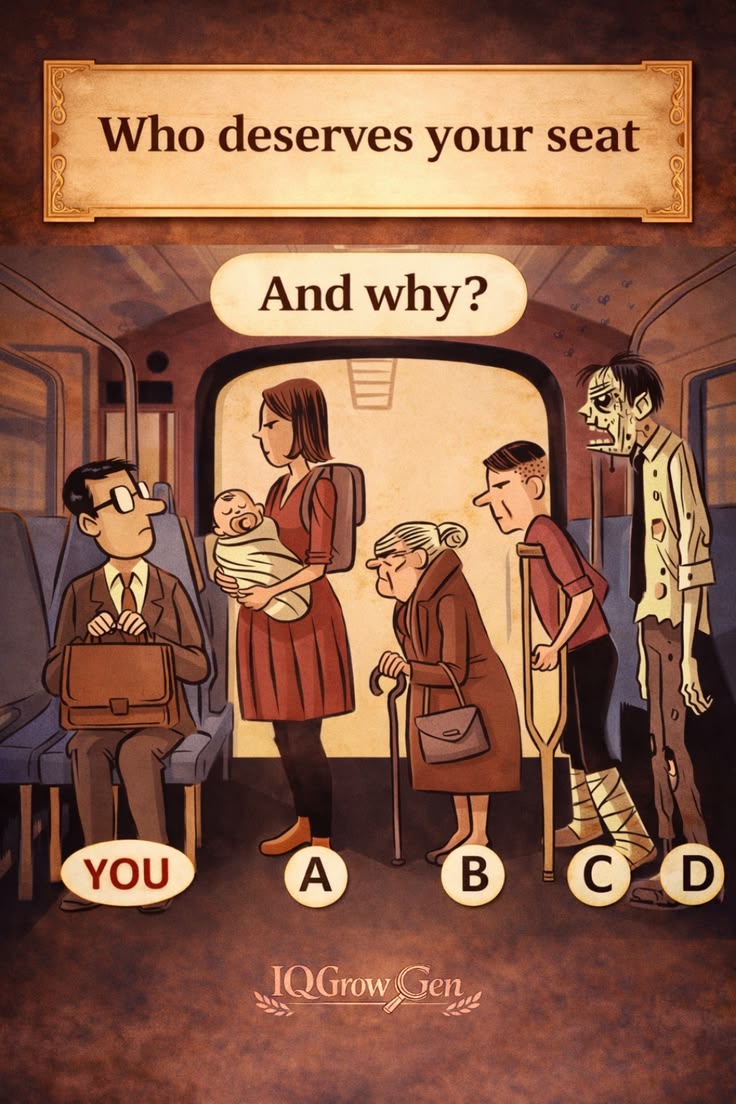
A widely shared visual puzzle asks a simple question inside a busy subway car:
“Who deserves your seat… And why?”
In the illustration, a seated passenger labeled “YOU” looks up at four standing individuals labeled A, B, C, and D:
-
Passenger A: A mother holding a wrapped, sleeping newborn baby.
-
Passenger B: An elderly woman leaning heavily on a walking cane.
-
Passenger C: A young man on crutches with a heavily bandaged leg and foot.
-
Passenger D: A decaying zombie standing at the back of the line.
Below, we break down the ethical and logical reasoning behind each option to determine who takes top priority!
Evaluating Each Passenger’s Needs
To determine priority on public transit, we consider physical stability, safety risks, and vulnerability.
1. Passenger A (Mother with Baby)
-
Vulnerability: High risk. Standing while holding an infant on a moving train presents a severe safety hazard if the train lurches or stops suddenly.
-
Impact: Giving her the seat protects two lives simultaneously (mother and baby).
2. Passenger B (Elderly Woman)
-
Vulnerability: High risk. Advanced age and reduced stability make standing on a moving vehicle difficult and dangerous, with a high risk of fall-related injuries.
3. Passenger C (Injured Man on Crutches)
-
Vulnerability: Moderate to high risk. Keeping weight off a broken or bandaged leg requires significant physical effort, especially when balancing on a moving train.
4. Passenger D (The Zombie)
-
Vulnerability: Humorous anomaly / Red herring. Unless safety protocol involves appeasing undead passengers, Zombie D doesn’t fit standard social priority models!
Priority Matrix: Public Transit Ethics
| Passenger | Condition | Primary Risk Factor | Priority Level |
| A | Mother holding a newborn baby | High fall risk impacting infant safety | Top Priority (#1) |
| B | Elderly woman with a cane | High risk of fall/injury due to age | High Priority (#2) |
| C | Man with crutches and bandaged leg | Physical fatigue and balance strain | High Priority (#3) |
| D | Zombie | Humorous visual gag / Distraction | N/A |
The Most Ethical Choice: Why Passenger A Takes Priority
While Passengers B and C are both highly deserving of priority seating, Passenger A (the mother holding a baby) represents the highest safety risk.
In the event of sudden braking or turbulence, an adult standing with a cane or crutches can attempt to hold a railing or brace themselves. However, a mother carrying a newborn cannot easily brace herself without risking dropping or injuring the baby. Giving the seat to Passenger A ensures the safety of two vulnerable individuals at once.
Note: In ideal transit courtesy, other able-bodied passengers nearby would also stand up, allowing Passengers A, B, and C to all sit down!
Conclusion
Moral visual puzzles highlight how empathy and practical safety considerations guide our everyday actions. Recognizing physical vulnerability allows us to make compassionate, thoughtful decisions in public spaces!
Frequently Asked Questions (FAQ)
Is there a single “correct” answer to priority seating riddles?
While Passenger A is traditionally considered top priority due to infant safety, both the elderly (Passenger B) and the injured (Passenger C) qualify for designated priority seating under real-world public transit guidelines.
Why do visual riddles include absurd elements like a zombie?
Including an obvious anomaly (like a zombie) adds humor and tests whether the viewer is paying attention to visual details rather than just scanning the main options.