


What Did You See First? The Elephant vs. Snake Optical Illusion Explained
Visual illusions and optical perception tests regularly go viral across social media. They engage readers by linking visual recognition habits with personality traits, future outlooks, or subconscious perception styles.
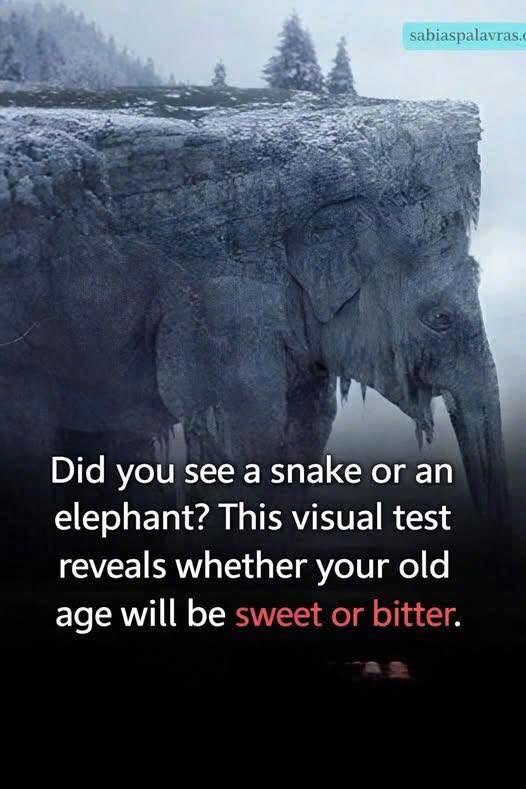
A widely shared visual graphic features a snowy rock cliff formation along with the prompt:
“Did you see a snake or an elephant? This visual test reveals whether your old age will be sweet or bitter.”
While image tests claiming to predict your future are meant purely for entertainment, the underlying visual phenomenon—how our brains process ambiguous shapes in nature—is rooted in real cognitive psychology.
Below, we break down the visual components of the illusion and explore the psychological interpretations behind each perspective.
Visual Breakdown: The Cliff & The Shapes
The image is a striking example of digital artwork or natural rock formation photography that mimics animal forms:
-
The Elephant: The overall shape of the icy cliff face forms a clear side profile of a massive elephant. The top plateau forms its head and back, the rock texture creates the eye and ear, and the vertical rock pillar extending downward creates the trunk and front legs.
-
The Snake (The Trunk): Readers who focus tightly on the long, textured vertical rock formation descending from the cliff often perceive it as a slithering snake or serpent before noticing the larger animal context.
Psychological Interpretations & Perspectives
Although visual tests are not clinical personality diagnostics, viral trends often associate what you spot first with distinct cognitive styles:
1. Seeing the Elephant First (The Big-Picture Optimist)
-
Visual Style: You process visual information holistically, seeing macro structures before focusing on smaller details.
-
Personality Archetype: You tend to be grounded, patient, and resilient. Elephants are traditionally associated with wisdom, memory, and longevity. People who spot the elephant first are often described as having a “sweet” future, characterized by stability, strong relationships, and peace of mind as they age.
2. Seeing the Snake First (The Detail-Oriented Observer)
-
Visual Style: You have sharp attention to detail, zooming in on fine textures and focal lines within an image.
-
Personality Archetype: You are cautious, analytical, and highly aware of your environment. In folklore and psychology, snakes represent vigilance and transformation. While visual tests playfully label this path as cautious or “bitter,” it actually reflects a keen focus on protecting yourself and staying prepared for life’s turns.
Perception Matrix
| Perception | Focus Area | Visual Processing Style | Symbolic Meaning |
| Elephant | Entire cliff face profile | Macro / Holistic processing | Wisdom, longevity, stability, peace |
| Snake | Vertical trunk / pillar | Micro / Detail-oriented processing | Vigilance, transformation, acute awareness |
The Science of Pareidolia
Why do we see animals in rocks and mountains? This occurs because of pareidolia, a psychological phenomenon where the human mind detects familiar patterns (especially human faces or animal shapes) in random visual stimuli.
Because our evolutionary survival depended on quickly recognizing living threats or allies in nature, our visual cortex constantly scans environment features—like frozen cliffs—for recognizable shapes.
Conclusion
Whether your visual processing zeroed in on the majestic elephant or the winding snake, optical illusions like this showcase how remarkably adaptable human visual perception can be!
Frequently Asked Questions (FAQ)
Can an optical illusion actually predict your future?
No. Visual perception tests are designed for entertainment, self-reflection, and exploring visual cognitive habits. They do not hold clinical or predictive power.
What is visual pareidolia?
Pareidolia is the brain’s inclination to perceive a specific, often meaningful image (like a face or animal) in a random or ambiguous visual pattern (such as clouds, rocks, or trees).