


Over vs. Under: The Definitive Answer to How Toilet Paper Should Be Hung
Few domestic debates spark as much passionate discussion as the proper orientation of a toilet paper roll. Whether in homes, offices, or hotel rooms, people have strong preferences about whether the loose end should hang over the front or under against the wall.
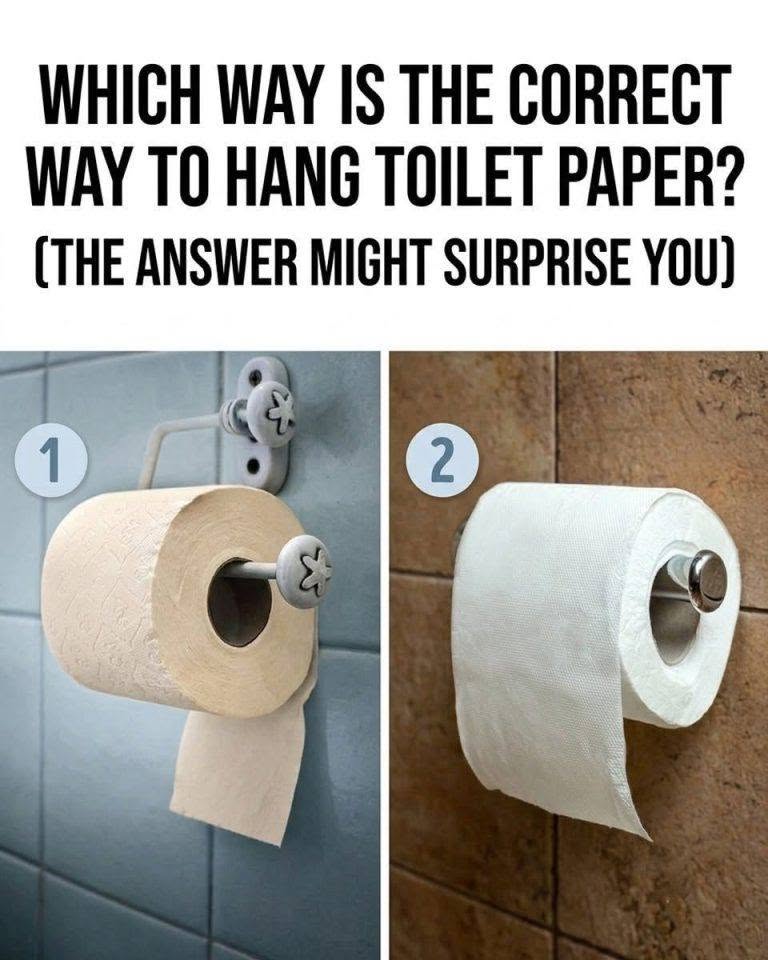
A popular viral graphic poses the question:
“WHICH WAY IS THE CORRECT WAY TO HANG TOILET PAPER? (THE ANSWER MIGHT SURPRISE YOU)”
The image highlights two distinct orientations:
-
Option 1 (Under): The loose sheet hangs behind the roll against the wall.
-
Option 2 (Over): The loose sheet hangs over the front, facing outward.
Below, we look into the historical evidence, patent history, and practical health benefits to determine the correct way once and for all!
The Historical Proof: The 1891 Original Patent
The ultimate authority on how toilet paper was intended to be used comes directly from its inventor, Seth Wheeler.
In 1891, Wheeler filed a patent (U.S. Patent No. 459,516) for his perforated paper roll innovation. The original patent diagrams clearly illustrate the roll hanging in the “Over” position (Option 2), with the loose sheet extending outward over the top of the roll.
Why Wheeler Designed It “Over”:
-
Ease of Dispensing: Pulling from the front makes it easier to locate, grab, and tear off sheets cleanly.
-
Visible Perforations: The perforated lines are clearly visible, preventing waste.
Comparing the Two Methods
| Feature / Benefit | Option 1: Under (Underhand) | Option 2: Over (Overhand) |
| Original 1891 Patent Intention | No | Yes |
| Hygiene & Germ Reduction | Lower (hands touch wall) | Higher (reduces wall contact) |
| Ease of Tear & Accessibility | Harder to reach | Easier to grab & tear |
| Pet & Toddler Protection | Higher (unrolling is harder) | Lower (cats/toddlers can unroll easily) |
The Hygiene Argument for “Over” (Option 2)
Beyond the historical patent evidence, health and sanitation experts heavily favor Option 2 (Over) for hygiene reasons:
-
Prevents Surface Contamination: When toilet paper hangs “under,” users’ fingers frequently brush against the bathroom wall when grabbing a sheet, transferring bacteria to the wall surface or picking up germs left by previous users.
-
Cleaner Dispensing: Hanging the paper “over” ensures that hands only touch the specific sheets of paper being pulled and used.
The One Exception: Pets and Toddlers
While Option 2 (Over) is the clear winner for patent accuracy and hygiene, proponents of Option 1 (Under) have one legitimate tactical advantage: pets and young children.
If a cat or toddler paws downward at a roll hung in the “Over” position, it rapidly unrolls the entire roll onto the floor. Hanging it in the “Under” position causes downward pawing to simply spin the roll endlessly without unraveling the paper!
Conclusion
According to original patent history and modern hygiene standards, Option 2 (Over) is officially the correct way to hang toilet paper!
Frequently Asked Questions (FAQ)
Who invented perforated toilet paper?
Seth Wheeler patented perforated toilet paper rolls in 1891, revolutionizing how paper was manufactured and dispensed worldwide.
Why do luxury hotels fold the end of the toilet paper into a triangle?
Hotels fold the lead sheet into a point (known as “toilet paper origami” or a sanitary seal) to show guests that the bathroom has been thoroughly cleaned and prepared for their arrival.