

IQ Test Math Puzzle Solved: What Is 5 + 11?
Math puzzles and logical sequence challenges frequently go viral on social media, testing analytical thinking and problem-solving skills.
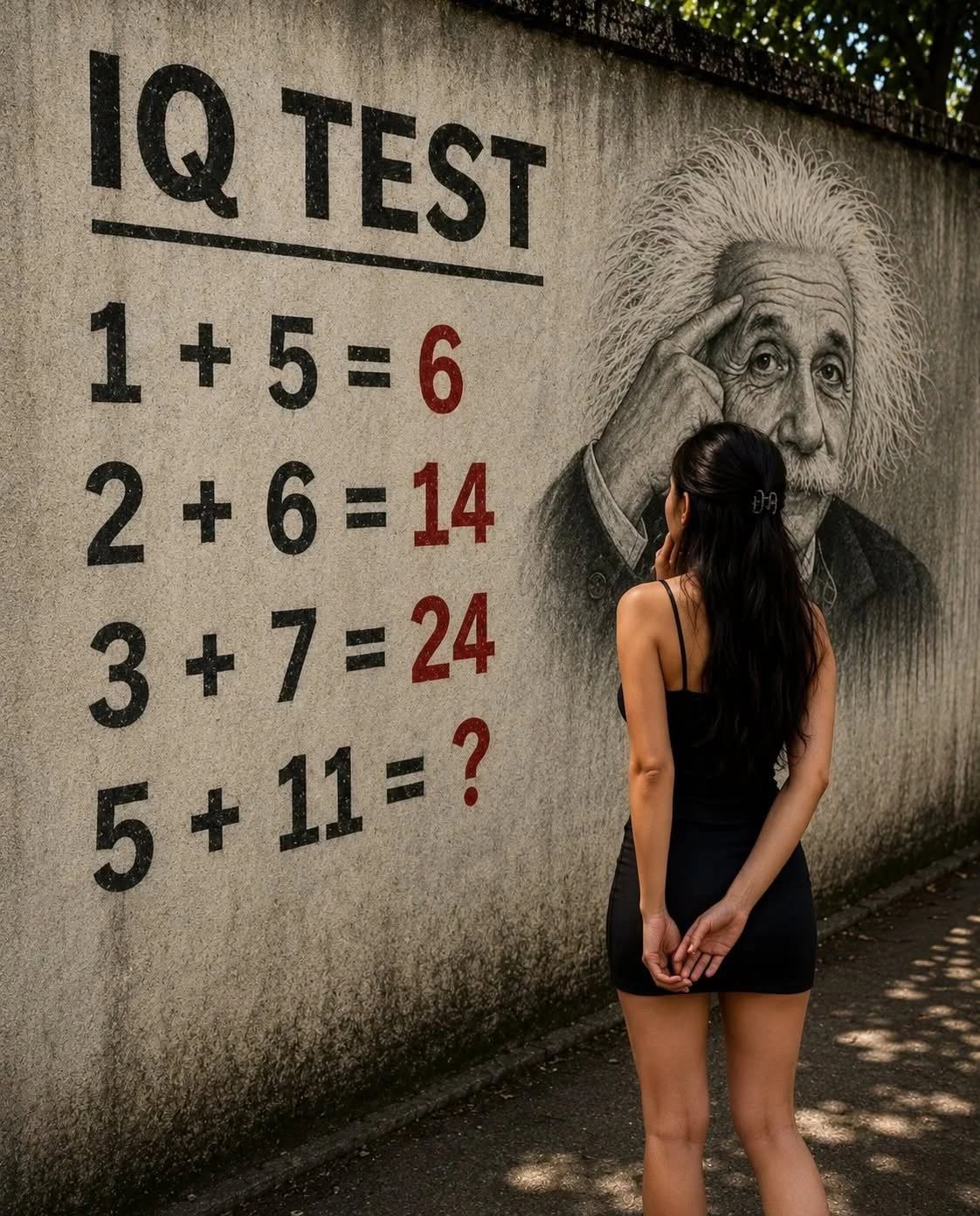
In this widely shared image challenge, a mural painted on a wall features a portrait of Albert Einstein alongside a series of non-standard equations labeled “IQ TEST”:
At first glance, standard arithmetic rules seem broken ($1+5=6$ works, but $2+6$ equals $8$, not $14$). However, like most sequence riddles, the goal is to discover the hidden rule or pattern governing the sequence.
Below, we break down the two primary mathematical methods used to solve this puzzle and explain why both 60 and 40 are popular answers!
Method 1: The Algebraic Multiplication Pattern (Result = 60)
The most direct and mathematically consistent logic applies a single algebraic rule to every line, treating $A + B$ as an operator formula rather than standard addition.
The Formula:
or equivalently:
Applying the Rule Step-by-Step:
-
Line 1 ($1 + 5$):
$$(1 \times 5) + 1 = 5 + 1 = 6$$ -
Line 2 ($2 + 6$):
$$(2 \times 6) + 2 = 12 + 2 = 14$$ -
Line 3 ($3 + 7$):
$$(3 \times 7) + 3 = 21 + 3 = 24$$ -
Final Line ($5 + 11$):
$$(5 \times 11) + 5 = 55 + 5 = 60$$
Primary Solution: Under this algebraic pattern, the final answer is 60.
Method 2: The Cumulative Running Total Pattern (Result = 40)
Another common way people solve sequence puzzles is by adding the result of the previous equation to the sum of the current line.
Applying the Running Total Step-by-Step:
-
Line 1: $1 + 5 = \mathbf{6}$
-
Line 2: Add previous result ($6$) to current equation ($2 + 6$):
$$6 + 2 + 6 = \mathbf{14}$$ -
Line 3: Add previous result ($14$) to current equation ($3 + 7$):
$$14 + 3 + 7 = \mathbf{24}$$ -
Final Line: Add previous result ($24$) to current equation ($5 + 11$):
$$24 + 5 + 11 = \mathbf{40}$$
Secondary Solution: Under the direct cumulative sum method, the final answer is 40.
Comparing the Solutions
| Solution | Method Used | Formula | Strengths |
| 60 | Independent Algebraic Rule | $A \times B + A$ | Works independently for every row without needing prior context. |
| 40 | Cumulative Sequence Addition | $\text{Previous Total} + A + B$ | Simple mental math following the visual order of lines. |
Why Brain Teasers Are Great Mental Exercise
-
Encourages Lateral Thinking: Teaches the mind to look beyond standard rules ($+$ sign) to identify abstract logical patterns.
-
Enhances Pattern Recognition: Trains working memory and visual analysis.
-
Fosters Healthy Debate: Demonstrates how different logical perspectives can lead to valid conclusions based on different initial assumptions!
Conclusion
Whether you calculated 60 using algebraic pattern logic or 40 using cumulative addition, both answers highlight creative problem-solving skills!
Frequently Asked Questions (FAQ)
Which answer is technically more mathematically sound?
60 is generally considered the stronger answer because it applies an independent formula $(A \times B + A)$ that does not rely on whether intermediate rows (like $4 + 8$) were omitted from the sequence.
Why do people get different answers on sequence riddles?
Because non-standard math puzzles replace conventional math symbols with custom logical operators, leaving room for multiple valid pattern interpretations!