
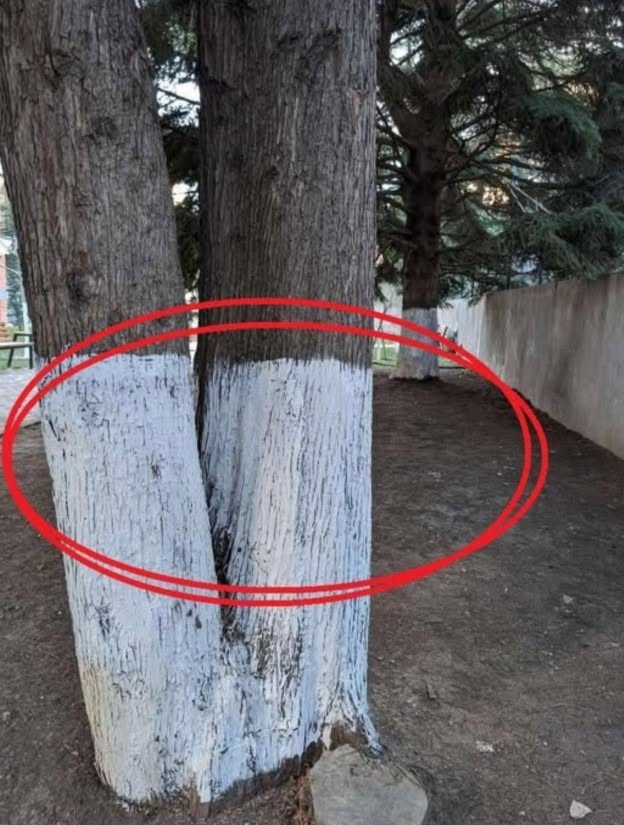


Walking through fruit orchards, public parks, or rural landscapes, you have likely noticed tree trunks painted stark white up to their lowest branches. Known in horticulture as tree whitewashing, this simple, cost-effective practice has been used by farmers and gardeners for centuries.
While it gives trees a neat, uniform appearance, whitewashing is primarily a protective measure engineered to shield bark from environmental stress, disease, and pests.
Below, we break down the science behind painting tree trunks, explain which paint formulations are safe, and share step-by-step application tips!
4 Science-Backed Reasons to Paint Tree Trunks
1. Prevents Sunscald and Bark Splitting
In late winter and early spring, dark tree bark absorbs thermal energy from direct sunlight, warming the tree’s living tissues (vascular cambium) beneath the surface. When temperatures plunge rapidly after sunset, these active cells freeze suddenly and rupture—a damaging condition called sunscald or frost cracking.
White paint reflects sunlight, keeping bark temperature stable throughout unpredictable winter weather.
2. Deterrence for Wood-Boring Insects
Cracks and crevices in raw bark are ideal egg-laying sites for wood-boring beetles, moths, and ants. Whitewashing creates a smooth, protective physical barrier that fills in small bark fissures, making it significantly harder for pests to burrow into the trunk.
3. Protection Against Rodents and Animals
During lean winter months, small animals like rabbits, voles, and mice often gnaw on the tender, nutrient-rich inner bark near the base of young trees. Adding hydrated lime or specialized repellents into a whitewash mix deters hungry wildlife from girdling the trunk.
4. Seals Pruning Wounds and Reduces Fungal Risks
The alkaline nature of traditional lime whitewash acts as a mild antibacterial and antifungal shield, reducing the likelihood of fungal spores settling into existing bark wounds or pruning cuts.
Latex Paint vs. Traditional Lime Whitewash
When painting tree trunks, choosing the correct material is critical. Never use oil-based paints, as they trap moisture, block gas exchange, and toxicify living plant tissue.
| Feature | Interior Latex Paint Mix | Traditional Lime Whitewash |
| Composition | 50% Water + 50% Flat White Interior Latex | Water, Hydrated Lime, and Salt |
| Durability | Long-lasting (1 to 2 seasons) | Wears off with heavy rain (requires frequent touch-ups) |
| Best For | Young fruit trees, shade trees, landscape aesthetics | Organic orchards & traditional pest control |
| Toxicity | Safe if water-based & flat-finish | All-natural, non-toxic |
How to Correctly Whitewash Tree Trunks
Step 1: Mix the Solution
Combine equal parts water and flat white interior latex paint in a bucket ($1:1$ ratio). Stir thoroughly until you achieve a smooth, milk-like consistency.
Step 2: Clean the Base of the Tree
Gently remove loose soil, fallen leaves, and debris from around the base of the trunk.
Step 3: Apply with a Soft Paintbrush
Use a wide, soft-bristled brush to apply the mixture from the ground level up to the lower main branches (about 2 to 3 feet high). Ensure the paint flows into all bark crevices where insects typically hide.
Step 4: Allow to Dry Completely
Apply on a clear, dry day when temperatures are above $10^\circ\text{C}$ ($50^\circ\text{F}$) so the coating dries thoroughly before rain or evening moisture sets in.
Conclusion
Whitewashing is one of the easiest, most rewarding preventive maintenance steps you can take for young or thin-barked trees. By reflecting harsh sunlight and repelling pests, a simple coat of diluted paint keeps your orchard healthy and thriving for years to come!
Frequently Asked Questions (FAQ)
What types of trees benefit most from whitewashing?
Young fruit trees (such as apple, peach, plum, and cherry), citrus trees, and young deciduous shade trees with thin bark benefit the most from whitewashing.
When is the best time of year to paint tree trunks?
The best time to apply whitewash is in late autumn before the first hard freeze, ensuring maximum protection against winter sunscald and cold temperature fluctuations.