
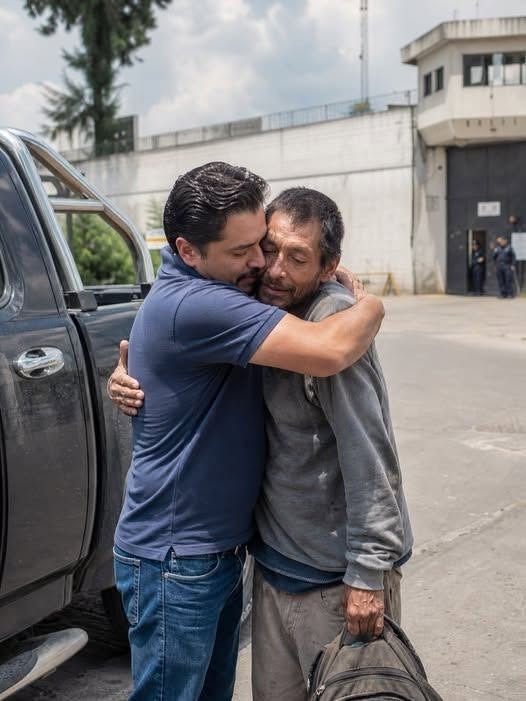

“Does Mom know I’m coming to your house?”
I was silent for a few seconds before answering,
“She knows.” But she didn’t say anything.
The truth was, by then my mother was already too weak. She lived part-time at Tomás’s house and part-time at Mariela’s, and for some time now her voice had carried no weight within the family.
My house was in a quieter area west of Guadalajara. I had managed to build a small business transporting agricultural products between Jalisco and Michoacán. We weren’t millionaires, but we lived comfortably and could give our two children a good school.
But when Esteban walked through the door, I immediately felt the tension in the air.
My wife, Sofía, was standing in the living room. The smile vanished from her face as soon as she saw the man with the old backpack.
“Did you really bring him here?” she asked in a stiff voice.
I replied,
“He has nowhere else to go.”
Sofía looked Esteban up and down and then back at me.
“Diego, our children live here.”
Esteban immediately lowered his head.
“If my sister-in-law isn’t comfortable, I can sleep in the garage for a few days.”
That sentence left a lump in my throat.
I took his small suitcase and brought it inside.
“No one is sleeping in the garage. You’re staying in the room by the patio.”
My children, Mateo and Alma, hid behind me, curiously watching this uncle they only knew a few vague stories about. Esteban sat down, took two cheap mints from his pocket, and timidly offered them to them.
Mateo was the first to accept. Alma looked at her mother before daring to extend her hand.
Sofía said nothing more, but throughout dinner her gaze was as cold as ice.
In the first few days, Esteban lived almost like a shadow. He got up very early, made his bed, swept the patio, fixed the crooked iron gate, changed the lightbulb in the entryway, and then went out to look for work.
But everywhere they looked at his record, those fifteen blank years and his background, they shook their heads.
Three weeks later he came home, his shoulders slumped. I was sitting in the small office behind the house and saw him stand in the doorway for a long time before speaking.
“No one hired you, did they?”
He gave a bitter smile.
“No. Some places said they’d call me. But they probably won’t.”
I glanced at the driver’s uniform of one of my employees, who had just quit and was still hanging there.
“You know how to drive trucks and cars, right?”
Esteban looked up.
“Yes.”
“So, starting tomorrow, you’re going to drive for me.”
He froze.
“Diego, you don’t have to do that.
” “I need someone I can trust. And you need a job. That’s all.”
When Sofia found out, she immediately objected in our room.
“Have you lost your mind? You’re going to hire an ex-convict as your driver? He’s going to transport merchandise, money, even your own children?”
I tried hard to stay calm.
“He’s my brother.
” “And someone who’s been in prison too!
” “He already paid for what he did, Sofia.”
She turned away.
“I just hope the day doesn’t come when you regret it.”
I didn’t answer.
From then on, Esteban started working for me. And what surprised me most was that he did his job more seriously than any of the men I had hired before. He was never late. He checked the vehicle carefully: the tires, the lights, the load. He kept detailed route notes. He treated the customers, the loaders, even people who before wouldn’t have even bothered to look at him, with respect.
Little by little, Mateo and Alma began to grow fond of their uncle. Esteban taught Mateo how to change a tire on a toy car, and Alma showed him how to plant tomatoes in a pot behind the kitchen. Every afternoon, when he returned, they both ran to the entrance to greet him as if they were waiting for someone who had been away for years.
Only Sofía continued to keep her distance.
She no longer said it openly, but her coldness never disappeared. She didn’t like Esteban spending too much time at the table with us, she didn’t like him touching the steering wheel of the family SUV, and she liked it even less that the children were growing more and more fond of him.
And then came the hardest blow, just when she least expected it…
The day my brother was released from prison, the whole turned their backs on him, including my mother, my older brother, and my two sisters. When he had nowhere else to go, only my two children and I opened the for him , despite my wife’s obvious discomfort at seeing him walk through the . I even got him a job as my personal driver… until one day my business collapsed, and he silently took my wife and me to a place that left me speechless. In that very moment, my wife felt ashamed of her own conscience, and I understood that, in this life, family will always be the most important thing.
My name is Diego Ramírez, I was born and raised in an old working-class neighborhood in Guadalajara, Jalisco. The streets around my house were always covered in dust, the walls of the houses faded by the sun, and the ranchera music from the cantina on the corner usually played until well into the night.
My family was never rich, but at least we lived with a certain warmth, until everything fell apart.
My older brother, Esteban Ramírez, was eight years older than me. When I was a child, I saw him as an indestructible wall. He would carry me on his back to cross alleys flooded by the rain, give up his share of tortillas to give to me, and even get into fights with older boys just because they made fun of my worn-out shirt.
But life in the poor neighborhoods of Guadalajara was never easy for an impulsive boy who had to grow up too fast.
When Esteban was twenty-seven, after a night of heavy drinking and a fight in a roadside bar, he seriously injured a man. As a result, he was sentenced to prison.
The day the police took him away, my mother collapsed in the doorway, her hands on her head. My father, a proud man to the core, slammed his fist on the table and muttered:
—From today on, I don’t have a son like him.
My older brother, Tomás, stood with his arms crossed, his gaze frozen, as if Esteban were a stain that had to be erased. My two sisters, Lucía and Mariela, just shook their heads, full of contempt, sighing repeatedly because “the family’s honor had been tarnished.”
And I, at that time, just stood motionless in a corner, watching as the vehicle transporting the prisoners disappeared around the corner.
Seven years later, my father died of a stroke.
Three years later, my mother also began to weaken from diabetes and heart complications. But, strangely enough, even though she had said the cruelest words about Esteban, she still kept an old photograph of him from when he was young in a drawer.
When fifteen years had passed, Esteban was released from prison.
The whole family knew beforehand. But nobody wanted to go and pick him up.
That night, during dinner at my mother’s house, Tomás put his plate down on the table and said coldly:
“Anyone who wants to mess with him, let them. But I’m not going to let someone like that set foot in my house.”
Lucia twisted her mouth disdainfully:
—People like him get out of jail and they’re still the same.
Mariela, while taking a sip of her coffee, added indifferently:
“It’s best if he manages on his own. Any house that takes him in will only bring misfortune.”
My mother remained silent for a long time. Then she asked in a tired voice:
—So, where is she supposed to go?
No one answered.
I looked around the table. People who shared the same blood as Esteban were talking about abandoning him as if he were a broken object.
Then I said:
—If nobody goes for him, I’ll go myself.
Everyone turned to look at me.
Thomas frowned:
—Diego, you have a transport company, a wife, and two children. Don’t bring problems home.