



Quick mental math puzzles are among the most shareable challenges on social media. They look deceivingly simple at first glance, but they are specifically designed to exploit how our brains process rapid visual information and sequential addition.
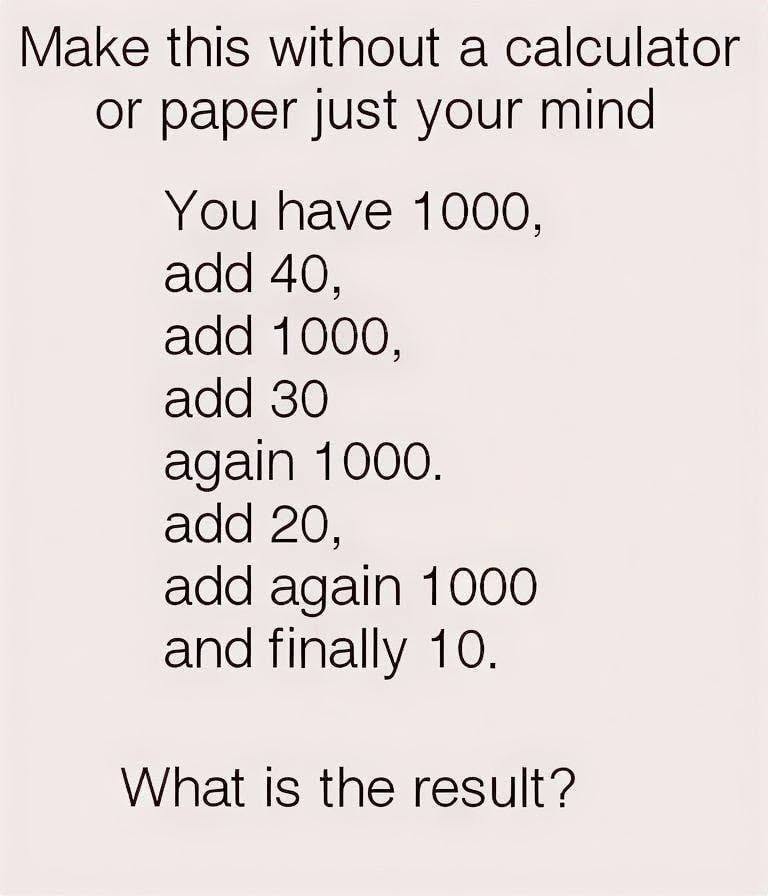
One famous viral image asks readers to perform quick mental arithmetic: “You have 1000, add 40, add 1000, add 30, again 1000, add 20, add again 1000, and finally 10. What is the result?”
Below, we break down the exact step-by-step solution, explain the psychological trick that causes thousands of people to get it wrong, and share tips for mastering mental math.
The Correct Solution (Step-by-Step)
If you follow the additions strictly step-by-step, here is how the total adds up:
-
Start with 1000
-
Add 40 $\rightarrow$ 1040
-
Add 1000 $\rightarrow$ 2040
-
Add 30 $\rightarrow$ 2070
-
Add 1000 $\rightarrow$ 3070
-
Add 20 $\rightarrow$ 3090
-
Add 1000 $\rightarrow$ 4090
-
Add 10 $\rightarrow$ 4100
The correct final result is 4100!
Why So Many People Incorrectly Answer 5000
When doing this puzzle quickly in your head, a surprisingly high percentage of people confidently arrive at 5000 instead of 4100. Here is why our minds trick us:
-
Decimal Place Confusion: As you reach $4090$, your brain naturally focuses on the sequence of thousands ($1000, 2000, 3000, 4000$).
-
Rounding Up Prematurely: Adding $10$ to $4090$ increases the tens column from $90$ to $100$, bringing the total to $4100$. However, when adding quickly, people instinctively carry that $100$ straight into the thousands column, jumping from $4000$ to $5000$!
3 Easy Mental Math Tricks to Avoid Common Mistakes
1. Group Thousands and Tens Separately
To avoid carrying errors, break the problem into two quick piles:
-
The Thousands: $1000 + 1000 + 1000 + 1000 = 4000$
-
The Smaller Numbers: $40 + 30 + 20 + 10 = 100$
-
Combine: $4000 + 100 = 4100$
2. Slow Down at the Tens Transitions
Whenever mental addition crosses a hundreds boundary (like moving from $90$ to $100$), pause for half a second to verify which digit position changes.
3. Visualize the Written Numbers
Mentally picturing standard column addition ($4090 + 10$) prevents your brain from relying solely on auditory counting rhythms.
Fascinating Facts About Mental Arithmetic
-
The Cognitive Trap: This math puzzle relies on a psychological phenomenon known as order-of-processing bias, where repetitive mental steps create a pattern expectation that overrides strict calculation.
-
Brain Activation: Performing mental calculations exercises the parietal lobe and the prefrontal cortex, boosting working memory and mental agility.
Conclusion
While it is easy to accidentally say 5000 when rushing through the addition in your head, taking a systematic approach reveals the true answer of 4100. Math teasers like this are a great reminder of how fascinating—and easily tricked—our brains can be!
Frequently Asked Questions (FAQ)
Is the answer 4100 or 5000?
The correct mathematical answer is 4100. The answer 5000 is a common mistake caused by rushing through the final addition ($4090 + 10$).
Why does this trick work so well?
It works because $4090 + 10$ equals $4100$, but because the human brain is tracking the four $1000$s simultaneously, people mentally round $4090$ up to $5000$ by mistake.