


Visual riddles and key-matching puzzles are among the most popular brain teasers on the internet. They challenge your visual-spatial reasoning, attention to detail, and pattern recognition skills.
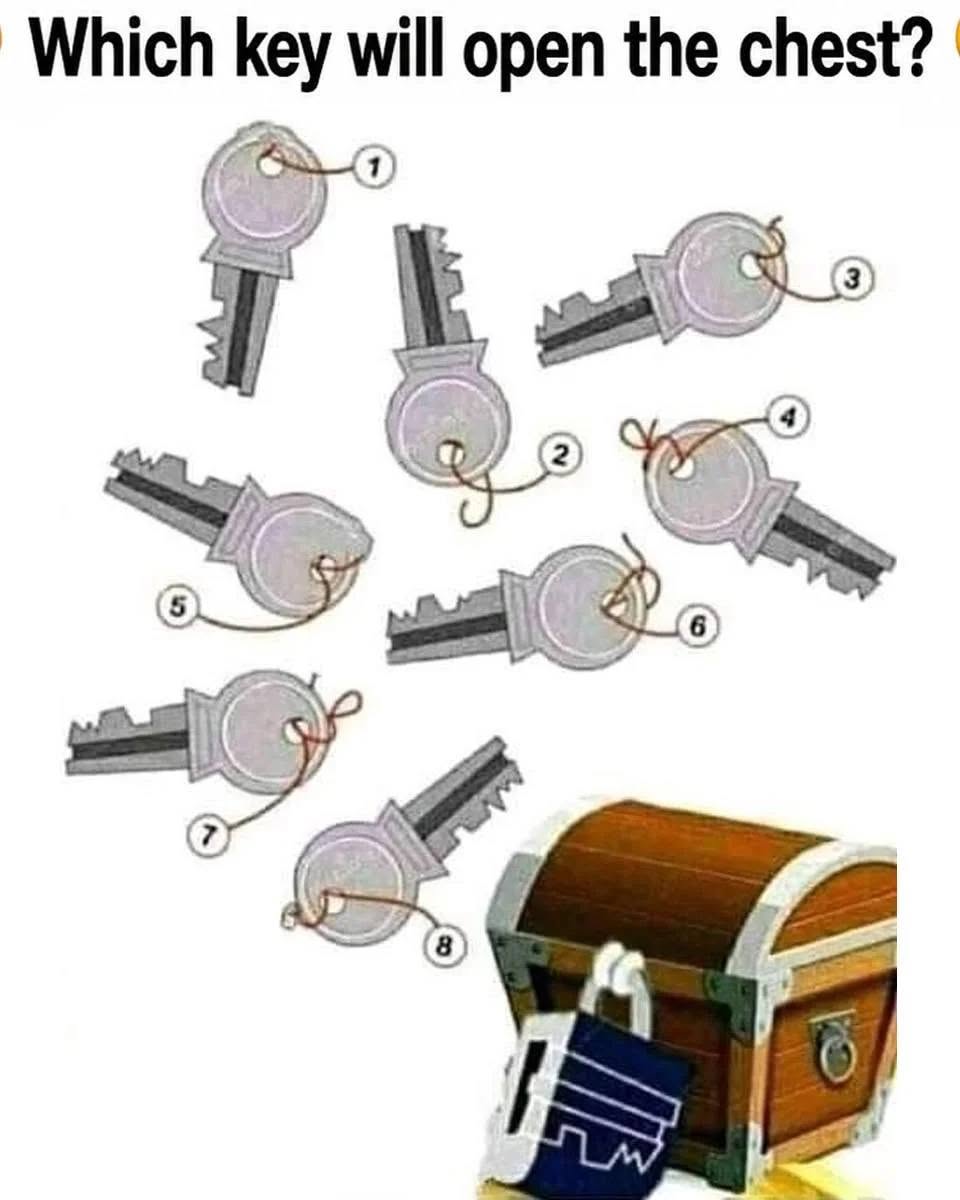
In this puzzle, you are presented with eight numbered keys and a chest secured by a lock that clearly displays the outline (silhouette) of the matching key blade.
Below, we break down the step-by-step solution, explain the key matching features, and discuss the cognitive benefits of solving visual puzzles daily.
The Solution: Finding the Matching Key
To identify the correct key, you need to examine the blade profile—specifically the teeth, notches, and spine layout shown on the lock.
Step-By-Step Analysis of the Lock Profile
-
The Spine (Top Edge): The key outline on the lock features a smooth, completely flat top edge (the spine).
-
The Teeth Pattern (Bottom Edge, from handle to tip):
-
First notch (near handle): A small rectangular step down.
-
Second section (middle): A prominent, raised square tooth.
-
Third section: A deep V-shaped triangular notch.
-
Fourth section (tip): A medium flat end (no notch on the far tip).
-
Comparing the Options
-
Keys with pronged/notched tips (Eliminated): Key 5 and Key 8 both have cutouts directly at the tip of the blade, which does not match the solid tip on the lock profile.
-
Keys with inverted tooth patterns (Eliminated): Key 2 and Key 3 have their deep V-notches placed closer to the handle rather than near the tip.
-
Key 1, Key 4, and Key 7: Vary in the height and shape of the middle tooth or the tip structure.
The Correct Answer: Key 6
If you orient Key 6 horizontally (matching the angle on the lock), its blade profile lines up identically with the white silhouette on the lock:
-
Flat spine along the top.
-
Rectangular step near the shoulder.
-
Raised square tooth in the center.
-
Deep V-notch near the end.
-
Solid, flat tip.
Why Visual Puzzles Are Great for Your Brain
Engaging with visual matching games and spatial puzzles isn’t just entertaining—it delivers genuine cognitive exercises:
1. Enhances Mental Rotation and Spatial Awareness
Determining if a key matches requires your brain to mentally rotate shapes in 2D space to align their features, exercising the parietal lobe of the brain.
2. Sharpens Pattern Recognition
Focusing on micro-details—such as notch depth, angle, and tip shape—trains your visual cortex to spot subtle differences in complex patterns quickly.
3. Boosts Focus and Working Memory
Holding the keyhole shape in your mind while scanning eight distinct key options actively exercises short-term working memory and concentration.
Tips for Solving Key and Lock Puzzles Faster
-
Isolate One Distinct Feature: Rather than looking at the entire key at once, pick one unique element (like a split tip or a deep notch) and instantly eliminate all keys that lack that feature.
-
Check the Orientation First: Identify which side is the smooth spine and which side holds the teeth before comparing shapes.
-
Use Process of Elimination: Cross off obvious non-matches first to reduce your choices down to two or three candidates.
Fascinating Facts About Locks and Keys
-
Ancient Pin Tumbler Locks: The earliest pin tumbler locks were made of wood and invented in ancient Egypt over 4,000 years ago!
-
The Yale Lock Revolution: In 1861, Linus Yale Jr. patented the modern flat tumbler key with notched edges, which remains the standard design for house doors around the world today.
Conclusion
Did you guess Key 6 right away? Whether you spotted it in 5 seconds or took a minute to compare every notch, visual logic teasers are a fun, daily workout for your eyes and brain.
Frequently Asked Questions (FAQ)
What is the correct key for this chest riddle?
The correct answer is Key 6. Its teeth sequence and flat spine match the exact silhouette displayed on the lock.
Why do key teeth have different notch depths?
In real-life pin tumbler locks, each notch depth corresponds to a specific length of pin inside the lock cylinder. When the correct key is inserted, all pins align at the shear line, allowing the lock to turn.
How can I improve my visual puzzle-solving speed?
Practice regularly with pattern recognition games, spot-the-difference challenges, and spatial rotation exercises to train your brain to process visual information faster.