
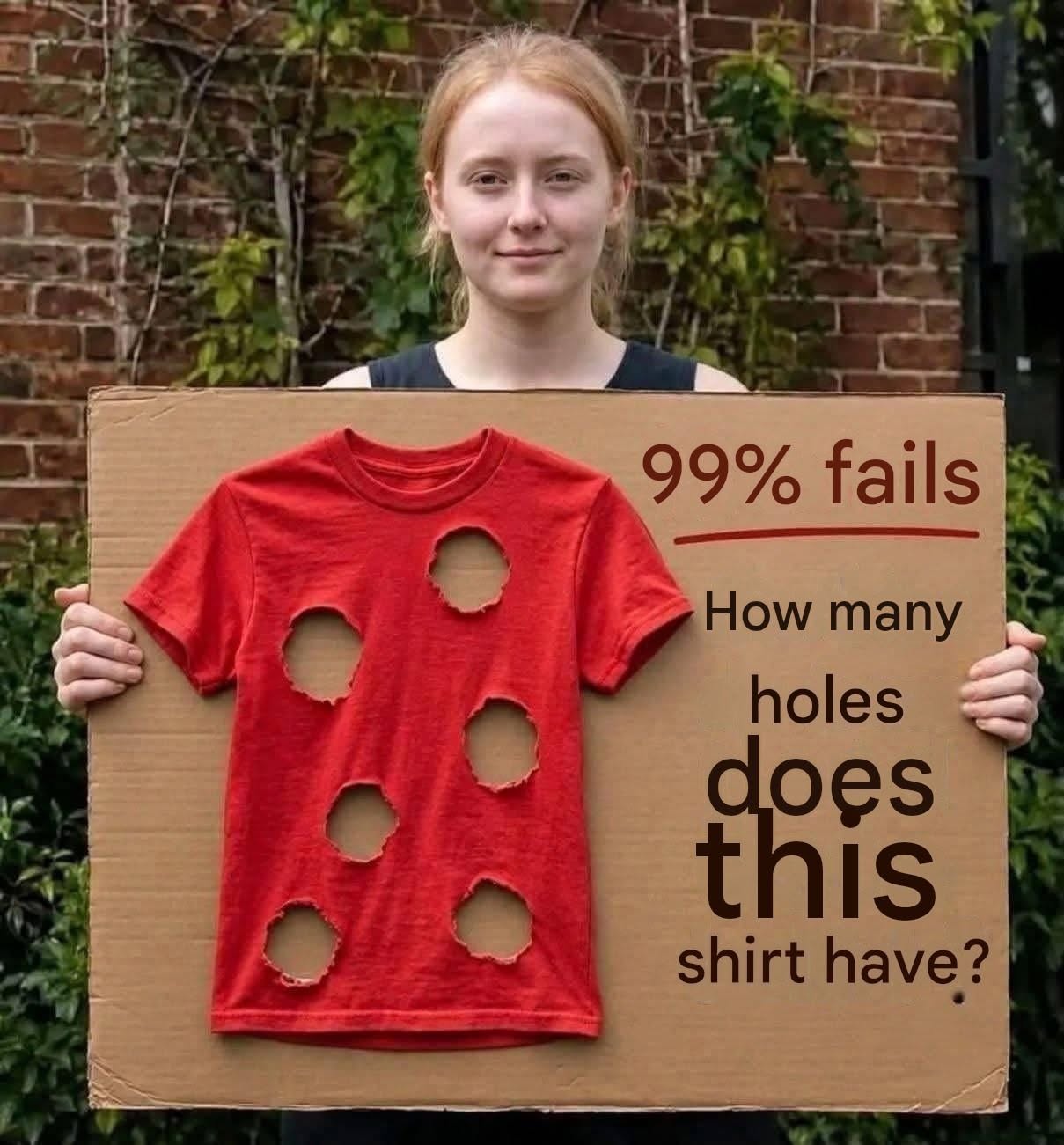


Visual puzzles and counting riddles have taken over social media feeds once again, captivating millions of users who love to test their logic against tricky optical images. One viral challenge that has generated thousands of comments and spirited online debates shows a young woman holding a sign with a red t-shirt mounted on cardboard. The headline boldly claims that “99% fails,” asking a deceptively simple question: “How many holes does this shirt have?”
At first glance, your brain might automatically count the visible circular cutouts dotting the front of the garment. However, just like classic lateral thinking puzzles, arriving at the exact total requires analyzing three-dimensional geometry, structural garment design, visual depth cues, and precise observation. Let’s break down the logic step-by-step to reveal the correct calculation and explore why our visual processing gets tricked so easily.
The Breakdown: Counting Every Single Hole
To solve this riddle accurately, we must divide the calculation into two distinct categories: standard functional openings and accidental cutouts or tears.
+------------------------------------------------------------------------+
|                          HOLE COUNT BREAKDOWN                          |
|                                                                        |
|   Standard Garment Openings:                                           |
|   * 1 Neck Hole (Collar opening)                                       |
|   * 2 Arm Holes (Sleeves)                                              |
|   * 1 Main Waist Opening (Bottom hem)                                  |
|   Subtotal: 4 Standard Holes                                           |
|                                                                        |
|   Cutout / Torn Openings:                                              |
|   * 5 Visible Cutouts on the Front Layer                               |
|   * 5 Matching Cutouts on the Back Layer (Cardboard visible through)   |
|   Subtotal: 10 Cutout Holes                                            |
|                                                                        |
|   GRAND TOTAL: 14 HOLES                                                |
+------------------------------------------------------------------------+
1. The Standard Structural Openings (4 Holes)
Before evaluating any damage or design cutouts, every wearable t-shirt must feature four default structural openings to function as apparel:
-
One neck opening at the top collar.
-
Two sleeve openings for the arms.
-
One large waist opening at the bottom hem.
Without these initial four construction points, the item would be a solid, sealed fabric rectangle rather than a wearable t-shirt.
2. The Visible Front Cutouts (5 Holes)
Looking directly at the red fabric attached to the cardboard backing, you can clearly count five distinct circular holes cut into the main body of the shirt. Three are arranged on the left side and two are positioned on the right side.
3. The See-Through Back Layer (5 Additional Holes)
Here is where the true trick lies. Notice the color and texture appearing inside each of the five circular openings: you can see the plain brown cardboard surface passing directly through the red shirt.
If the back layer of the t-shirt were whole and intact, you would see solid red fabric filling the inner back of the shirt through those front openings. Because the cardboard background is completely exposed across all five cutouts, the holes must pass cleanly through both the front and back layers of the fabric.
This means there are 5 cutouts on the front side and 5 matching cutouts on the back side, bringing the total number of damaged or cut openings to 10.
The Final Calculation
Combining both standard structural openings and fabric cutouts yields the complete equation:
The Psychology Behind Why People Get It Wrong
Why does the claim “99% fails” hold true for so many casual viewers? The answer lies in how human visual perception prioritizes information when scrolling through digital media.
Fast vs. Slow Thinking
In cognitive psychology, our mental processing is often split into two distinct modes:
-
System 1 (Fast & Intuitive): This system makes rapid judgments based on immediate visual cues. It sees 5 cutouts on the front and quickly adds 4 structural openings to guess 9, or simply answers 5 based purely on the cutouts.
-
System 2 (Analytical & Deliberate): This system slows down to inspect details, recognizing that the background cardboard is visible straight through, meaning the back fabric layer must also have 5 matching holes.
Because social media encourages fast scrolling, most viewers rely exclusively on System 1, resulting in quick, incorrect guesses that spark massive debate in the comments.
Cognitive Health Benefits of Daily Brain Teasers
Regularly engaging with lateral thinking riddles, optical illusions, and math puzzles is far more than a fun pastime. Mental agility exercises offer measurable benefits for brain fitness and long-term wellness.
1. Enhancing Spatial Reasoning
Spatial reasoning is the ability to visualize 3D objects, interpret physical layers, and understand spatial relationships. Exercises like analyzing whether a hole penetrates one or two layers of fabric strengthen the parietal lobe, which aids in real-world spatial orientation and navigation.
2. Improving Attention to Detail
Modern screen habits can reduce attention spans. Taking a moment to analyze a detailed image trains your brain to slow down, notice subtle background textures, and evaluate visual evidence carefully.
3. Supporting Mental Agility and Neuroplasticity
Challenging your mind with novel problem-solving tasks promotes neuroplasticity—the brain’s capacity to form new neural connections. Maintaining an active intellectual routine supports cognitive resilience as you age.
Everyday Applications: Critical Thinking in Life and Finance
The ability to look beyond surface impressions and examine underlying details is a crucial skill that extends far beyond online riddles. Analytical thinking plays a major role in personal decision-making, higher education, career growth, and financial stability.
Thorough Analysis in Professional and Financial Matters
Whether you are reviewing contract terms with an attorney, comparing mortgage and personal loan rates, setting up a retirement account, or consulting with a financial planner, paying attention to hidden details prevents costly mistakes. Just as discovering the matching holes in the back of the shirt requires a second look, making wise investments in business, real estate, or technology requires thorough research.
Protecting Long-Term Well-Being
Prioritizing lifelong learning and cognitive fitness goes hand-in-hand with securing physical and financial protection. Ensuring you have robust health insurance, personal safety nets, and continuous educational development forms a holistic strategy for long-term health and personal success.
Quick Tips for Master Mind Puzzles
To avoid falling into common visual traps when solving online riddles, keep these simple guidelines in mind:
-
Check for Transparency: Look closely at what is visible through openings or cutouts.
-
Consider Structural Essentials: Remember that standard garments, containers, or objects have built-in functional openings.
-
Count Layer by Layer: Separate the front, back, interior, and exterior components before adding totals together.
-
Pause Before Answering: Give your analytical brain time to double-check initial assumptions before posting your final answer.
Fascinating Facts About Visual Perception and Apparel
-
The Figure-Ground Relationship: The human visual cortex uses figure-ground organization to distinguish primary focal objects (the red shirt) from secondary backgrounds (the cardboard).
-
Color Contrast Impact: High-contrast color combinations—like bright red against natural brown cardboard—draw immediate visual focus, making surrounding structural details easier to overlook.
-
The Power of Interactive Questions: Image posts featuring choice-based questions or high fail-rate claims generate significantly higher user engagement because humans naturally seek validation through problem-solving.
Conclusion
The viral red shirt riddle is a brilliant demonstration of how visual perspective can twist a simple question into an engaging debate. While a superficial glance might lead to quick guesses like 5 or 9, a thorough analytical breakdown proves that 14 total holes exist when accounting for standard garment construction and both fabric layers. The next time you spot a mind-bending puzzle on your feed, take an extra moment to look through the layers—you might just spot the answer that 99% of people miss!
Frequently Asked Questions (FAQ)
What is the final correct total for the red shirt riddle?
The complete logical total is 14 holes. This accounts for the 4 natural openings of a standard t-shirt (neck, waist, two sleeves) plus 10 cutout openings (5 cutouts on the front fabric layer and 5 corresponding cutouts on the back layer).
Why do many people guess 9 instead of 14?
People who guess 9 usually add the 4 structural openings to the 5 visible front cutouts, but they fail to account for the back layer being cut open to expose the cardboard background.
What if you only count accidental or cut holes?
If you strictly exclude standard garment openings (neck, sleeves, hem) and only count cutouts, the answer is 10 holes (5 on the front layer and 5 on the back layer).
How do visual riddles improve critical thinking?
Visual riddles force us to question initial assumptions, analyze background details, and apply multi-step logic rather than relying on rapid knee-jerk intuition.