

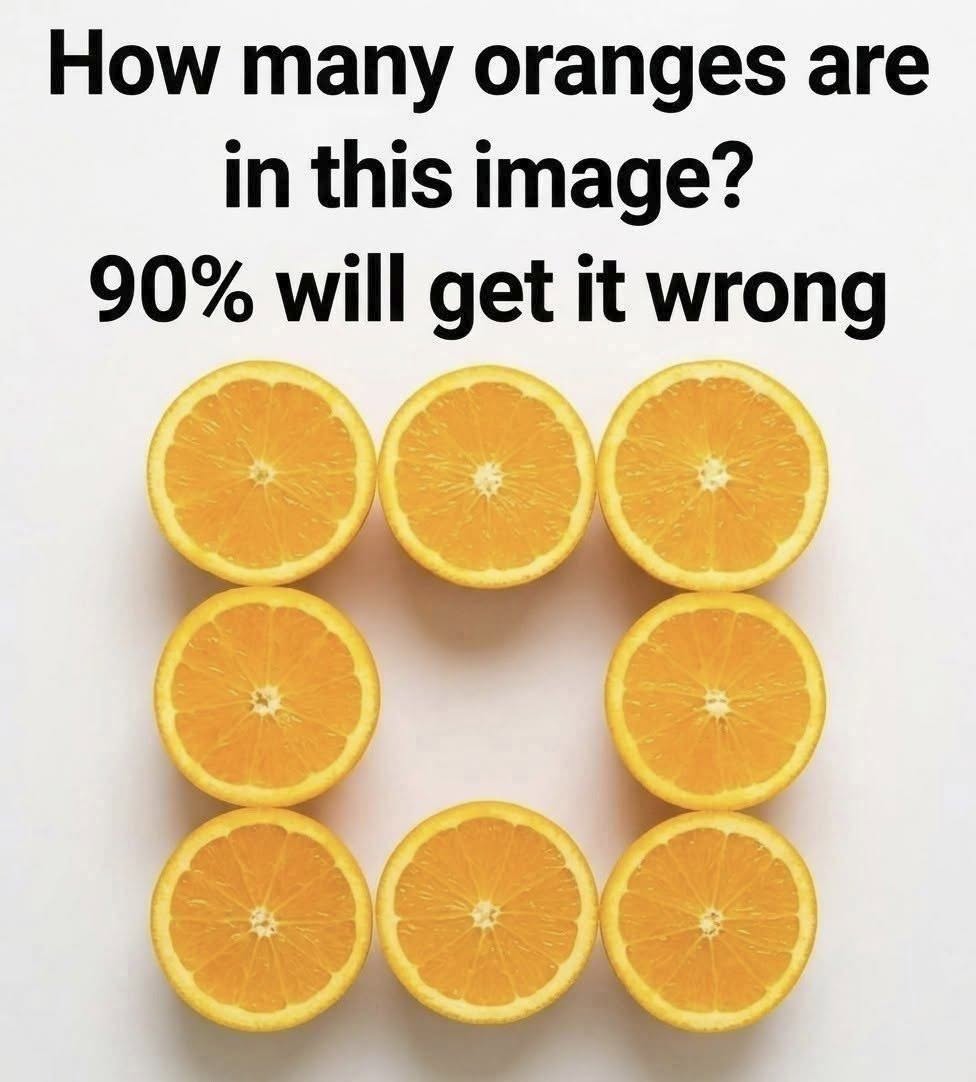


Visual puzzles, brain teasers, and optical illusions have dominated social media feeds for years, captivating millions of users daily. From the famous dress color controversy to subtle counting riddles, these interactive images trigger an irresistible urge to test our perception, share our answers, and engage in friendly debate with friends and strangers alike. One classic style of viral visual puzzle features sliced fruit—such as oranges arranged in a grid—accompanied by a bold challenge claiming that a massive percentage of people will fail to solve it correctly.
At first glance, these visual riddles appear deceptively simple. A quick scan suggests a straightforward numerical answer. However, when you look closer at how the items are sliced, positioned, or framed, the puzzle reveals a layer of logic that separates casual observers from sharp analytical thinkers. Understanding why these image challenges spark such intense interest offers fascinating insights into human psychology, cognitive processing, visual perception, and the way our brains process complex information under brief exposure.
How Our Brains Process Visual Puzzles and Slices
When you look at an image containing objects cut in half, your brain immediately attempts to recognize familiar patterns. This instant recognition process relies on visual shortcuts that help us navigate the physical world efficiently. However, in the context of a riddle or visual brain teaser, these automatic shortcuts can lead to hilarious misunderstandings.
+-----------------------------------------------------------------------+
|                         VISUAL PERCEPTION STEPS                       |
|                                                                       |
|   1. Instant Pattern Recognition -> Identifies orange halves / shapes |
|   2. Rapid Mental Assembly      -> Combines pieces into whole units   |
|   3. Logical Evaluation          -> Differentiates halves vs whole     |
+-----------------------------------------------------------------------+
The Gestalt Principles of Perception
Psychologists refer to our inherent tendency to group objects, recognize shapes, and complete incomplete figures as Gestalt principles. When viewing halved oranges arranged in a geometric square:
-
Closure: The mind naturally tries to fill in missing gaps to perceive complete, unbroken whole objects.
-
Continuity: Our visual pathway follows lines and smooth curves, grouping aligned items together.
-
Proximity: Items situated closely together are perceived as belonging to a single group or set.
Because of closure and proximity, your visual cortex wants to mentally combine separate half slices into whole pieces of fruit. Depending on whether a viewer counts individual visual elements present on the screen or calculates the equivalent number of whole fruits, two entirely different yet logical answers emerge.
Breaking Down the Math: Whole Fruits vs. Slices
To understand the riddle’s answer, we must examine how the question is stated and how mathematical logic applies to physical representation.
Method 1: Counting Visual Halves
If you strictly count the visible distinct slices present in the image grid, you will count eight separate pieces. Each piece represents an orange cut directly down the middle, displaying its juicy citrus segments and rind ring. If the riddle asks for the count of visible items on the white background, the numerical total is eight visual items.
Method 2: Calculating Equivalent Whole Oranges
If you apply fractions and basic arithmetic, each visible element represents $1/2$ (one half) of a whole fruit. Therefore, calculating the complete whole fruits yields a simple formula:
Thus, mathematically speaking, there are four complete oranges represented across those eight halves.
Method 3: The Semantic Catch
The reason so many people argue in comment sections comes down to semantics and language interpretation:
-
Literal visual interpretation: “I see 8 individual orange pieces on my phone screen.”
-
Mathematical equivalency interpretation: “Eight half-oranges equal exactly 4 whole oranges.”
-
Physical presence interpretation: “Since none of these halves are connected, there are zero complete oranges.”
This clever play on language is precisely what fuels high engagement rates, spirited debates, and endless shares across community channels.
Cognitive Benefits of Regular Mental Exercises
Engaging with daily riddles, brain teasers, and counting challenges is far more than an entertaining distraction. Cognitive experts and healthcare professionals frequently highlight the long-term benefits of maintaining active mental habits throughout all stages of life.
1. Enhancing Focus and Attention to Detail
Modern digital media environments often encourage rapid skimming and short attention spans. Solving visual teasers requires deliberate observation, slowing down your visual processing to inspect tiny details, alignment, and subtle cues that might otherwise be overlooked.
2. Promoting Neuroplasticity
Neuroplasticity refers to the brain’s remarkable ability to reorganize itself by forming new neural connections throughout life. When you challenge your mind with novel problem-solving tasks, spatial reasoning exercises, and educational puzzles, you encourage cognitive flexibility and adaptive thinking skills.
3. Improving Spatial Reasoning
Spatial reasoning involves mentally manipulating 2D and 3D objects, visualizing how pieces fit together, and calculating proportions. Exercises that ask viewers to reconstruct whole items from visual fractions strengthen the brain’s parietal lobe function, which plays a major role in spatial navigation and quantitative reasoning.
The Role of Educational Technology in Mental Fitness
As digital technology advances, mobile learning platforms, interactive apps, and educational software have transformed traditional brain training into accessible, daily micro-learning sessions. Today, individuals of all ages utilize specialized tools to track memory, logical agility, and processing speed.
Brain Training Applications
Modern technology platforms incorporate gamified cognitive tests that present users with memory patterns, rapid math challenges, and visual discrimination tasks. These platforms leverage adaptive learning algorithms to keep exercises challenging yet achievable, encouraging consistent daily practice.
Classroom and Distance Education
Educators across primary, secondary, and higher education levels increasingly integrate visual puzzles into introductory STEM (Science, Technology, Engineering, and Math) curricula. Using playful visual riddles helps students grasp abstract concepts such as fractions, geometry, and logical deduction in an approachable, stress-free environment.
Practical Tips for Improving Your Puzzle-Solving Skills
If you want to become sharp at solving viral visual riddles, optical illusions, and math logic tests, consider implementing these simple observational strategies:
-
Read the Prompt Carefully: Pay close attention to wording. Does the question ask for “halves,” “whole items,” “visible shapes,” or “triangles”?
-
Deconstruct the Image Layer by Layer: Avoid making split-second assumptions. Break the picture into quadrants and inventory each segment individually.
-
Look for Overlaps and Hidden Elements: Many visual teasers hide smaller shapes within larger geometric outlines or obscure elements behind high-contrast backgrounds.
-
Apply Math Explicitly: Write down explicit fractions or equations rather than relying solely on mental estimation.
-
Verify Alternative Interpretations: Ask yourself how someone else might read the same question differently. Identifying semantic ambiguity is key to finding the “trick.”
Fascinating Facts About Human Perception and Citrus Fruits
To complement our visual puzzle analysis, here are several intriguing facts combining visual science, human memory, and citrus botany:
-
Color Perception and Naming: The color “orange” was named after the citrus fruit, not the other way around. Before the word entered the English language around the 16th century, the hue was simply referred to as “geoluread” (yellow-red).
-
Foveal Vision Focus: The human eye can only focus sharply on a tiny central region called the fovea, which accounts for roughly 2% of your visual field. The rest of your peripheral vision relies on brain predictions, which is why visual illusions easily trick us.
-
Perceptual Constancy: Your brain maintains the perceived size, color, and shape of an object even when lighting or camera angles change drastically.
-
Vitamin C and Brain Health: Consuming fresh citrus fruits rich in Vitamin C supports overall cardiovascular health and neuroprotective function, aiding healthy cognitive aging alongside mental exercises.
Financial and Personal Wellness: Investing in Cognitive Longevity
While solving fun riddles on social media offers quick entertainment, long-term mental sharpness directly impacts your personal independence, career performance, and overall quality of life. Maintaining sharp cognitive performance is a critical element of holistic wellness planning as individuals plan for career advancement, business innovation, higher education, and comfortable retirement.
Long-Term Health and Lifestyle Planning
Just as individuals secure comprehensive health insurance, explore life insurance options, or consult financial planning advisors to protect their physical and economic futures, maintaining cognitive health requires proactive investment. Engaging in lifelong learning through formal education courses, reading, language acquisition, and regular problem-solving ensures your mental faculties remain resilient throughout every chapter of life.
Conclusion
Whether you counted 4 whole oranges, 8 visual halves, or argued that no complete oranges exist in the image, visual puzzles serve as a fantastic reminder of how wonderfully unique human perception can be. These viral riddles bridge the gap between simple entertainment and fascinating cognitive science, reminding us to look closer, question initial assumptions, and appreciate the complex ways our eyes and brains collaborate. The next time you encounter a viral image challenge online, take a extra moment to analyze the layout, share it with family or colleagues, and enjoy the friendly debate that follows!
Frequently Asked Questions (FAQ)
What is the definitive answer to the orange count puzzle?
The answer depends on how you interpret the question. Visually, there are 8 distinct half-slices shown in the grid. Mathematically, 8 half-oranges equal 4 whole oranges ($8 \times 0.5 = 4$).
Why do visual puzzles go viral so easily on social media platforms?
Visual puzzles trigger the “curiosity gap” and invite active participation. Because people naturally form immediate opinions and want to test their accuracy against others, they leave comments, tag friends, and share the image, driving high engagement algorithms.
How do optical illusions trick our sight?
Optical illusions take advantage of the visual cortex’s reliance on shortcuts, lighting cues, past experiences, and pattern recognition rules (like Gestalt principles). When presented with ambiguous visual data, the brain fills in details that may not accurately reflect physical reality.
Can solving daily visual puzzles help prevent cognitive decline?
While puzzles alone are not a guaranteed cure or preventative measure for age-related conditions, studies suggest that maintaining an active, mentally stimulating lifestyle—combined with regular physical exercise, balanced nutrition, and social interaction—helps build cognitive reserve and supports long-term brain health.