
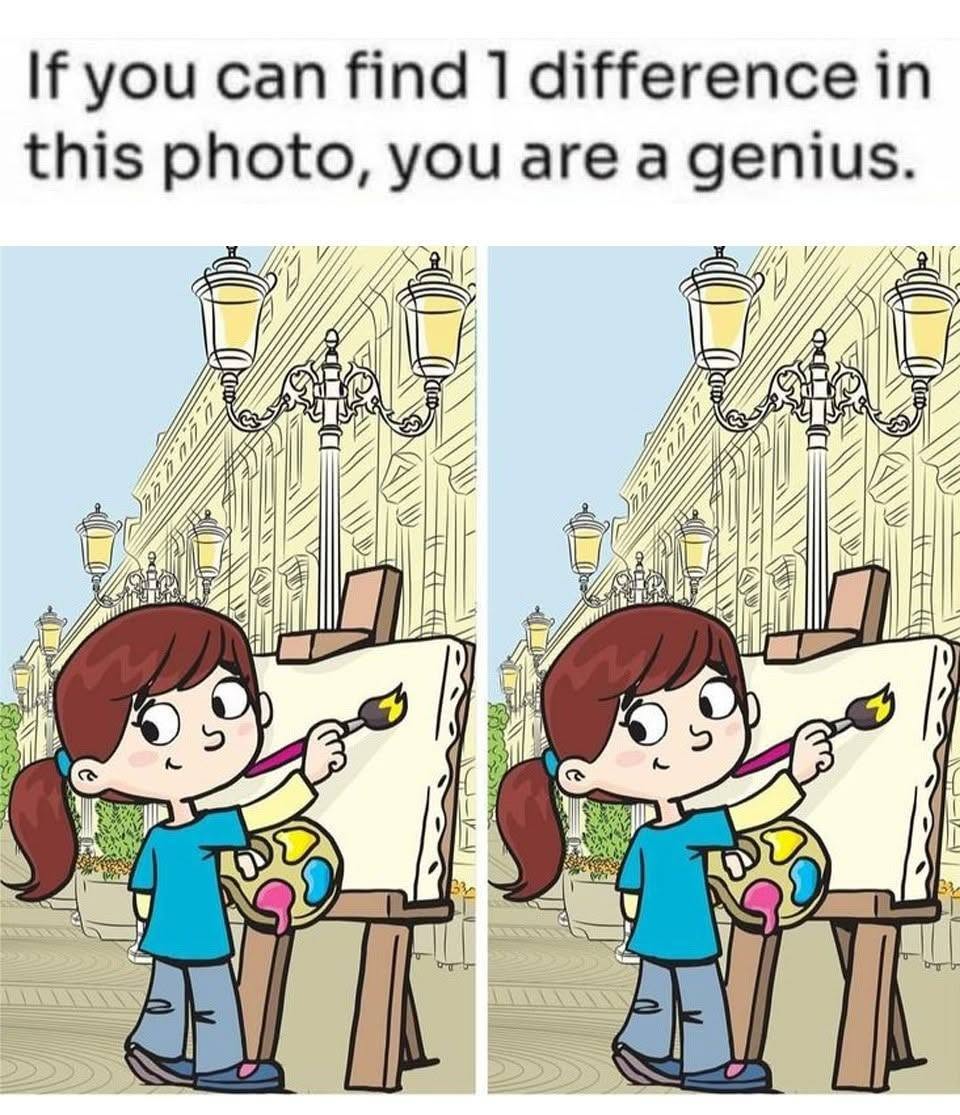


“Spot-the-difference” visual puzzles are a popular staple across social media, engaging audiences with playful challenges like “If you can find 1 difference in this photo, you are a genius.” These illustrations test our spatial awareness, attention to fine detail, and ability to systematically scan complex scenes.
Understanding visual search mechanisms, why small details often escape our immediate notice, and how brain teasers help exercise cognitive focus offers engaging insights into how our minds process visual information.
Uncovering the Solution: The Subtle Difference Revealed
When analyzing side-by-side illustrations featuring detailed scenes—such as an artist painting on an easel outdoors—the key to finding the discrepancy lies in systematically scanning background elements, tools, and decorative features.
                    [ Visual Comparison Audit ]
                                 |
     +---------------------------+---------------------------+
     |                                                       |
[ Left Illustration ]                               [ Right Illustration ]
 - Girl holding paintbrush & palette                 - Girl holding paintbrush & palette
 - Canvas on easel with street scene                 - Canvas on easel with street scene
 - Streetlamp on far left WITH yellow light          - Streetlamp on far left WITHOUT yellow light
The Difference
-
The Far-Left Streetlamp: Look at the small streetlamp along the building wall on the far left edge of the image (just behind the girl’s hair).
-
On the left image, the small lamp glass is colored yellow (lit up).
-
On the right image, the small lamp glass is left uncolored/white (unlit).
-
Why Our Brains Miss Subtle Visual Details
It is surprisingly easy to overlook small differences in visual puzzles due to several cognitive phenomena:
| Cognitive Process | How It Works | Impact on Puzzles |
| Central Focus Bias | The visual system prioritizes central, detailed objects (the girl, easel, palette) over peripheral elements. | Background streetlamps are subconsciously ignored during initial scanning. |
| Change Blindness | The brain fails to register small changes between two images when scanning back and forth rapidly. | Minor color shifts in small background details slip past undetected. |
| Color Continuity | When multiple objects share a color (like yellow paint and yellow lamps), the brain assumes uniformity. | The eye skips over repeated yellow elements without auditing each one. |
Benefits of Visual Search Exercises
Regularly practicing visual search puzzles offers valuable mental workouts:
-
Sharpens Attention to Detail: Trains the visual cortex to scrutinize fine patterns, edges, and color consistency rather than relying on quick visual assumptions.
-
Enhances Working Memory: Holds visual information in short-term storage while shifting focus between two side-by-side frames.
-
Builds Systematic Scanning Skills: Encourages grid-based visual scanning (left-to-right, top-to-bottom), a useful skill in proofreading, auditing, and quality control.
Key Takeaways and Conclusion
While social media captions tend to exaggerate the difficulty by calling solvers “geniuses,” finding the missing yellow light on the far-left streetlamp rewards patience and systematic visual scanning. Taking a methodical approach makes even the trickiest visual puzzles easy to solve!
Frequently Asked Questions (FAQ)
Where is the difference in this picture?
The difference is located on the small streetlamp on the far left edge of the image (behind the girl’s head). The lamp on the left image is filled in yellow, while the one on the right is white.
How do you solve spot-the-difference puzzles quickly?
Break the image down into a grid and scan systematically from one corner to another, comparing individual elements (like background objects, shadows, and colors) rather than looking at the picture as a whole.