

I Am a Number, But When You Add ‘G’ to Me, I Go Away: Riddle Answer Explained
Riddles, wordplay teasers, and linguistic brain games perform exceptionally well across social media platforms like Facebook. By framing a simple vocabulary puzzle around numerical concepts, these brain teasers challenge your word association, spelling flexibility, and lateral thinking.
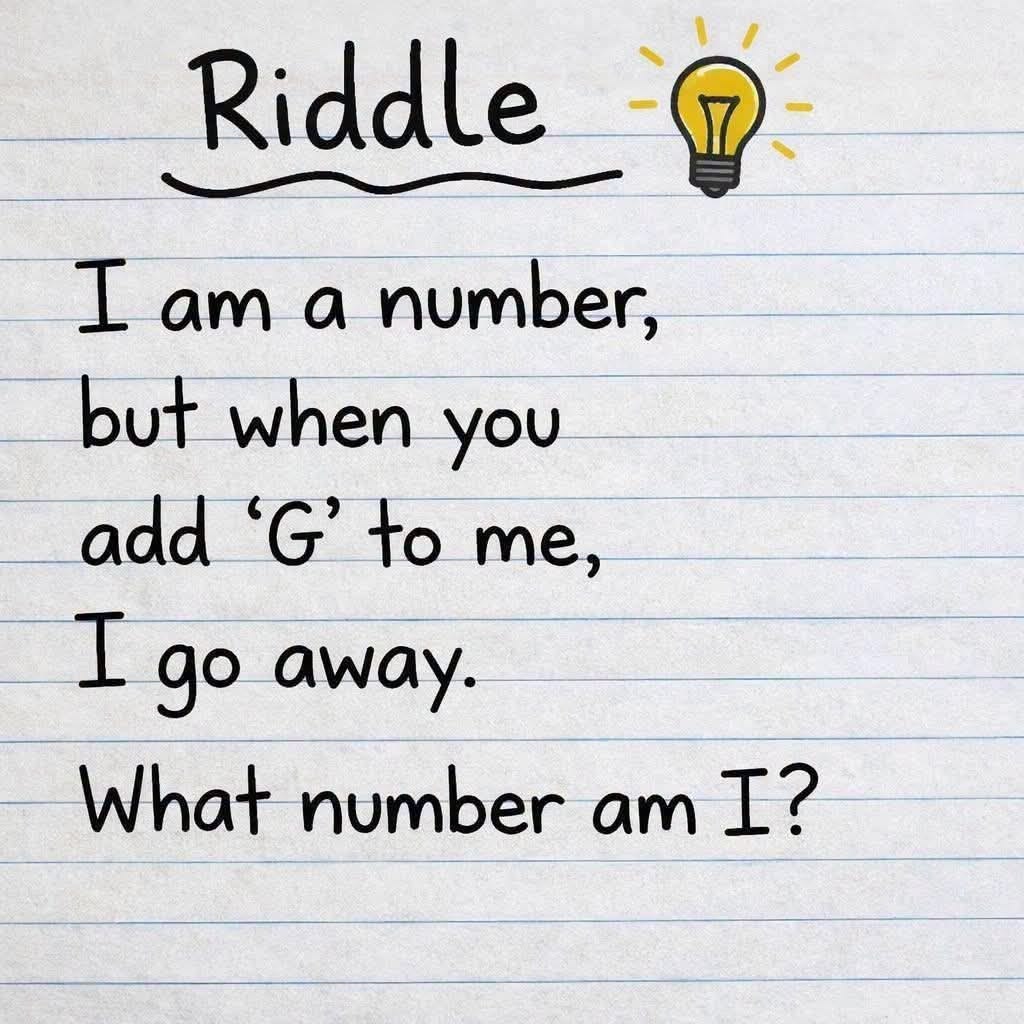
A widely shared graphic written on lined notepad paper with a lightbulb graphic asks:
“I am a number, but when you add ‘G’ to me, I go away. What number am I?”
While many solvers immediately try to solve this mathematically or look for abstract scientific symbols, the trick relies entirely on English word formation.
In this guide, we break down the wordplay logic, reveal the step-by-step transformation, and explain the exact answer to this viral riddle.
The Wordplay Logic Explained
The solution hinges on finding a standard English number name that transforms into a word meaning “to leave” or “to go away” simply by prefixing or suffixing the letter ‘G’.
                       [ RIDDLE WORD TRANSFORMATION ]
                                     |
      --------------------------------------------------------------
     |                                                              |
 [ BASE NUMBER ]             [ ADD THE LETTER 'G' ]        [ RESULTING WORD ]
 • ONE (Number 1)            • Add 'G' to the front        • G + ONE = GONE
 • Represents a number       • Simple prefix addition      • Means "departed" / "went away"
1. The Starting Number: ONE
The base number in question is ONE (1).
2. Adding the Letter ‘G’
When you take the word “ONE” and place the letter ‘G’ at the very beginning, it spells:
3. “I Go Away”
The word “GONE” is the past participle of “go,” directly describing something or someone that has left, vanished, or gone away—perfectly fulfilling the riddle’s clue.
Breakdown of Clues
| Riddle Clue | Wordplay Match | Meaning / Logic |
| “I am a number” | ONE | The cardinal number $1$ |
| “Add ‘G’ to me” | G + ONE | Appending the letter ‘G’ to the start |
| “I go away” | GONE | Definition: Departed, absent, or no longer present |
Conclusion
The correct answer to “I am a number, but when you add ‘G’ to me, I go away” is the number ONE (which becomes GONE).
Frequently Asked Questions (FAQ)
Why is the answer ONE and not another number?
When you add ‘G’ to “ONE”, you form the word “GONE,” which literally means “to go away.” No other number forms a synonym for leaving when ‘G’ is added.
What type of riddle is this?
This is a classic wordplay / spelling riddle that uses a mathematical decoy to distract the reader from basic anagrams and letter additions.