

Which Glass Has More Water? Archimedes’ Principle & Puzzle Solution Explained
Visual physics puzzles and logic teasers generate immense engagement across social media platforms like Facebook. By challenging viewers to apply Archimedes’ Principle of volume displacement to everyday items, these brain teasers test both intuitive thinking and basic scientific reasoning.
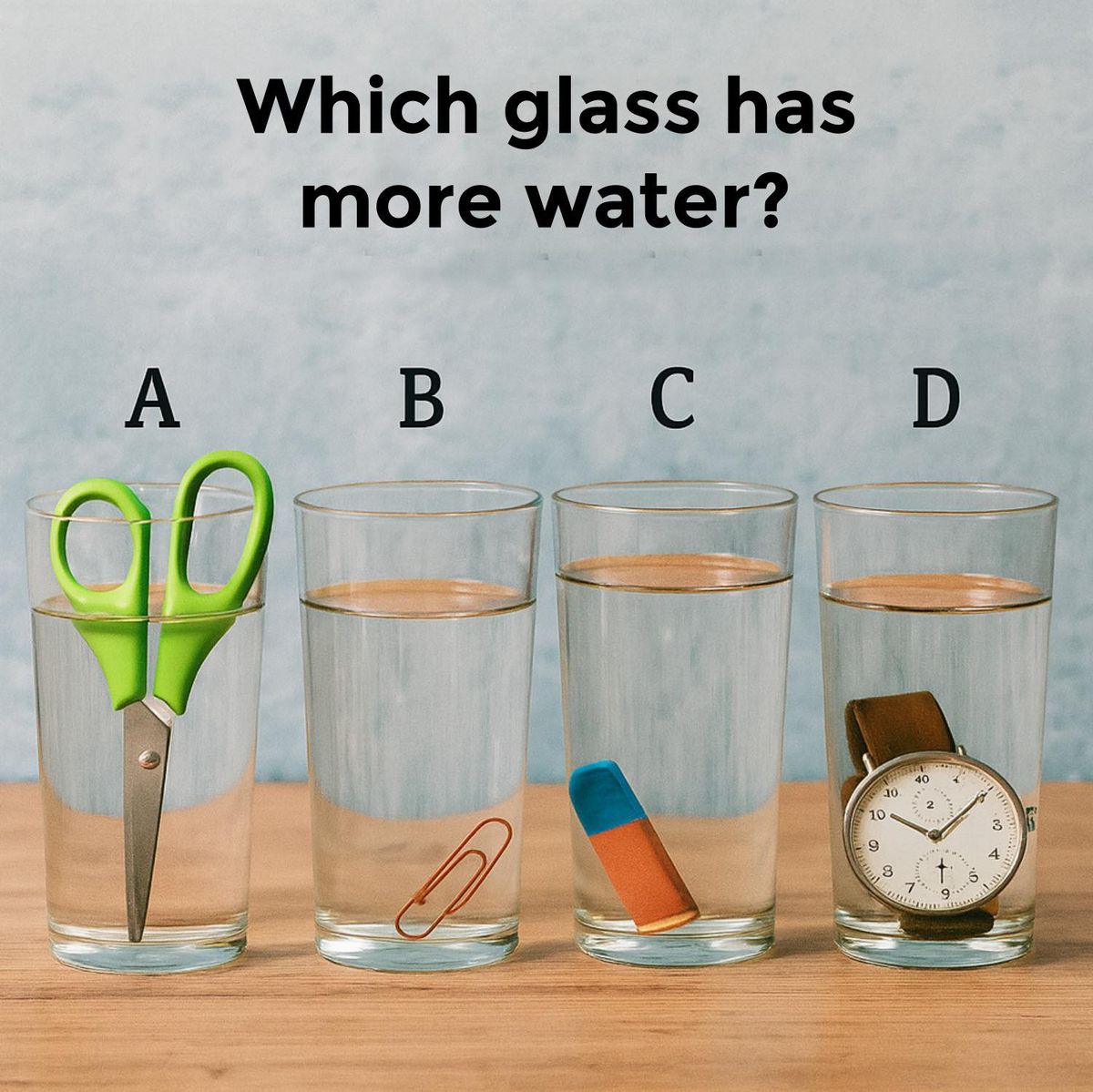
A popular physics puzzle presents four identical glass tumblers filled to nearly the same visual height, each holding a different submerged object:
“Which glass has more water?”
Glass A: Scissors
Glass B: Paperclip
Glass C: Eraser
Glass D: Wristwatch
While all four glasses appear to hold the same total volume of contents (water plus object), the key to solving the riddle lies in understanding volume displacement.
In this guide, we break down Archimedes’ Principle step-by-step to reveal which glass contains the maximum actual volume of water.
Breakdown of Volume Displacement
According to Archimedes’ Principle, an object submerged in liquid displaces a volume of fluid equal to the physical volume of the object itself.
                      [ VOLUME DISPLACEMENT FORMULA ]
                                     |
      --------------------------------------------------------------
     |                                                              |
 [ TOTAL VISUAL VOLUME ]                                 [ ACTUAL WATER VOLUME ]
 • Total Level = Water + Object Volume                   • Actual Water = Total Level - Object Volume
 • Equal apparent water line in all glasses               • Smallest Object Volume = Most Actual Water
To find which glass contains the most actual water, we must evaluate the physical volume (space occupied) of each submerged item:
-
Glass A (Scissors): Substantial size and metallic/plastic mass, displacing a large volume of water.
-
Glass D (Wristwatch): Heavy casing, face, and leather strap, occupying a very large physical volume.
-
Glass C (Eraser): Solid rectangular block taking up moderate space.
-
Glass B (Paperclip): Extremely thin wire construction occupying the smallest physical volume of all four objects.
Since the total visual level in all glasses is equal:
Because the paperclip in Glass B takes up the least space, the least amount of water was displaced to reach that line. Consequently, removing the paperclip leaves behind the highest volume of actual liquid!
Object Volume & Water Ranking Table
| Glass | Submerged Item | Object Volume / Space Occupied | Actual Water Volume | Ranking (Most to Least Water) |
| B | Paperclip | Smallest (Minimal Displacement) | Highest | 1st (Most Water) |
| C | Eraser | Moderate | Medium-High | 2nd |
| A | Scissors | Large | Medium-Low | 3rd |
| D | Wristwatch | Largest (Maximum Displacement) | Lowest | 4th (Least Water) |
Conclusion
The correct answer is Glass B. Because the paperclip occupies the smallest physical volume of any item shown, Glass B contains the most actual water.
Frequently Asked Questions (FAQ)
Why is Glass B the correct answer?
All glasses show roughly the same total liquid line. Since the paperclip in Glass B takes up the smallest volume, less water is displaced by the object, meaning Glass B contains the most actual water.
What scientific law explains this puzzle?
This puzzle demonstrates Archimedes’ Principle of displacement, which states that any object submerged in a fluid displaces a volume of fluid equal to its own volume.