

Which Is Heaviest? Ice vs. Water vs. Salt Science Puzzle Explained
Science brain teasers and density riddles perform exceptionally well on social media because they challenge everyday assumptions and spark debate. By asking readers to compare equal volumes of common substances, these posts encourage quick critical thinking.
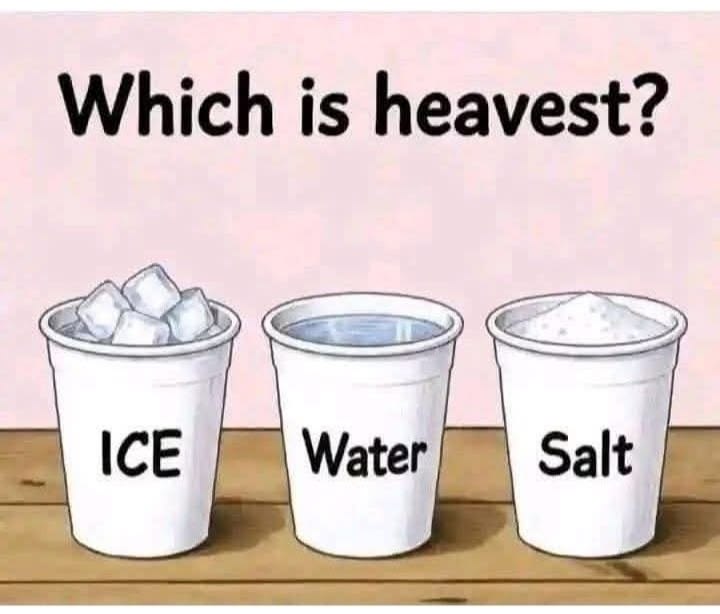
A popular viral image shows three identical cups labeled with different contents:
“Which is heaviest?”
1. Ice (Cup filled with ice cubes)
2. Water (Cup filled with liquid water)
3. Salt (Cup filled with fine table salt)
While ice and water are often mistaken to weigh the same, evaluating the bulk density and mass of each cup reveals that Salt is decisively the heaviest.
In this guide, we break down the scientific reasoning, compare the density of each material, and explain why each cup weighs what it does.
Scientific Density Breakdown
To determine which cup is heaviest, we compare the density ($\text{g/cm}^3$) and packing factor of each substance assuming equal cup volume:
                          [ DENSITY COMPARISON ]
                                    |
      --------------------------------------------------------------
     |                              |                               |
  [ ICE CUBES ]               [ LIQUID WATER ]               [ TABLE SALT ]
 • Density: ~0.92 g/cm³       • Density: 1.00 g/cm³       • Bulk Density: ~1.2 g/cm³
 • High air gap volume        • Solid liquid volume       • Solid chemical (NaCl)
1. Ice (Lightest)
-
Density: Pure ice has a density of approximately $0.917\text{ g/cm}^3$.
-
Air Gaps: Ice cubes stacked in a cup leave significant empty air gaps between the solid pieces, lowering the total mass contained in the cup even further.
2. Water (Middle)
-
Density: Liquid water has a density of $1.00\text{ g/cm}^3$ at room temperature.
-
Volume Fill: Liquid fills 100% of the cup’s interior volume without air pockets, making a full cup of water significantly heavier than a full cup of ice cubes.
3. Salt (Heaviest)
-
Density: Table salt (Sodium Chloride, NaCl) has a solid crystal density of about $2.16\text{ g/cm}^3$.
-
Bulk Density: Even when accounting for small air spaces between fine salt grains, the bulk density of table salt remains roughly $1.2\text{ to }1.3\text{ g/cm}^3$.
-
Added Fill: The salt cup in the graphic is also heaped slightly above the rim, increasing its total mass.
Substance Comparison Table
| Cup Content | Physical State | Approximate Density | Air Gap Impact | Overall Weight Ranking |
| Ice | Solid Cubes | $\approx 0.92\text{ g/cm}^3$ | High (large gaps between cubes) | 3rd (Lightest) |
| Water | Liquid | $1.00\text{ g/cm}^3$ | None (100% liquid fill) | 2nd |
| Salt | Granular Solid | $\approx 1.20\text{–}1.30\text{ g/cm}^3$ (Bulk) | Low (tightly packed granules) | 1st (Heaviest) |
Why Ice Floats & Salt Sinks
This simple experiment directly connects to real-world physical laws:
-
Water Expands When Freezing: As liquid water freezes into ice, its molecular structure expands into a crystalline lattice, making solid ice less dense than liquid water ($0.92\text{ g/cm}^3$ vs $1.00\text{ g/cm}^3$). This is why ice floats in water.
-
Salt Density: Table salt consists of sodium and chlorine ions tightly bound together, making it inherently denser than water molecules. When placed in water, salt sinks and dissolves.
Conclusion
The answer to “Which is heaviest?” is clearly Salt. Salt has both the highest material density and tightest granular packing, giving its cup the greatest total mass compared to water and ice.
Frequently Asked Questions (FAQ)
Why is a cup of ice lighter than a cup of water?
Water expands when it freezes, which reduces its density. Additionally, stacked ice cubes leave large air pockets inside the cup, resulting in less total mass than a cup completely filled with liquid water.
Does salt dissolve in water because it is denser?
Dissolving is a chemical process involving water molecules separating sodium and chlorine ions. However, salt’s higher density ($2.16\text{ g/cm}^3$) causes it to sink to the bottom before dissolving.