

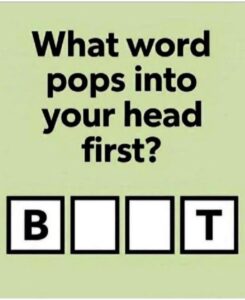
What Word Pops Into Your Head First? The B _ _ T Word Puzzle Solved
Fill-in-the-blank word games and subconscious association tests are wildly popular across social media. They spark vibrant engagement because they play on priming, cognitive bias, and personal vocabulary habits—showing how different minds complete the exact same incomplete visual cue.
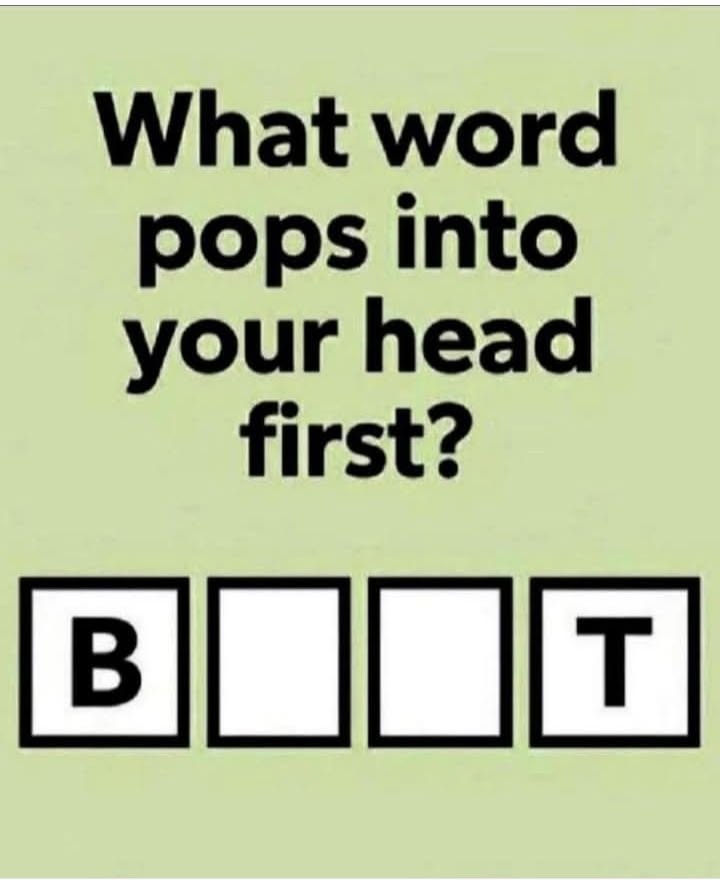
A widely shared brain teaser presents four letter boxes on a soft green background under a straightforward question:
“What word pops into your head first?”
[ B ] [ _ ] [ _ ] [ T ]
Because the pattern specifies only four letters beginning with B and ending with T, there are dozens of valid English dictionary words that fit the frame. However, certain common everyday words tend to dominate initial subconscious responses.
In this guide, we break down the most common words generated by this puzzle, explore the cognitive psychology behind word association, and provide a comprehensive word bank solution.
Deconstructing the Puzzle: Top Subconscious Word Association
When presented with B _ _ T, most people immediately think of one of a handful of high-frequency 4-letter English words:
                    [ WORD COMPLETION FREQUENCY ]
                                  |
      -------------------------------------------------------------
     |                  |                 |                        |
  [ BOAT ]           [ BEAT ]          [ BEST ]                 [ BOOT ]
  • Transportation   • Music / Rhythm  • Excellence / Rating    • Footwear / Trunk
  • Double Vowels    • Double Vowels   • Consonant + T          • Double Vowels
1. BOAT (Vowels: O, A)
One of the most common visual completions. The sequence B-O-A-T is learned very early in reading development, making it a primary structural match for the B _ _ T framework.
2. BEAT (Vowels: E, A)
Associated with music, heartbeats, or victory. The E-A vowel combination is a natural linguistic bridge between B and T.
3. BEST (Vowels/Consonants: E, S)
Unlike vowel-vowel completions, B-E-S-T utilizes a consonant cluster before the final T. Because “best” is among the most frequently spoken words in daily life, it often bypasses structural rules and pops into mind instantly.
4. BOOT (Vowels: O, O)
A classic concrete noun referring to footwear (or the trunk of a car in British English). Double-letter fills like O-O are mentally satisfying to complete.
Comprehensive Word Bank Solution Table
Here is a breakdown of valid English words that satisfy the B _ _ T template:
| Category | Words | Vowels / Letters Used | Context / Usage |
| High Frequency (Nouns) | BOAT, BOOT, BAIT, BENT, BEET | O-A, O-O, A-I, E-N, E-E | Vehicles, footwear, fishing, geometry, vegetables |
| High Frequency (Verbs/Adj) | BEAT, BEST, BLYT | E-A, E-S | Rhythm/defeat, top-tier quality |
| Historical / Niche | BRUT, BUST, BATT | R-U, U-S, A-T | Dry champagne/raw, sculpture/break, batting |
The Psychology of Word Association Puzzles
Why do people get different answers, and why does everyone feel convinced their word is the most obvious?
-
Semantic Priming: What you were reading or doing right before seeing the image heavily influences your choice. If you were listening to music, BEAT might pop up. If you were getting dressed, BOOT might take precedence.
-
Frequency Heuristic: The human brain is a prediction engine. It defaults to the highest-frequency words stored in its lexical memory bank to fill in missing visual information with minimum mental effort.
Conclusion
There is no single “correct” answer to “What word pops into your head first?”—whether you saw BOAT, BEAT, BEST, or BOOT, every valid completion highlights how uniquely your brain navigates language and pattern recognition!
Frequently Asked Questions (FAQ)
What are the most common answers for the B _ _ T puzzle?
The most frequent answers are BOAT, BEAT, BEST, BOOT, and BAIT.
Is there a single correct answer to this riddle?
No, this is an open-ended psychological word-association teaser rather than a single-answer riddle. Any valid 4-letter English word starting with B and ending with T is a valid solution.