

I Had 6 Eggs, Broke 2, Fried 2, Ate 2: The Viral Riddle Solved
Riddles that involve simple math and cooking steps are a viral mainstay across social media. They spark spirited debates in comment sections because people often interpret the sequence of events in completely different ways.
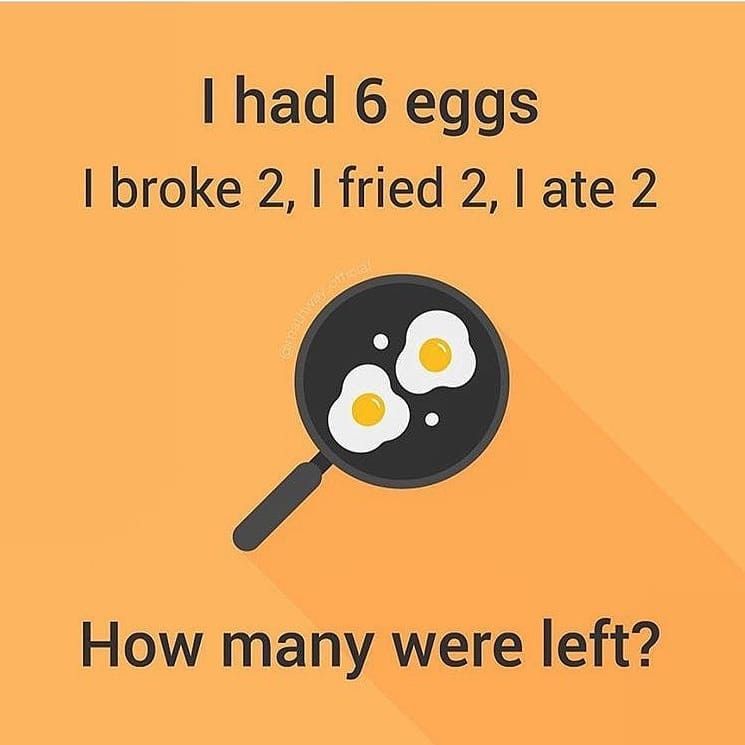
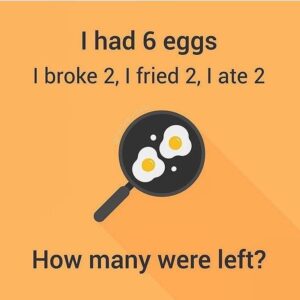
A classic viral riddle features a minimalist graphic of a frying pan with two eggs cooked sunny-side up and asks:
“I had 6 eggs”
“I broke 2, I fried 2, I ate 2”
“How many were left?”
At first glance, it feels like a standard subtraction problem ($6 – 2 – 2 – 2 = 0$). However, when you analyze the natural process of preparing breakfast, you quickly realize that the three actions describe the exact same two eggs.
In this guide, we break down the sequential logic behind the puzzle, explain the math, and provide the definitive solution.
Deconstructing the Riddle: Sequential Cooking Logic
The key to cracking this riddle is understanding that breaking, frying, and eating are not independent actions performed on separate pairs of eggs—they describe a chronological process applied to the same pair of eggs.
                   [ EGG PREPARATION TIMELINE ]
                                 |
      -------------------------------------------------------
     |                           |                           |
 [ STEP 1: BREAK ]          [ STEP 2: FRY ]             [ STEP 3: EAT ]
 • Cracked open 2 eggs      • Cooked those 2 eggs       • Consumed those 2 eggs
 • (4 uncracked remaining)  • (4 uncracked remaining)   • (4 whole eggs remaining)
1. “I broke 2”
You start with 6 eggs. To cook eggs, you must first break their shells. You crack open 2 eggs, leaving 4 untouched, whole eggs.
2. “I fried 2”
Next, you fry the 2 eggs you just broke open into the pan. You still have 4 untouched, whole eggs sitting on the counter.
3. “I ate 2”
Finally, you eat the 2 eggs you broke and fried.
Mathematical & Logical Breakdown
To see how the numbers work out, we can track both consumed eggs and remaining whole/raw eggs:
| Category | Start Count | Action Taken | Final Count |
| Eggs Processed (Broken, Fried, Eaten) | 0 | Cracked, cooked, and consumed 2 | 2 |
| Eggs Remaining (Whole & Uncooked) | 6 | Subtract the 2 processed eggs | 4 |
Alternative Interpretations & Edge Cases
While 4 is the universally accepted answer to this classic riddle, commenters often debate alternative interpretations based on word phrasing:
-
The Literal Process Answer (4 Eggs): You broke, fried, and ate the same 2 eggs, leaving 4 whole, uncracked eggs remaining.
-
The Literal Subtraction Answer (0 Eggs): If you treat “broke 2,” “fried 2,” and “ate 2” as 6 distinct eggs ($2 + 2 + 2 = 6$), then $6 – 6 = \mathbf{0}$ eggs left. (Note: This ignores basic cooking logic, as you wouldn’t fry or eat unopened, unbroken eggs!)
-
The Past Tense “Had” Trick (0 Eggs): Some argue that saying “I had 6 eggs” implies you no longer have any left at all.
Conclusion
The logical answer to “I had 6 eggs…” is 4. You cracked 2 eggs, fried those same 2 eggs, and ate them—leaving 4 whole, uncracked eggs sitting untouched!
Frequently Asked Questions (FAQ)
What is the correct answer to the 6 eggs riddle?
The standard logical answer is 4 eggs.
Why is the answer 4 instead of 0?
Because you must break an egg before you fry it, and fry an egg before you eat it. The riddle describes three sequential steps performed on the same 2 eggs, not 6 separate eggs.