

Solve This Riddle: I Have No Doors, But I Have Keys… What Am I?
Riddles and wordplay teasers are among the most engaging mental challenges on social media. By leveraging everyday words with multiple meanings, riddles force the brain to rethink literal concepts and find the clever double meaning hiding in plain sight.
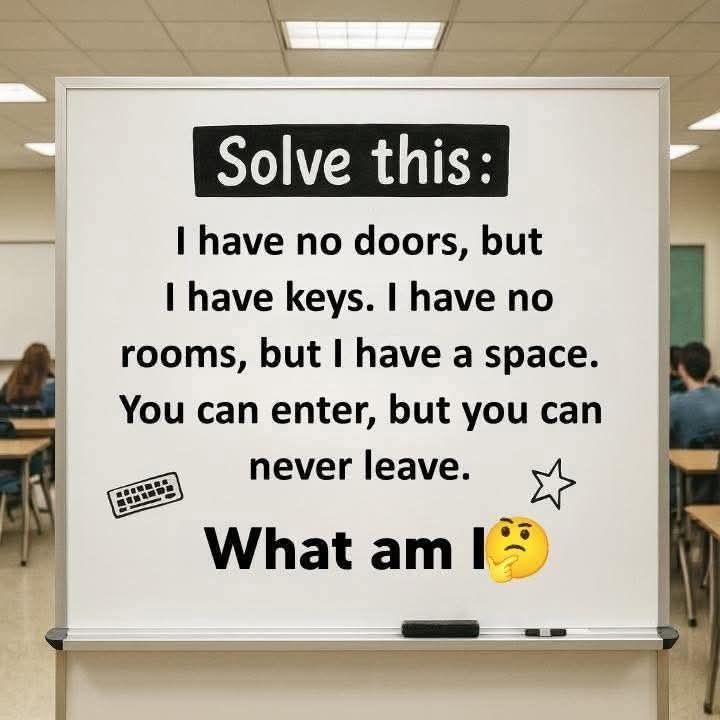
A popular riddle written across a classroom whiteboard presents the following clue:
“Solve this:”
“I have no doors, but I have keys.”
“I have no rooms, but I have a space.”
“You can enter, but you can never leave.”
“What am I?”
While words like “doors,” “rooms,” “keys,” and “enter” immediately prime the mind to think of a house, hotel, or building, the actual answer is a completely non-architectural, everyday tool.
In this guide, we break down the clever wordplay behind each line of the riddle and reveal the definitive answer.
Deconstructing the Clues: Double Meanings Explained
To solve this riddle, we must look at how each line uses terminology commonly associated with physical buildings to describe a piece of hardware:
                    [ DECODING THE KEYBOARD RIDDLE ]
                                   |
      -------------------------------------------------------------
     |                             |                               |
 [ "KEYS" ]                   [ "SPACE" ]                     [ "ENTER" ]
 • Not door locks             • Not physical living quarters   • Not walking into a room
 • Letter & number buttons    • The Spacebar key               • The Enter / Return key
1. “I have no doors, but I have keys”
Rather than keys used to unlock traditional doors or padlocks, these “keys” refer to the individual letter, number, symbol, and function buttons found on a typing surface.
2. “I have no rooms, but I have a space”
Rather than a physical room or living space, “space” refers to the long Spacebar key used to insert blank spaces between words during typing.
3. “You can enter, but you can never leave”
Rather than physically entering a building, you press the Enter key (or Return key) to submit a command or start a new line. However, because it is a physical object, there is no “Exit” or “Leave” key that allows a user to physically walk away from it.
Comparative Breakdown: Physical Building vs. Keyboard Wordplay
| Clue Phrase | Architectural Perception | Keyboard Reality |
| “Keys” | Metal instruments to open locked doors | Plastic input buttons (A–Z, 0–9, F-keys) |
| “Space” | An open room or area inside a house | The Spacebar key at the bottom |
| “Enter” | Walking through an doorway | Pressing the Enter/Return key |
| “Leave” | Exiting through a door | Non-existent; there is no “Leave” key |
The Answer
The correct answer to the riddle is a KEYBOARD (or Computer Keyboard).
(Note: A Piano is another common candidate for “keys” and “space,” but “Enter” uniquely pinpoints a computer keyboard!)
The Psychology of Double Meanings in Riddles
Why does this riddle trick so many people?
-
Semantic Framing: The combination of “doors,” “rooms,” and “enter” immediately frames the scenario around real estate or architecture.
-
Cognitive Flexibility: Solving the puzzle requires breaking free from the initial architectural mental frame and pivoting toward technology and typing terminology.
Conclusion
The whiteboard riddle “I have no doors, but I have keys” is a brilliant demonstration of linguistic misdirection. By cleverly repurposing technological terms as physical locations, it delivers a fun “aha!” moment once the answer clicks.
Frequently Asked Questions (FAQ)
What is the answer to the “I have no doors, but I have keys” riddle?
The correct answer is a Computer Keyboard.
Why is a piano not the primary answer?
While a piano has “keys” and requires “space,” it lacks an “Enter” function, making a computer keyboard the precise answer for all three clues.