

What Word Pops Into Your Head First? The Psychology of Word Completion Puzzles
Word puzzles, fill-in-the-blanks, and optical teasers are among the most highly engaging posts on social media. They trigger immediate participation because the human brain is hardwired for pattern recognition and closure. When presented with incomplete information, your mind instantly attempts to complete the set.
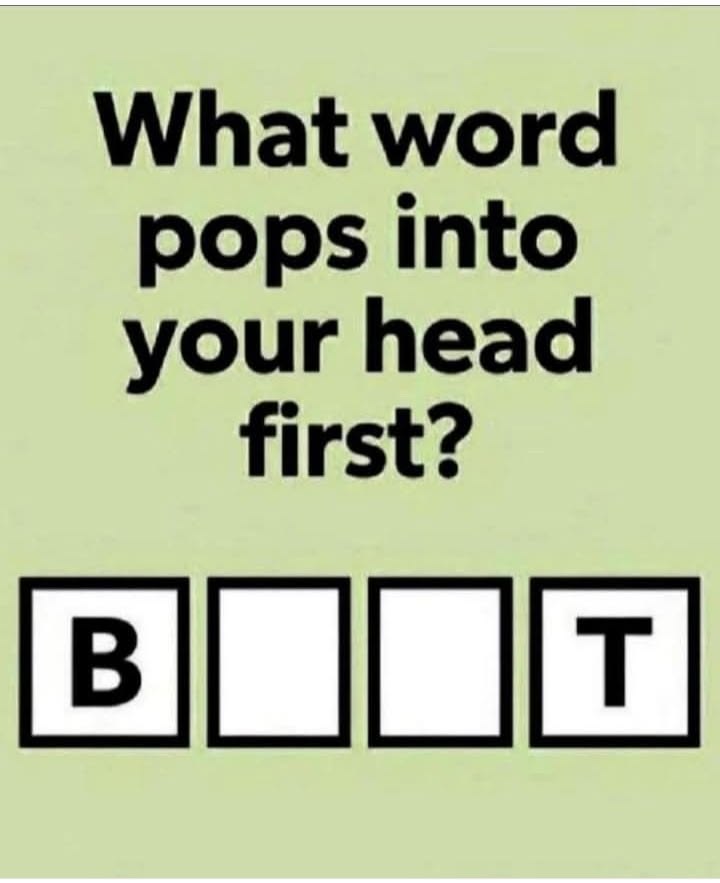
A popular word completion teaser challenges viewers on a muted sage-green background with a straightforward question:
“What word pops into your head first?”
[ B ] [ _ ] [ _ ] [ T ]
Given only the starting letter B and ending letter T, the brain must fill in two missing vowels or consonants in a 4-letter matrix.
In this guide, we break down the most common words generated by this puzzle, explore the cognitive psychology of semantic priming, and provide a comprehensive list of valid solutions.
Deconstructing the Puzzle: Common Brain Responses
What makes this visual prompt so effective at sparking debate in comment sections?
                    [ WORD COMPLETION MECHANISM ]
                                   |
      -------------------------------------------------------------
     |                             |                               |
 [ DAILY OBJECTS ]         [ ACTIONS & DESCRIPTIONS ]     [ SLANG & CASUAL ]
 • BOOT (Footwear)         • BEAT (Rhythm/Rhythm)         • BENT (Angle/Direction)
 • BOAT (Water vessel)     • BEST (Top tier)              • BUNT (Baseball play)
 • BAIT (Lure/Decoy)       • BOLT (Fastener/Dash)         • BUST (Statue/Break)
1. The High-Frequency Nouns (BOAT, BOOT, BAIT)
For most people, concrete, easy-to-visualize nouns like BOAT or BOOT jump to mind first. The double-vowel center (O-O or O-A) creates a natural structural fit for standard English spelling patterns.
2. The Superlatives and Actions (BEST, BEAT, BENT)
Others immediately associate the frame with abstract qualities or active verbs like BEST, BEAT, or BENT.
Complete Word Solution Matrix (B _ _ T)
Below is a breakdown of common English 4-letter words matching the pattern B _ _ T:
| Word | Part of Speech | Common Context / Meaning |
| BEST | Adjective / Noun | Of the highest quality or excellence |
| BOAT | Noun | A vessel designed for traveling across water |
| BOOT | Noun / Verb | Protective footwear; to restart a computer system |
| BEAT | Verb / Noun | To defeat; a recurring rhythm or pulse |
| BAIT | Noun / Verb | Food used to entice fish/animals; a decoy |
| BOLT | Noun / Verb | A metal fastener; to run away suddenly |
| BENT | Adjective / Verb | Curved or altered out of shape |
| BUST | Noun / Verb | A sculpted head/chest; a raid or failure |
| BUNT | Verb / Noun | A short hit in baseball |
| BLOT | Noun / Verb | A spot or stain; to dry liquid with paper |
The Psychology: Semantic Priming and Gestalt Principles
Why do different people see entirely different words first when viewing the exact same prompt?
1. Semantic Priming
Your current mental state, recent conversations, or environment strongly influence which word surfaces first. This cognitive phenomenon is known as semantic priming. If you recently went fishing, BAIT might appear instantly; if you’re working on tech, BOOT might take precedence.
2. Gestalt Law of Closure
The human brain dislikes incomplete structures. The Gestalt Principle of Closure explains that when presented with missing gaps, the mind automatically fills in the missing visual or textual data using subconscious memory banks to form a complete concept.
Conclusion
Whether your brain jumped to BOAT, BEST, BOOT, or BEAT, every response offers a quick glimpse into how your mind processes vocabulary and spatial completion.
Frequently Asked Questions (FAQ)
What is the purpose of the “B _ _ T” word puzzle?
It is a word completion teaser designed to test pattern recognition, vocabulary access, and subconscious mental associations (semantic priming).
How many valid 4-letter English words match the pattern B _ _ T?
There are over a dozen valid English words that fit this pattern, including BOAT, BOOT, BEST, BEAT, BAIT, BOLT, BENT, BUST, BUNT, and BLOT.