

The Price Paid for Procrastination: Why “Waiting to Be Ready” Is a Trap
Procrastination is often framed as simple laziness, but psychological research shows it is actually an emotional regulation issue. Many people delay starting new projects, launching businesses, or adopting healthier habits because they are waiting for an elusive feeling of total readiness, perfect timing, or zero uncertainty.
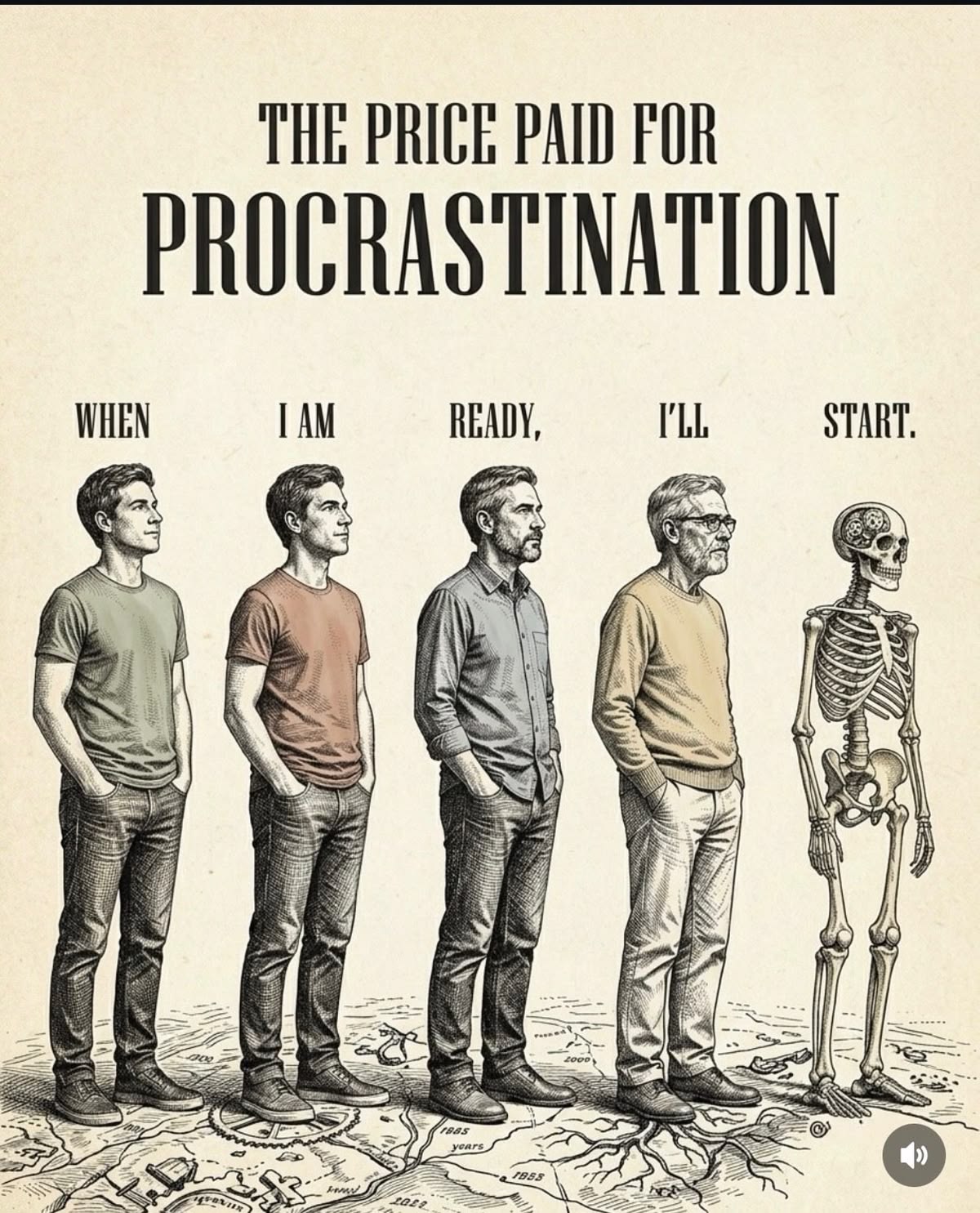
A striking viral illustration highlights the silent cost of this delay under a bold title:
“THE PRICE PAID FOR PROCRASTINATION”
Below the headline, five figures stand side-by-side in a timeline of aging, each paired with a word that spells out a common mental trap:
-
“WHEN” – A young man in his early 20s stands waiting, hands in his pockets.
-
“I AM” – The man enters his 30s, still waiting in the exact same stance.
-
“READY,” – Middle age arrives, with graying hair and beard, yet no action has been taken.
-
“I’LL” – An elderly man with glasses looks forward, still standing idle.
-
“START.” – A bare skeleton with exposed brain gears remains standing in place, representing a lifetime spent waiting for “readiness” until time ran out.
This stark visual commentary delivers a sobering message: if you wait until you feel 100% ready to start, you will wait your entire life.
In this guide, we break down the visual symbolism of this illustration, explore why the brain falls into the “readiness illusion,” and share actionable methods to break free from delay and start taking immediate action.
Deconstructing the Image: The Timeline of Inaction
What makes this illustration so compelling and thought-provoking across social media platforms?
                     [ THE TIMELINE OF DELAY ]
                                 |
      -------------------------------------------------------
     |                  |                  |                 |
 [ "WHEN" ]         [ "I AM" ]         [ "READY," ]      [ "I'LL START." ]
 • Early youth      • Adulthood        • Middle age      • Old age to skeleton
 • Hands in pockets • Static posture   • Graying hair    • Zero action taken
 • Waiting phase    • Continued delay  • Time slipping   • Opportunity lost
1. Static Posture Across Decades
Notice how every iteration of the man retains the exact same posture—standing upright with hands shoved in pockets, staring passively ahead. While his physical body ages, his state of action remains completely frozen. This visually demonstrates how procrastination isn’t a temporary delay; without intentional intervention, it becomes a permanent lifestyle.
2. The Gears in the Skeleton
The final stage shows a skeleton whose brain cavity is filled with mechanical gears. This subtle detail symbolizes overthinking and internal paralysis: spent entirely on planning, worrying, and mental calculation, but never translated into physical movement.
Comparative Breakdown: Waiting for Readiness vs. Starting Unready
| Dimension | Waiting to Be Ready | Starting Before You’re Ready |
| Mindset | Seeking perfection and certainty | Embracing iteration and growth |
| Emotional State | Anxiety, hidden guilt, regret | Courage, dynamic momentum, learning |
| Skill Building | Theoretical, passive knowledge | Practical, real-world experience |
| Time Horizon | Infinite delay (“Someday”) | Immediate execution (“Today”) |
The Psychology of the “Readiness Trap”
Why do so many capable people get caught in the cycle of perpetual waiting?
1. Perfectionism and Fear of Failure
Waiting to feel “ready” is often a protective shield against potential failure or judgment. As long as you are “getting ready,” you cannot be criticized or evaluated because you haven’t actually launched or submitted your work yet.
2. Misunderstanding Action and Motivation
Most people assume the sequence of progress works like this:
In reality, behavioural psychology demonstrates that action actually comes first:
Taking a tiny, imperfect step creates momentum, which in turn generates the feeling of readiness and confidence you were waiting for in the first place.
Practical Strategies to Break the Procrastination Cycle
-
Adopt the 5-Minute Rule: Commit to working on a task for just 5 minutes without caring about the quality. Once momentum is established, continuing is significantly easier.
-
Lower the Bar for “Version 1.0”: Expect your first attempt at anything to be messy. Give yourself explicit permission to produce a rough draft, a messy prototype, or a slow first run.
-
Replace “I Need To” With “I Choose To”: Reframe tasks from overwhelming obligations into active personal choices to reduce internal emotional resistance.
Conclusion
The visual warning of “When I am ready, I’ll start” serves as a powerful wake-up call. Perfection is a moving target, and perfect timing does not exist. The best time to start was yesterday—the second best time is right now.
Frequently Asked Questions (FAQ)
What is the main message behind “The Price Paid for Procrastination” image?
The image illustrates how waiting for perfect timing or complete readiness causes time to pass by without any real action being taken, ultimately leading to a lifetime of missed potential.
How can I stop overthinking and start taking action?
Focus on breaking big goals down into microscopic steps. Focus on taking a single 2-minute action rather than trying to figure out the entire project path at once.