

How Many Cats Did You Find? The Vintage Puzzle Solved
Hidden object games, visual search puzzles, and optical illusion illustrations have fascinated puzzle lovers for decades. Designed with atmospheric vintage artwork, these brain teasers challenge your observational skills, patience, and visual processing speed by blending subjects seamlessly into shadows and foliage.
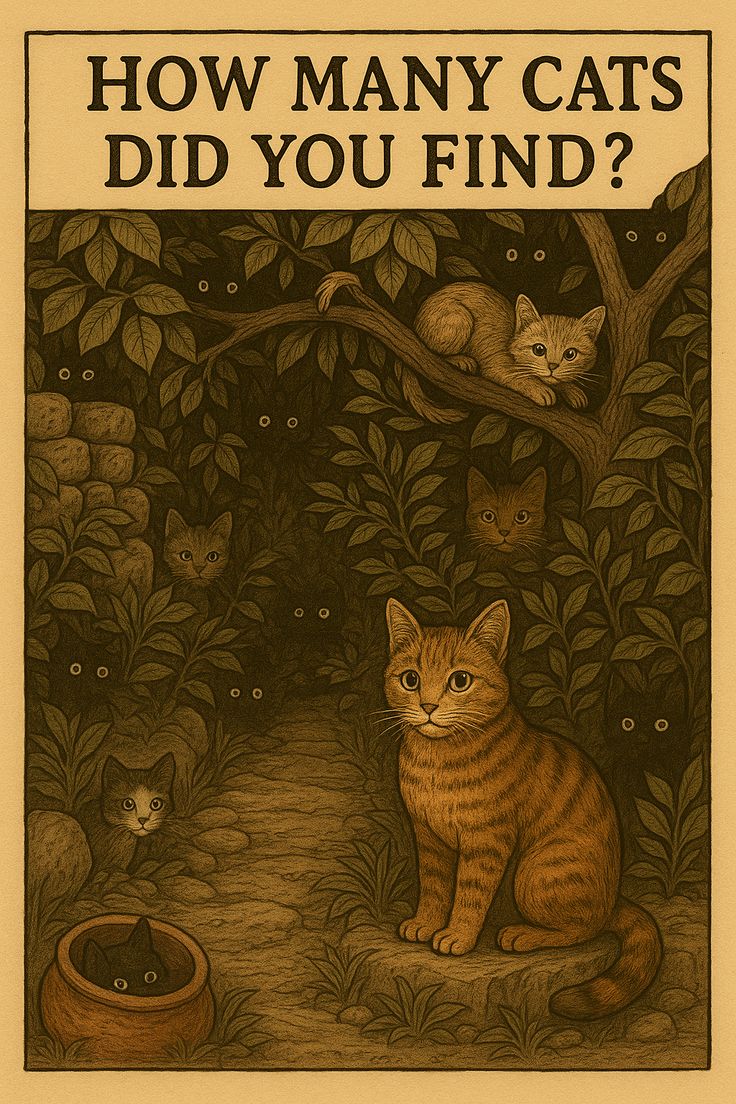
One widely shared vintage-style illustration presents a moody garden scene filled with trees, stone walls, and dense leaves under a direct challenge:
“HOW MANY CATS DID YOU FIND?”
While the large, fully visible tabby cat sitting prominently in the foreground captures your immediate attention, a closer look reveals dozens of glowing pairs of eyes and partially obscured felines lurking throughout the shadowy background.
In this full solution guide, we map out every visible and hidden cat location step-by-step, discuss effective visual search strategies, and reveal the true total count!
Deconstructing the Image: Locating Every Cat
To avoid missing any felines hidden in the shadows, let’s break down the illustration into distinct zones: the fully rendered visible cats, the partially hidden faces, and the glowing pairs of eyes lurking in the dark foliage.
       [ UPPER TREE CANOPY ]
    (Glowing Eyes in Shadow)
               |
 [ LEFT BUSHES ]   [ CENTER PATHWAY ]   [ RIGHT BRANCHES ]
 (Faint Faces &     (Prominent Tabby    (Branch Perch &
 Glowing Eyes)       & Pot Kitten)       Hidden Leaves)
1. Fully Rendered & Partially Visible Cats (6 Cats)
-
Foreground Tabby: The large, fully detailed orange-striped cat sitting on the path near the lower-right center.
-
Tree Branch Perch: A visible tabby cat curled up on the large horizontal branch in the upper-right section.
-
Pot Hider: A small cat peeking out from inside the clay pot in the lower-left corner.
-
Lower-Left Bush: A small cat’s face emerging from the rocks/leaves directly above the clay pot.
-
Mid-Left Foliage: A cat’s face peeking through the leaves on the middle-left side near the stone wall.
-
Mid-Right Bush: A faint cat face peering through the dense leaves behind the main foreground tabby.
2. Glowing Pairs of Eyes in the Shadows (8 Pairs)
Beyond the fully formed heads and bodies, the artist embedded glowing pairs of eyes hiding deep in the dark background shadows:
-
Upper Left (Leaves): 1 pair of eyes near the top-left foliage corner.
-
Mid-Upper Left (Stone Wall): 1 pair of eyes nestled just above the stone wall.
-
Lower-Left Foliage: 1 pair of eyes tucked low in the bushes.
-
Center Tunnel/Path: 2 distinct pairs of eyes lurking deep in the central dark archway.
-
Upper Right Canopy: 2 pairs of eyes hiding near the top-right tree branches.
-
Lower-Right Bush: 1 pair of eyes peeking out from the bottom-right shadow behind the main cat.
Breakdown Table of Found Cats
| Category | Locations | Count |
| Foreground / Main Cats | Main path (1), Tree branch (1), Clay pot (1) | 3 |
| Partially Hidden Faces | Lower-left rocks (1), Mid-left wall (1), Mid-right leaves (1) | 3 |
| Shadow Eyes (Hidden Felines) | Upper left (1), Wall (1), Lower left (1), Center path (2), Top right (2), Lower right (1) | 8 |
| GRAND TOTAL | All Categories Combined | 14 |
Cognitive Science Behind Hidden Object Puzzles
Why do visual search puzzles capture our focus so effectively?
1. Figure-Ground Perception
Our brain’s visual system constantly works to separate figures (objects of interest, like the main cat) from the ground (the background foliage and shadows). When an artist deliberately makes the background mirror the features of the object—such as using dark leaf cutouts to mimic glowing eyes—figure-ground perception is challenged, slowing down our processing time.
2. The Gamification of Pattern Matching
Finding hidden objects activates the brain’s reward centers. Every time you spot a pair of eyes that you previously overlooked, your brain receives a quick hit of satisfaction, keeping you engaged until every item is located.
Practical Tips for Solving Visual Search Puzzles
-
Grid Scanning: Break the image into four equal quadrants and search each section completely before moving to the next.
-
Adjust Screen Brightness: Increasing display brightness or zooming in on shadowy areas makes low-contrast details (like faint eyes) much easier to identify.
-
Focus on Specific Features: Instead of looking for an entire cat shape, search specifically for symmetry—such as paired circles (eyes) or triangular shapes (ears).
Conclusion
While casual viewers often stop counting around 5 or 6, a thorough inspection of the shadows reveals a grand total of 14 cats (including 8 pairs of hidden eyes lurking in the dark background).
Taking a few minutes for visual search challenges is a fantastic way to train your observation skills, stretch your working memory, and keep your vision sharp!
Frequently Asked Questions (FAQ)
What is the total number of cats in the image?
The grand total is 14 cats (6 clearly structured cats/faces + 8 hidden pairs of eyes in the shadows).
How many cats are clearly visible at first glance?
There are 3 main visible cats: the large tabby on the path, the cat on the tree branch, and the kitten inside the clay pot.
Where is the hardest hidden cat to find?
The pair of eyes tucked deep inside the center shadowy tunnel archway is often the easiest to miss due to low visual contrast.