

Can You Find The Mitsake? The Classic Brain Teaser Solved
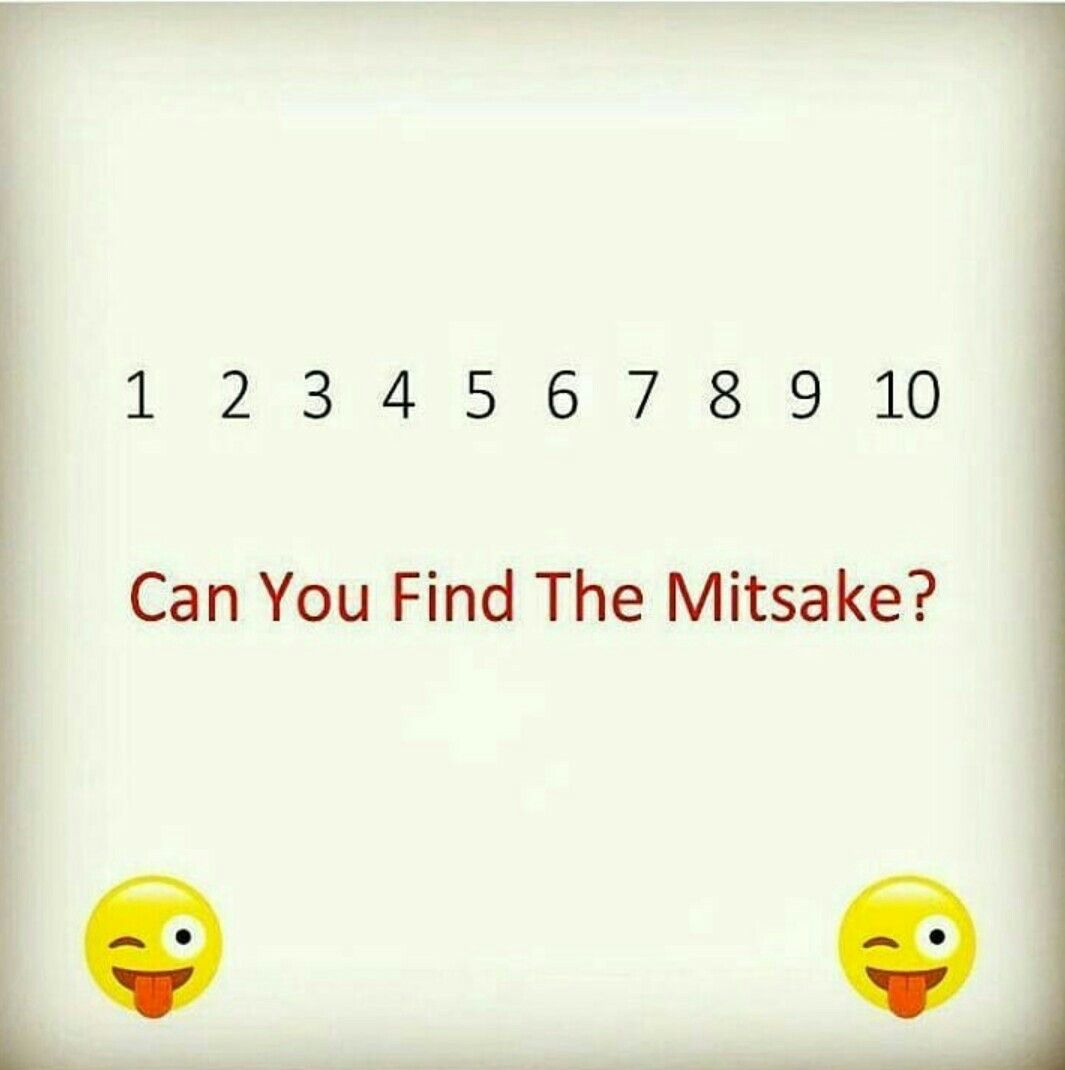
Mind games, word puzzles, and visual trick questions are a staple of social media entertainment. They challenge our attention to detail, spark lively debate in comment sections, and test how quickly our minds can catch subtle errors. One of the most famous and enduring visual brain teasers in this genre presents a simple line of numbers alongside a bold question:
“1 2 3 4 5 6 7 8 9 10”
“Can You Find The Mitsake?”
At first glance, most people immediately direct their visual focus toward the row of numbers, scanning back and forth from 1 to 10 to see if a digit was skipped, swapped, or repeated. However, the numbers are completely sequential and correct. The real error isn’t mathematical—it is a clever spelling mistake hidden right in plain sight within the prompt text itself.
In this full solution guide, we break down the trick, explore the cognitive science of why our eyes naturally overlook spelling errors, compare mental exercise techniques, and share tips to sharpen your daily proofreading and focus.
Deconstructing the Image: The Solution Revealed
If you spent minutes checking the numerical sequence without finding anything wrong, here is the exact breakdown:
The Real Error: A Misspelled Word
-
The Numbers (
1 2 3 4 5 6 7 8 9 10): Perfect and completely error-free. -
The Text (
Can You Find The Mitsake?): The word “Mistake” is misspelled as “Mitsake” (swapping the letter ‘s’ and ‘t’).
The Science of Perception: Why Your Brain Misses “Mitsake”
Why do so many people scan the numbers multiple times while completely glossing over the misspelled word? The answer lies in how our brains process written language and visual expectation.
1. Expectation Bias and Task Framing
When presented with a prominent row of numbers followed by a challenge to find an error, your brain assumes the challenge is numerical or mathematical. Because your visual cortex prioritizes scanning the primary subject (the numbers), it treats the sentence beneath as simple instruction text rather than part of the puzzle itself.
2. Typoglycemia and Pattern Processing
The human brain does not read words letter by letter; instead, it processes entire words as single visual units (orthographic processing). As long as the first and last letters of a word remain in place, and the internal letters are familiar, your brain automatically corrects the word in real-time. This cognitive shortcut enables fast reading comprehension, but it also creates a blind spot for typos like “Mitsake”.
Comparing Mental Exercise Types
Engaging in varied cognitive tasks keeps different areas of your brain active and adaptable. The table below compares common visual and text-based challenges:
| Puzzle Category | Key Neural Mechanism | Primary Cognitive Benefit |
| Spelling & Text Teasers | Language processing & proofreading focus | Improves detailed visual scanning and typographical accuracy |
| Numerical Sequences | Working memory & mathematical logic | Sharpens quantitative analysis and structured thinking |
| Hidden-Object Graphics | Figure-ground segregation & spatial perception | Enhances pattern recognition and visual attention |
| Logic & Lateral Thinking | Deductive reasoning & problem-solving | Encourages creative, out-of-the-box thinking |
Practical Tips to Improve Detail Orientation
Whether you are proofreading important documents, evaluating data, or solving fun online riddles, these techniques will help you spot hidden errors much faster:
1. Read Text Backward
When checking written work for spelling mistakes, read the sentence from right to left (word by word). This disrupts your brain’s natural tendency to auto-correct sentences and forces you to examine each word individually.
2. Question the Framing
When presented with a visual puzzle, don’t assume the trick is where the prompt directs your attention. Look at the title, captions, borders, punctuation, and background elements before focusing on the main image.
3. Take a Pause Before Answering
Resist the urge to rush through visual scanning. Taking three extra seconds to inspect every word letter-by-letter allows your conscious focus to catch what automatic pattern recognition missed.
Conclusion
The “Can You Find The Mitsake?” brain teaser is a classic example of how easily our expectations can trick our perception. By focusing all our attention on the correct numbers from 1 to 10, we effortlessly read past “Mitsake” without noticing the swapped letters.
Taking a quick moment for brain teasers like this is a fun, engaging way to challenge your observation skills, test your attention to detail, and keep your cognitive focus sharp!
Frequently Asked Questions (FAQ)
What is the mistake in “Can You Find The Mitsake”?
The mistake is the word “Mitsake”, which is misspelled. The correct spelling is “Mistake”.
Why is the word “Mitsake” so hard to notice?
Your brain automatically reads words as whole units rather than individual letters. Because “Mitsake” starts with ‘M’ and ends with ‘ake’, your mind automatically corrects it to “Mistake” while reading.
Are the numbers 1 through 10 correct?
Yes, the numbers 1 2 3 4 5 6 7 8 9 10 are completely correct and serve as a distraction from the misspelled word below.