

How Many Faces Can You See? The Hidden Profile Illusion Solved
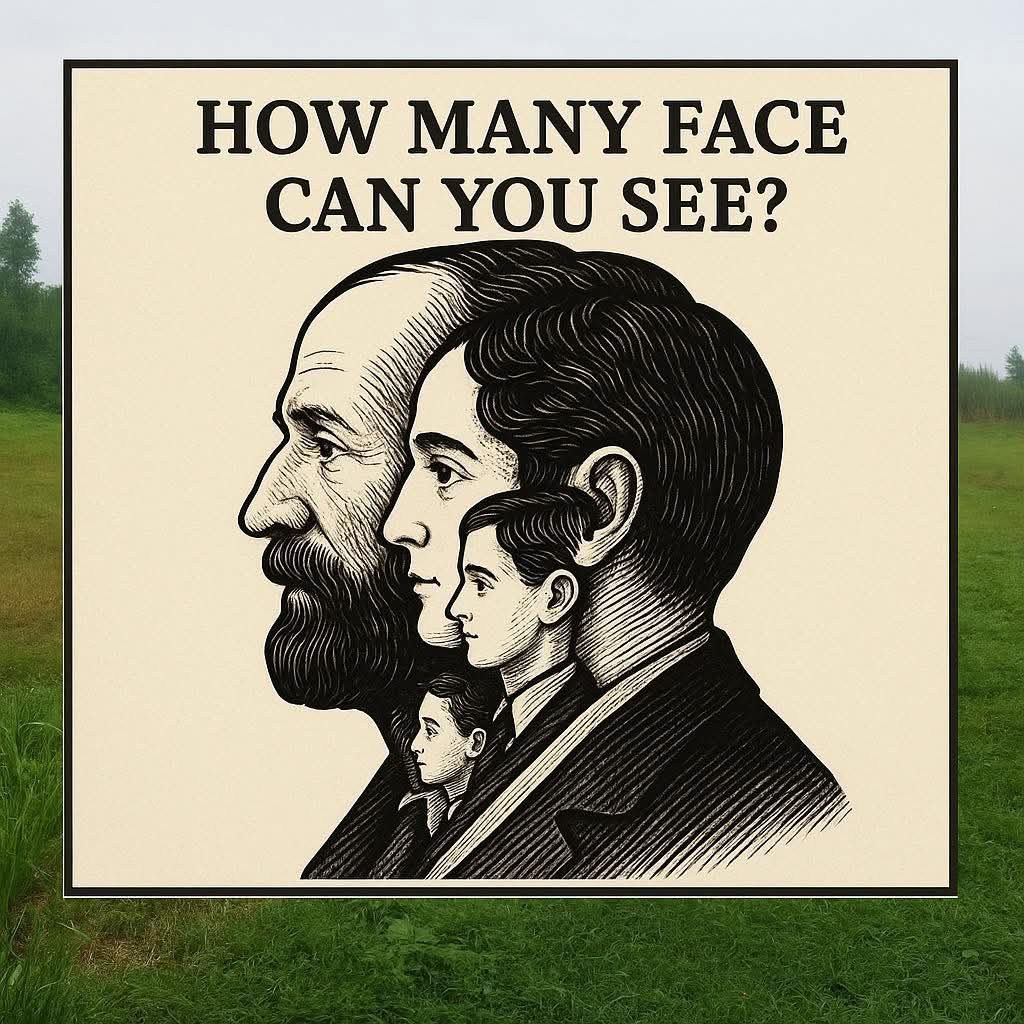
Visual illusions and optical puzzles have a unique ability to capture our imagination, challenge our focus, and stir lively debates across social media platforms. Simple yet clever black-and-white line art can transform a basic image into an intriguing mental workout. The popular visual puzzle titled “How Many Face Can You See?” features layered, profile silhouettes of men nested within one another, leaving viewers scanning back and forth to figure out exactly how many distinct faces are hidden in the illustration.
At first glance, your eyes naturally gravitate toward the largest, most prominent facial profile on the left side of the artwork. However, as you examine the inner contour lines and negative space, additional faces begin to reveal themselves, each tucked neatly inside the next. This artistic technique creates a fascinating visual cascade that reflects different generations of life—from an elderly gentleman to an adult man, a teenager, and a young child.
Whether you spotted all the faces right away or were left second-guessing your initial count, this comprehensive guide breaks down the complete visual answer, explores the neurological science behind face perception, and highlights how visual puzzles support cognitive health and lifelong mental sharpness.
Deconstructing the Image: The Complete Solution
To resolve the debate once and for all, let us carefully break down the artwork from the largest external profile down to the smallest internal silhouette. In total, there are 4 distinct faces hidden within this nested artwork.
1. Face 1: The Elder (Outer Left Profile)
-
Visual Characteristics: The largest and most obvious face positioned on the far left. It depicts an older gentleman with a prominent balding forehead, a defined nose, a full beard, and detailed facial lines indicating age and maturity.
-
Placement: Formulating the outer left boundary of the entire silhouette structure.
2. Face 2: The Adult Man (Middle-Upper Profile)
-
Visual Characteristics: Positioned immediately inside the beard and jawline of the first face. This profile shows a younger adult man with dark, wavy hair styled backward, clean-shaven features, and a focused gaze.
-
Placement: Nestled directly against the chest and inner jawline of the elderly figure, making up the middle section of the main illustration.
3. Face 3: The Youth (Middle-Lower Profile)
-
Visual Characteristics: Located below the chin of the adult man. This profile represents a younger male or teenager with smooth features, shorter hair, and a high collar visible near the neck.
-
Placement: Tucked into the frontal chest area of the second figure, facing the exact same leftward direction.
4. Face 4: The Young Boy (Innermost Lower Profile)
-
Visual Characteristics: The smallest profile in the entire graphic, depicting a young boy or child looking toward the left.
-
Placement: Nestled near the bottom center of the illustration, sitting directly beneath the chin of the third face along the suit lapel line.
The Science of Visual Perception: How Your Brain Sees Faces
Why do our minds find nested optical illusions so compelling, and why do different people spot hidden elements at varying speeds? The answer lies in the complex visual processing system of the human brain.
The Fusiform Face Area (FFA)
Humans possess a specialized neural region located in the visual cortex known as the Fusiform Face Area (FFA). From infancy, our brains are hardwired to prioritize human facial features above almost any other visual stimulus. This evolutionary adaptation helps us recognize family members, interpret emotional cues, and assess safety in our environment.
When presented with an image containing overlapping lines, the FFA immediately works to isolate facial contours, eyes, noses, and mouth shapes. Because the artist behind this puzzle used shared boundary lines—where the back of one head forms the profile edge of another—the brain must continuously shift between “figure” and “ground” to isolate each individual person.
Pareidolia and Contour Sharing
This graphic relies on two key perceptual phenomena:
-
Contour Sharing: The artist shares border lines across multiple shapes. The jaw of the elder becomes the outer frame for the adult man, and the collar of the adult man becomes the frame for the youth.
-
Pareidolia: The psychological tendency of the human mind to perceive familiar patterns (especially human faces) within abstract shapes or artistic line work.
Cognitive Benefits of Visual Puzzles and Brain Training
Engaging with optical illusions, riddle images, and hidden-object challenges is far more than just lighthearted entertainment. Regular mental stimulation plays a vital role in maintaining brain performance, spatial reasoning, and cognitive resilience throughout every stage of life.
1. Enhances Visual Processing and Focus
Scanning an artwork for subtle details forces your brain to practice selective attention. By training your mind to ignore broad overall shapes and concentrate on fine lines, you sharpen your visual processing speed and attention to detail.
2. Promotes Neuroplasticity
Neuroplasticity refers to the brain’s ability to reorganize itself by forming new neural connections. When you challenge your mind with new puzzles, pattern-recognition games, or logical problems, you encourage your neural network to stay adaptable and active.
3. Supports Mental Well-being and Stress Relief
Taking a few minutes out of a busy workday to solve a visual challenge provides a micro-break for your mind. Focusing intently on a creative puzzle allows you to reset, reducing mental fatigue and boosting mood through the release of dopamine when you successfully find the answer.
The Symbolic Meaning: Generations, Legacy, and Life Planning
Beyond its cognitive appeal, the visual structure of four nested male profiles carries a powerful symbolic theme: the progression of life across generations.
The imagery gracefully illustrates how grandfather, father, son, and grandson are interconnected within a single family tree. Each generation carries the legacy of the one before it while paving the way for the future.
Practical Lessons in Generational Planning
Just as the artwork demonstrates how closely generations are connected, real life requires thoughtful planning to support family members at every age:
-
Education and Youth Development: Investing early in quality education, mentorship, and health support ensures that children and young adults build a strong foundation for future success.
-
Family Protection and Health: Safeguarding your loved ones through comprehensive health management and financial protection guarantees peace of mind during unexpected life events.
-
Retirement and Asset Preservation: For older adults, establishing a solid retirement strategy, managing investment portfolios, and organizing legal affairs ensures that assets and wisdom are smoothly transferred to future generations.
Comparing Cognitive Health Practices
Maintaining peak mental clarity requires a well-rounded lifestyle approach. The table below outlines how visual puzzles compare to other popular brain-stimulating activities:
| Activity | Primary Cognitive Focus | Mental & Physical Benefit |
| Visual Illusions & Puzzles | Spatial perception & contour discrimination | Enhances visual detail recognition and focus |
| Sudoku & Logic Riddles | Deductive reasoning & working memory | Strengthens analytical problem-solving skills |
| Reading & Continuous Learning | Vocabulary acquisition & complex comprehension | Builds cognitive reserve and expands knowledge |
| Aerobic Physical Exercise | Cardiovascular health & cerebral blood flow | Stimulates brain-derived neurotrophic factor (BDNF) |
| Social & Family Engagement | Emotional intelligence & communication | Reduces cognitive decline and lowers stress |
Practical Tips to Improve Your Observation Skills
If you want to spot hidden details quickly in visual riddles and optical illusions, try applying these proven observation techniques:
-
Trace the Edges First: Instead of looking at the center of an image, trace the outer boundaries and inner shadow lines. Hidden shapes are almost always concealed along major structural lines.
-
Shift Your Viewing Distance: Move back from your screen or tilt your device slightly. Changing your focal distance alters how light and contrast hit your eyes, making hidden figures jump out.
-
Invert or Soften Your Focus: Slightly squinting your eyes reduces fine visual noise, allowing your brain to process the broader geometric shapes and hidden silhouettes more clearly.
-
Scan Methodically: Divide the illustration into four imaginary quadrants and examine each section from top to bottom, left to right, rather than scanning randomly.
Fascinating Facts About Human Vision and Visual Illusions
-
Rapid Recognition: The human brain can recognize an image of a human face in as little as 13 milliseconds.
-
Left-Side Bias: Research shows that people naturally tend to look at the left side of a face first when evaluating features or expressions.
-
Optical History: Artists have used nested profiles and hidden face techniques for centuries, dating back to classical Renaissance sketches and 19th-century trade card illustrations.
-
Brain Exercise Impact: Studies suggest that adults who regularly participate in word and number puzzles retain cognitive function equivalent to individuals ten years younger.
Conclusion
The “How Many Face Can You See?” visual puzzle is a brilliant demonstration of artistic design and human psychology. By layering four generations of male profiles—the elder, the adult man, the youth, and the young boy—into a single continuous outline, the illustration challenges our visual perception while celebrating the deep connections of family legacy.
Taking time to engage with brain teasers like this one offers a quick, rewarding way to sharpen your focus, test your observation skills, and give your mind a healthy daily workout.
Frequently Asked Questions (FAQ)
How many faces are hidden in this image?
There are exactly 4 faces hidden in the artwork, representing four different generations: an elderly man with a beard, an adult man with dark wavy hair, a youth, and a young child at the bottom.
Why do some people only see 2 or 3 faces at first?
The brain tends to focus on the largest, highest-contrast features first (the outer profile and the main center face). The two smaller faces at the bottom are nested inside inner line work, requiring closer selective attention to separate them from the surrounding shading.
Are visual puzzles good for keeping your brain sharp?
Yes! Regularly practicing visual puzzles, optical illusions, and memory games helps stimulate pattern recognition, improves visual-spatial awareness, and supports long-term cognitive health.