


The Lines of Life: Understanding Human Behavior and the Power of Choice
Human social behavior is often shaped by paths of least resistance. Judging others or engaging in idle chatter requires very little emotional energy, whereas actively helping someone demands effort, empathy, and personal initiative.
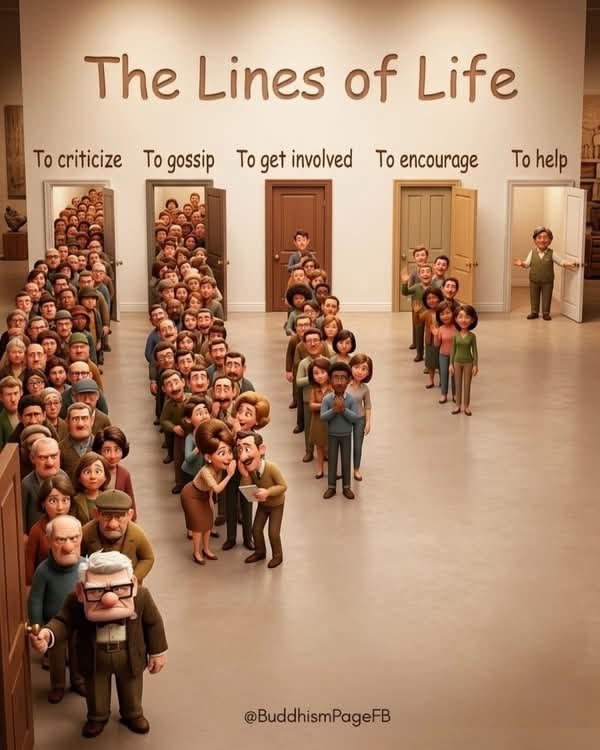
A compelling conceptual artwork titled “The Lines of Life” visually illustrates this human dynamic through five doors, each with wildly varying queue sizes:
-
To criticize: The longest, most packed line overflowing through the doorway.
-
To gossip: A dense, crowded line filled with people whispering to one another.
-
To get involved: A moderate queue of individuals stepping forward.
-
To encourage: A sparse group of smiling, supportive figures.
-
To help: An almost completely vacant room featuring only a single person standing near the open door.
Below, we examine why people naturally flock toward critical behaviors and explore actionable ways to shift our mindset toward constructive action!
Why Is the “Criticize” Line Always the Longest?
Psychology offers clear insights into why negative or passive social behaviors attract large crowds:
1. The Low Barrier to Entry
Criticizing and gossiping demand zero accountability, skill, or emotional vulnerability. It provides immediate social bonding over shared disapproval without requiring personal risk.
2. Superiority & Defense Mechanisms
Expressing judgment often acts as a projection of internal insecurity. Putting others down temporarily boosts one’s ego and creates a false sense of moral or social superiority.
3. The Energy of Action vs. Observation
-
Criticism & Gossip: Passive observation.
-
Encouragement & Helping: Active engagement requiring time, resources, and emotional investment.
Behavior Matrix: Path of Least Resistance vs. Purposeful Action
| Door / Path | Effort Level | Social Impact | Core Motivation |
| To criticize | Minimal | Negative / Destructive | Insecurity, projection, judgement |
| To gossip | Low | Splitting / Alienating | Boredom, superficial bonding |
| To get involved | Moderate | Neutral to Positive | Curiosity, civic duty |
| To encourage | High | Positive / Uplifting | Empathy, emotional maturity |
| To help | Highest | Transformative / Direct | Selflessness, active compassion |
3 Ways to Switch Lines in Daily Life
1. Pause Before Reacting
When tempted to point out a flaw or repeat a rumor, pause and ask: “Is this true? Is it necessary? Is it kind?” Simply withholding judgment shifts your mental habit away from the crowd.
2. Practice Active Encouragement
Make a conscious effort to praise someone’s hard work, validate a friend’s effort, or offer positive feedback. Encouragement acts as fuel for growth and builds lasting trust.
3. Move from Words to Service
Instead of discussing what should be done, take direct responsibility. Offering practical help—whether volunteering, supporting a colleague, or assisting a neighbor—moves you into the quietest, most impactful line.
Conclusion
The visual of “The Lines of Life” serves as a stark reminder of human nature, but our place in these queues is never permanent. Every day brings fresh opportunities to step out of the crowded lines of judgment and stand in the courageous, quiet line of service and support!
Frequently Asked Questions (FAQ)
How can I break the habit of joining in on workplace gossip?
Politely redirect the conversation by highlighting something positive about the subject, changing the topic, or stepping away gracefully without participating.
Why does giving encouragement feel more rewarding than criticizing?
Encouraging others triggers the release of oxytocin and dopamine in both the giver and receiver, fostering genuine human connection and long-term psychological well-being.