



The Law of Interconnectedness: Why Pulling Others Down Collapses Everyone
In work, relationships, and personal growth, it is easy to focus so heavily on rivalry or ego that we lose sight of shared dependencies. Sabotaging someone else often comes at a high personal cost, even if the harm isn’t immediately obvious.
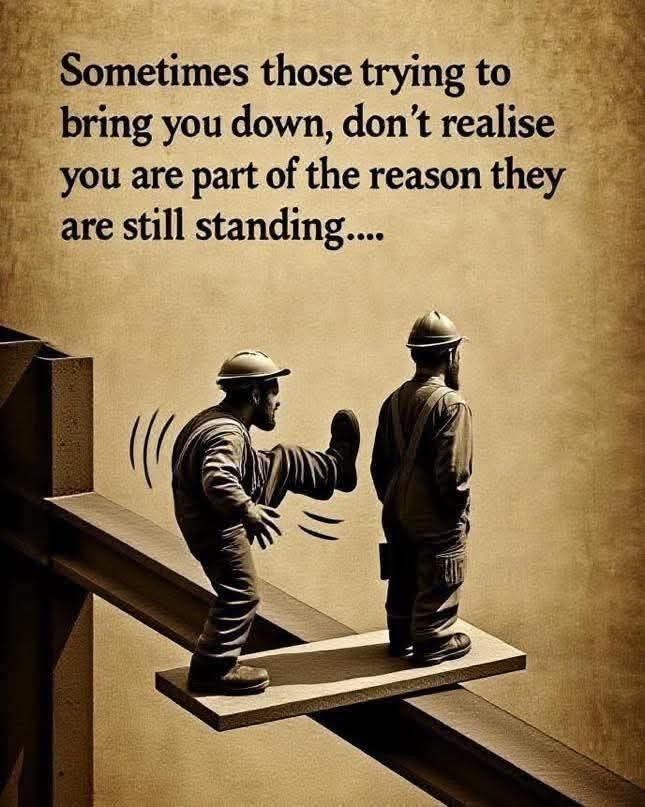
A striking conceptual illustration captures this exact lesson:
Two construction workers in hard hats stand high above ground on a wooden plank extending over a steel beam.
One worker prepares to kick the other off the plank into the abyss.
However, the worker about to be kicked acts as the counterweight holding the plank stable over the beam—meaning if he falls, the plank tilts, and the kicker falls with him.
Text above reads: “Sometimes those trying to bring you down, don’t realise you are part of the reason they are still standing….”
This visual serves as a vivid metaphor for how spite, jealousy, and lack of gratitude can lead to self-destruction.
Below, we examine the psychological trap of pulling others down, why gratitude protects our stability, and how to navigate toxic dynamics effectively!
The Physics of Emotional & Professional Interdependence
In mechanics, a lever system requires balance and counterweight to maintain equilibrium. Human ecosystems—like workplaces, families, and communities—function under identical principles:
-
The Shared Foundation: Both workers rely on the same plank and beam to stay elevated.
-
The Hidden Counterweight: The person being targeted provides the weight holding the plank secure.
-
The Self-Destructive Strike: By removing the counterweight out of malice or ego, the aggressor destroys their own footing.
Behavior Comparison Matrix
| Mindset / Action | Destructive Sabotage (Kicking) | Collaborative Growth (Supporting) |
| Primary Motivation | Envy, insecurity, need for control | Mutual respect, teamwork, long-term stability |
| Perceived Goal | Removing perceived competition | Strengthening the collective foundation |
| Actual Result | Sudden collapse of both parties | Shared success, security, and elevation |
| Long-Term Impact | Damaged trust and self-inflicted failure | Sustainable progress and strong relationships |
3 Lessons for Navigating Toxic Interdependence
1. Recognize Unseen Contributions
Before criticizing or undermining a peer, colleague, or partner, take a step back and consider what they bring to the table. Often, people handle invisible stresses, workloads, or emotional burdens that keep the entire structure stable.
2. Don’t React with Immediate Revenge
If you find yourself in the position of the worker being targeted, maintain your composure and anchor your position. Often, an aggressor’s own actions will reveal the flaw in their strategy without you needing to retaliate.
3. Build Solid, Grounded Platforms
Move away from precarious situations where your safety depends on unpredictable people. Seek out environments, workplace cultures, and friendships built on solid ground rather than shaky wooden planks.
Conclusion
Success is rarely a solo performance; it is a delicate balance of mutual support and shared foundations. Protect the people who help keep you standing, and never let short-sighted ego compromise your long-term stability!
Frequently Asked Questions (FAQ)
What is the “Crab Mentality” in psychology?
The “Crab Mentality” refers to a phrase derived from crabs trapped in a bucket—if one crab attempts to climb out, the others drag it back down rather than allowing it to escape, ensuring nobody succeeds.
How can I deal with a colleague who is trying to undermine me?
Focus on documenting your work clearly, maintaining professional standards, and communicating directly with leadership or HR. Often, letting your performance speak for itself allows self-destructive behavior from others to expose itself naturally.