


The 6 Eggs Riddle Solved: How Many Eggs Are Left?
Simple word problems and logic riddles frequently trend on social media because they trick our brains into overcomplicating basic math.
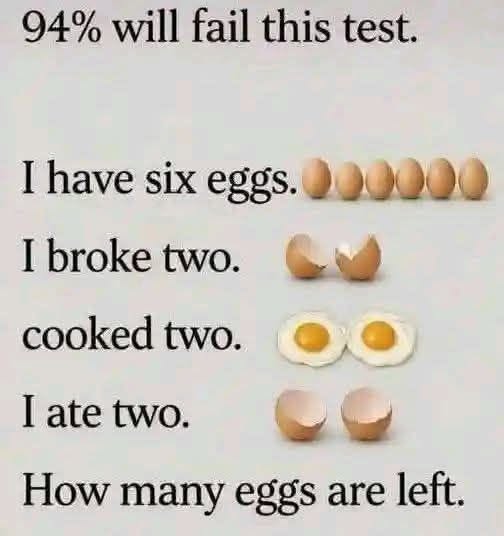
In this classic viral teaser, a picture of six eggs is presented alongside a short story:
“94% will fail this test.”
“I have six eggs.”
“I broke two.”
“Cooked two.”
“I ate two.”
“How many eggs are left.”
While quick guessers often say 0 after subtracting 2 three separate times ($6 – 2 – 2 – 2 = 0$), the true answer to the intended logic puzzle is 4!
Below, we break down the logic step-by-step to explain why.
The Step-by-Step Logic Breakdown
To solve the riddle correctly, you have to follow the chronological sequence of preparing a meal rather than treating each line as a brand-new set of eggs:
-
Initial Amount: You start with 6 intact eggs.
-
“I broke two”: You crack 2 eggs open to prepare them for cooking. (Remaining whole eggs: 4 | Cracked eggs: 2)
-
“Cooked two”: You cook those same 2 eggs that you just broke open.
-
“I ate two”: You eat those same 2 cooked eggs.
Riddle Breakdown Summary
| Action | Eggs Affected | Intact / Remaining Eggs | Status of the 2 Used Eggs |
| Start | 0 | 6 | Intact in carton |
| Broke 2 | 2 | 4 | Broken open for cooking |
| Cooked 2 | 2 (same pair) | 4 | Fried / Cooked |
| Ate 2 | 2 (same pair) | 4 | Consumed |
The Intended Answer is 4!
(You still have 4 whole, unused eggs remaining).
Why Do Most People Fail This Riddle?
The puzzle tricks the reader using two main linguistic traps:
-
Sequential vs. Cumulative Action: Viewers assume that breaking 2, cooking 2, and eating 2 are three separate actions performed on different pairs of eggs ($2 + 2 + 2 = 6$), which would leave zero eggs. In reality, these actions describe the sequential process of preparing one single pair of eggs!
-
Past vs. Present Tense: The riddle begins in the present tense (“I have 6 eggs”) and shifts to the past tense (“I broke… cooked… ate”). If the actions were already completed in the past, the present starting total of 6 whole eggs remains unaffected.
Alternative Interpretations
Depending on how strictly you define the phrase “How many eggs are left?”, there are two common ways people answer:
-
4 Unused / Intact Eggs (Standard Answer): 4 whole eggs remain in their shells ready to be cooked later.
-
0 Unprocessed Eggs: If the actions happened to 6 separate eggs consecutively, 0 would be left.
-
2 Shells Left: If asking strictly about physical remnants, you are left with 4 intact eggs and 2 empty eggshell pairs!
Conclusion
By realizing that breaking, cooking, and eating all refer to the exact same pair of eggs, the riddle straightforwardly leaves 4 whole eggs remaining!
Frequently Asked Questions (FAQ)
Is the answer 4 or 0?
The standard logical solution is 4, as breaking, cooking, and consuming are sequential steps taken on the same two eggs.
Why does the image show 4 empty shell halves?
The visual graphic shows 2 broken shell halves at the top and 2 broken shell halves at the bottom (representing the 2 cracked eggs), along with 2 cooked eggs in the middle and 6 intact eggs at the very top to illustrate the process!