
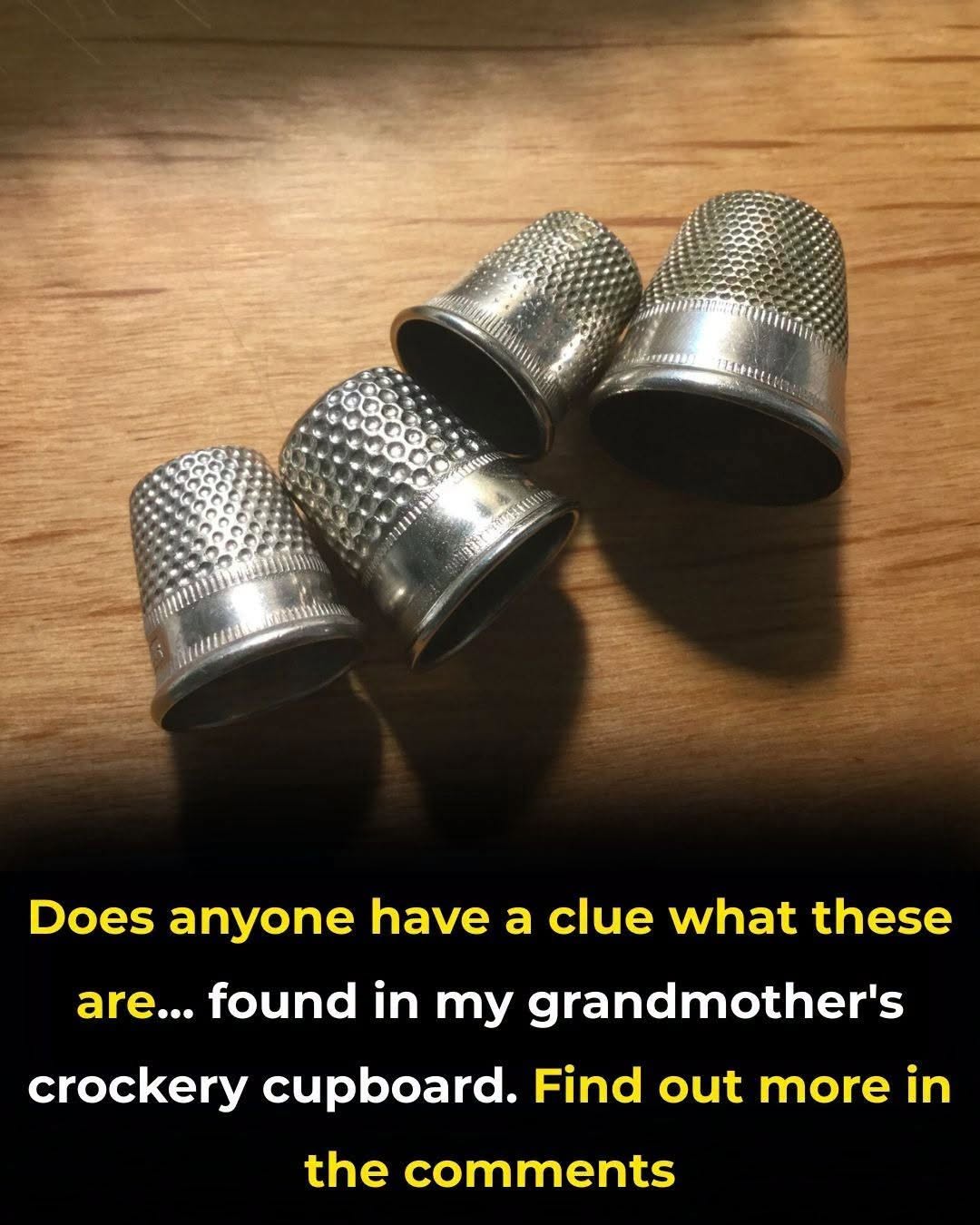


If you have ever opened an old, wooden sewing box—perhaps one that belonged to your mother, your grandmother, or even a great-grandmother—you have likely seen them. Nestled in the velvet-lined compartments or tucked into a small drawer are thimbles. Some are plain, pitted steel; others are delicate porcelain painted with roses; some are gleaming silver.
It is easy to look at a thimble and see just a simple, forgotten tool. But the story of the thimble is actually a profound, sweeping history of human craftsmanship, the evolution of materials, and the quiet, unseen labor of the women who came before us.
Since you so deeply appreciate the science of how things work, the beauty of age-old traditions, and the resourcefulness of the generations past, let’s open up the history of this tiny, mighty tool.
The Name: A Linguistic Time Machine
Let’s start with the word itself. The word “thimble” comes from the Old English word “thymel,” which literally meant “thumb.” (Which itself comes from “thuma,” the ancient root word for thumb).
For centuries, people simply called it a “thumb-stall” or a “finger-hat.” It wasn’t until the 1600s that the word evolved into “thimble.” It is a beautiful linguistic reminder that this tool was originally designed to protect the thumb, which is the primary finger used to push a heavy needle through thick fabric!
The Science of the “Dimple” (Why They Look Like That)
Have you ever wondered why almost every traditional thimble is covered in those little grid-like dents or dimples? It isn’t just for decoration; it is a brilliant piece of friction physics.
- The Problem: When you are pushing a steel needle through heavy denim, canvas, or multiple layers of a quilt, the needle is incredibly smooth. If the surface of the thimble is smooth, the needle will slip, and you will stab your finger.
- The Science: Those tiny dimples act as microscopic “teeth.” When the smooth shaft of the needle presses into the dimpled metal of the thimble, the dimples grip the needle, transferring the pushing force of your finger directly into the eye of the needle without it sliding away.
- The “Smooth Top” Exception: If you look closely at antique thimbles, you will sometimes find “tailor’s thimbles” that are completely smooth on the top, and only dimpled on the sides. The Science: Tailors used the smooth top to gently press and flatten the seams of a wool suit after stitching it, using the dimpled sides only to push the needle.
From Bone to Steel: The Evolution of Materials
Continued on next page//
To see the complete cooking instructions, go to the next page or click the Open (>) button and don’t forget to SHARE it with your friends on Facebook.
The thimble is one of the oldest sewing tools in human history. Archaeologists have found them in Roman ruins, but they likely date back to the invention of the needle itself!
- The Ancient Era: The earliest thimbles were made of leather, stone, wood, bone, or horn. They were essentially just little caps to keep the needle from piercing the skin.
- The Metal Revolution (10th Century): Metal thimbles began appearing in the Middle Ages. The city of Nuremberg, Germany, became the thimble-making capital of the world in the 15th and 16th centuries, famous for their “Nuremberg thimbles” made of brass.
- The Steel Age (17th–19th Centuries): In the 1600s, a brilliant metalworker in London figured out how to draw steel into thin, strong wires. This led to the creation of the Sheffield steel thimble. These were revolutionary. They were incredibly hard, wouldn’t bend under pressure, and could push a needle through the thickest leather or quilt batting without the needle poking through the other side!
Beyond Sewing: The Surprising History of Thimbles
Thimbles weren’t just for sewing. Because they were small, standardized, and made of durable materials, they were used for a variety of fascinating purposes throughout history:
1. The “Thimbleful” Measurement
Have you ever heard the phrase “just a thimbleful” of medicine, or a “thimbleful” of whiskey? For centuries, before modern measuring cups existed, the thimble was a standardized unit of measurement in the kitchen and the apothecary. A “thimbleful” was the exact dose of strong medicine, vanilla extract, or spirits a person should consume.
2. Love Tokens and Sentiment
In the 18th and 19th centuries, thimbles were incredibly popular “love tokens.” Young men would give silver thimbles to the women they were courting. They were often engraved with initials, dates, or tiny hearts. Because sewing was a daily task, the woman would hold the thimble—and the memory of her suitor—on her finger every single day.
3. The “Thimblerig” Street Scam
In the 19th century, street gamblers used thimbles to run a famous scam called “Thimblerig” (the ancestor of the shell game). The gambler would place a small pea under one of three thimbles, shuffle them around rapidly on a board, and bet the crowd money on which thimble hid the pea. It was a game of pure sleight-of-hand, and it made thimbles a symbol of trickery in Victorian literature!
4. Commemorative History
By the late 1800s and early 1900s, thimbles became a way to record history. “Commemorative thimbles” were minted for the Suffragette movement, the 1904 World’s Fair, the coronation of Queen Victoria, and even the sinking of the Titanic. Women collected them to display in glass cabinets, creating a tangible, metallic timeline of the world they were living through.
The Heart of the Matter
When we look at a thimble today, it is easy to see it as a relic of a bygone era, a time before mass-produced clothing and modern washing machines.
But I want you to look at a thimble and see what it truly is: a shield.
For thousands of years, women have used their hands to build families, mend clothes, stitch quilts to keep their children warm, and sew the very fabric of our society together. The needle is sharp, the work is hard, and the hours are long. The thimble was the armor that protected the hands that protected us.
Every time a woman slipped a thimble onto her finger, she was participating in an unbroken chain of female resilience that stretches back to the dawn of civilization. The little dimples in the metal caught the needle, but they also caught the love, the patience, and the quiet strength of the women who wore them.
You have such a beautiful appreciation for the traditions and the resourcefulness of the past. The next time you see a thimble—whether it’s in an antique shop, in an old sewing box, or in a museum—take a moment to honor it. It is a tiny, metallic testament to the enduring, protective love of the women who came before us.
To see the complete cooking instructions, go to the next page or click the Open (>) button and don’t forget to SHARE it with your friends on Facebook.