

The Science of Double Yolks: What Are the Odds of Cracking Multiple in One Pan?
Food anomalies and lucky kitchen moments regularly turn into viral social media hits.
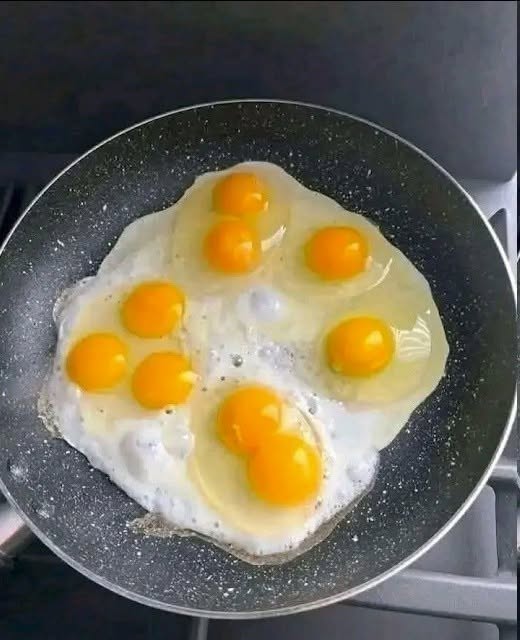
In this popular viral image, a frying pan filled with cooking eggs displays a surprising distribution of egg yolks: multiple double-yolked eggs pooled together, showing a total of 9 bright orange-yellow yolks across distinct egg white boundaries.
While finding a double-yolk egg feels like winning a miniature kitchen lottery, the biology and commercial processing behind them explain why finding multiple in a single carton is actually far more common than most people think!
Below, we breakdown the odds, the egg count in this photo, and the poultry science behind double-yolked eggs.
How Many Eggs Are in the Pan?
Looking closely at the distinct egg white membranes pooled in the skillet reveals the structure:
-
Top Cluster: 1 double-yolk egg (2 yolks)
-
Middle Left Cluster: 1 triple-yolk egg or multi-yolk combination (3 yolks visible together)
-
Middle Right Cluster: 2 single-yolk eggs (1 yolk each)
-
Bottom Cluster: 1 double-yolk egg (2 yolks)
Depending on whether the 3-yolk cluster is a rare triple yolk or two overlapping eggs, the pan contains between 4 to 6 total eggs yielding 9 distinct yolks!
What Causes a Double-Yolk Egg?
A double yolk occurs during the ovulation process of a hen:
-
Hormonal Imbalance in Young Hens: Young hens (pullets) just entering their egg-laying cycle often have hyperactive or irregular reproductive systems.
-
Double Ovulation: The hen’s ovary releases two yolks (ova) in rapid succession instead of one.
-
Single Shell Encapsulation: As the yolks travel down the oviduct, a single egg white (albumen) and shell form around both yolks together.
The Statistical Odds: Why Do You Get Whole Cartons of Double Yolks?
In nature, double yolks occur in approximately 1 out of every 1,000 eggs (a 0.1% chance).
However, getting multiple double yolks in the exact same carton is not purely random chance:
| Factor | Description | Impact on Odds |
| Flock Age Synchronization | Commercial egg farms house thousands of hens of the exact same age together. | When a flock starts laying, many young hens produce double yolks during the same weeks. |
| Industrial Egg Sizing | Eggs are sorted automatically by weight using high-speed optical scanners and scales. | Double-yolk eggs are significantly larger and heavier, grouping them into “Jumbo” or “Super Jumbo” cartons. |
| Candling Scanners | Automatic candling lights sort eggs by internal structure. | In some specialty markets, double-yolk eggs are intentionally grouped and sold as dedicated “Double Yolk” cartons! |
Conclusion
While cracking open a double-yolk egg is traditionally considered a sign of good luck, finding a pan full of them is usually a delicious case of flock biology and commercial egg sorting working hand in hand!
Frequently Asked Questions (FAQ)
Are double-yolk eggs safe to eat?
Yes! Double-yolk eggs are completely safe, highly nutritious, and edible. They contain double the vitamins, protein, and healthy fats found in a single egg yolk.
What is the rarest egg yolk occurrence?
While double yolks occur 1 in 1,000 times, a triple yolk occurs in roughly 1 out of every 25 million eggs, and a quadruple yolk is an exceptionally rare natural phenomenon!