

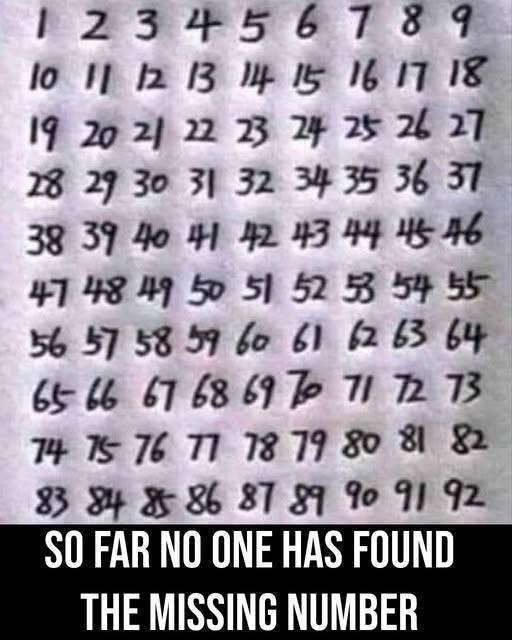


Brain Teaser: Can You Find the Missing Numbers in This Sequential Grid?
Number sequences and visual search puzzles are classic ways to challenge cognitive focus, visual scanning speed, and attention to detail.
In this viral mathematical visual puzzle, a grid of handwritten numbers appears to count sequentially from $1$ all the way to $92$. However, despite how orderly the rows look at a glance, a few numbers are skipped along the way!
Below, we reveal the missing numbers in this puzzle and break down why human eyes often glaze right over missing items in grid patterns.
Puzzle Solution: Which Numbers Are Missing?
When carefully checking row by row, you will find two missing numbers in the grid sequence:
1. The First Missing Number: 33
-
Location: Look at the 4th row (starting at 28).
-
The Sequence:
28, 29, 30, 31, 32, 34, 35, 36, 37 -
What’s Missing: The number 33 is omitted entirely between $32$ and $34$.
2. The Second Missing Number: 88
-
Location: Look at the 10th row (the bottom row, starting at 83).
-
The Sequence:
83, 84, 85, 86, 87, 89, 90, 91, 92 -
What’s Missing: The number 88 is omitted entirely between $87$ and $89$.
Number Grid Sequence Breakdown
| Row Range | Numbers Present in Row | Missing Number(s) |
| Row 1 (1–9) | $1, 2, 3, 4, 5, 6, 7, 8, 9$ | None |
| Row 2 (10–18) | $10, 11, 12, 13, 14, 15, 16, 17, 18$ | None |
| Row 3 (19–27) | $19, 20, 21, 22, 23, 24, 25, 26, 27$ | None |
| Row 4 (28–37) | $28, 29, 30, 31, 32, 34, 35, 36, 37$ | 33 |
| Row 5 (38–46) | $38, 39, 40, 41, 42, 43, 44, 45, 46$ | None |
| Row 6 (47–55) | $47, 48, 49, 50, 51, 52, 53, 54, 55$ | None |
| Row 7 (56–64) | $56, 57, 58, 59, 60, 61, 62, 63, 64$ | None |
| Row 8 (65–73) | $65, 66, 67, 68, 69, 70, 71, 72, 73$ | None |
| Row 9 (74–82) | $74, 75, 76, 77, 78, 79, 80, 81, 82$ | None |
| Row 10 (83–92) | $83, 84, 85, 86, 87, 89, 90, 91, 92$ | 88 |
Why Brain Teasers Like This Trick Our Perception
Puzzles like this capitalize on how our brain processes familiar patterns:
-
Expectation Bias: Because the numbers start in order ($1, 2, 3…$), your brain anticipates the sequence continuing smoothly and “autocorrects” minor omissions during a fast scan.
-
Repetitive Digits: Double-digit repeating numbers like $33$ and $88$ can visually blend into adjacent double digits (like $32/34$ or $87/89$), making their absence less obvious to casual observers.
-
Grid Formatting: Arranging numbers in neat, uniform rows creates a strong visual rhythm that masks small breaks in numerical logic.
Conclusion
Did you manage to catch both missing numbers ($33$ and $88$) on your first try? Sharing simple, fun visual challenges with friends is a great way to test observation skills and take a refreshing mental break!
Frequently Asked Questions (FAQ)
Are there one or two missing numbers in this puzzle image?
There are two missing numbers: 33 (in the row starting with 28) and 88 (in the bottom row starting with 83)!
How can you train your mind to solve visual scanning puzzles faster?
The most effective technique is active tracking—instead of scanning whole rows loosely, use a pointer or read each number aloud to prevent your visual cortex from skipping over pattern gaps!