


The Hidden Dogs Visual Test: What Does Your Perception Say About Your Mental Age?
Visual brain teasers and figure-ground optical illusions have long fascinated audiences online. By using negative space, silhouette layering, and figure-ground reversal, artists create images where multiple distinct figures are embedded within a single graphic.
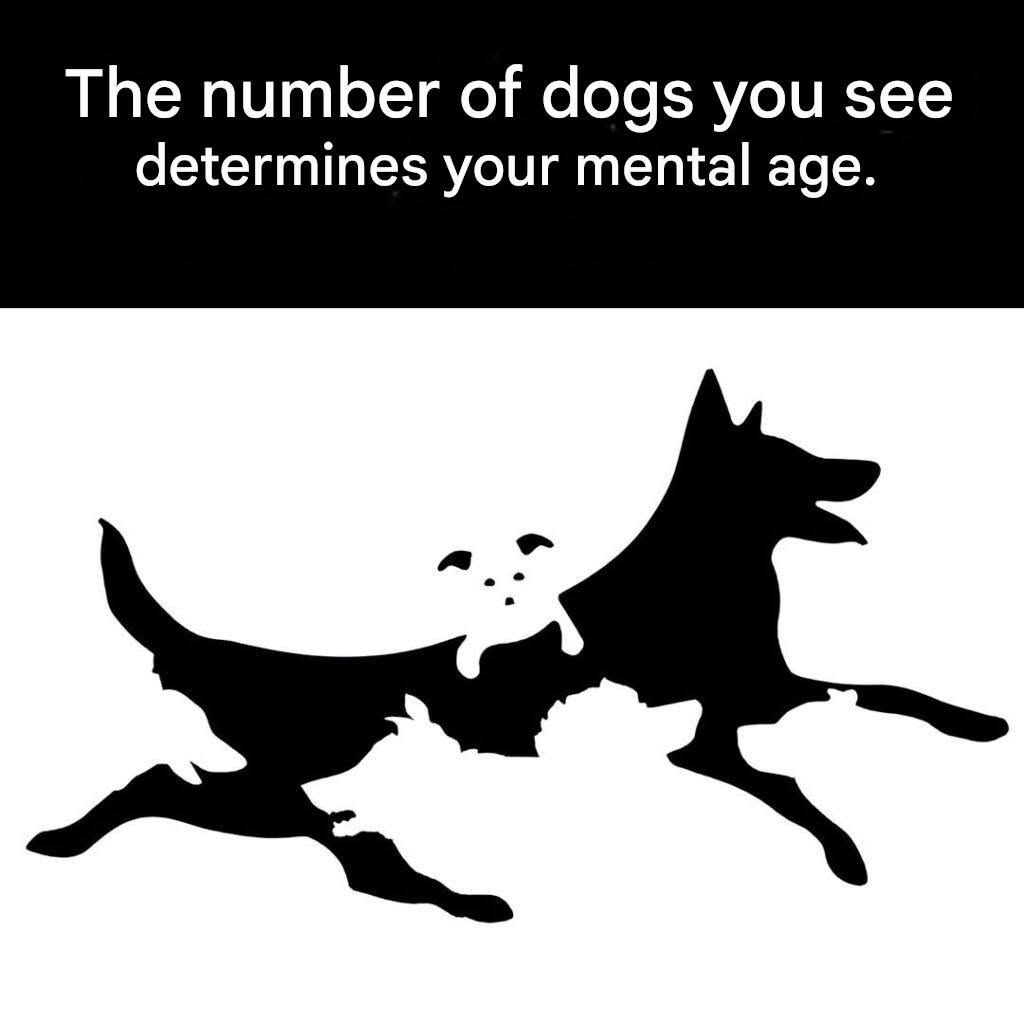
In this viral mental age optical test, viewers are asked to count how many dogs they can spot within the silhouette. According to popular internet test interpretations, the number of dogs you spot corresponds to different personality traits and “mental age” profiles!
Below, we break down the location of all 7 hidden dogs and what your score reveals about your visual perception and style!
The 7 Hidden Dogs Breakdown
While most viewers spot $4$ or $5$ dogs immediately, there are actually 7 distinct dog figures designed into the black and white spaces:
1. The Large German Shepherd Silhouette (Right)
-
Location: Occupies the right side of the main black silhouette.
-
Details: A large, alert dog head with pointed ears facing right.
2. The Small Puppy / Spaniel Head (Center Top)
-
Location: Formed in the white negative space on top of the black dog’s back.
-
Details: A cute white puppy face looking directly forward with floppy dark ears and small eyes.
3. The Prowling/Running Hound (Left)
-
Location: The main body and tail section stretching to the left.
-
Details: Formed by the curved black silhouette extending toward the left edge.
4. The White Dog Head (Center Bottom)
-
Location: Formed in the white negative space beneath the main black dog.
-
Details: A detailed profile head of a dog facing left, created by the white space between the legs.
5. The Small Terrier / Poodle Profile (Far Left Bottom)
-
Location: Tucked near the lower rear legs on the left.
-
Details: A smaller dog outline carved out near the lower hind legs.
6. The Tiny White Pup (Center Dip)
-
Location: Located right below the front chest of the large dog silhouette.
-
Details: A small white silhouette head peeking out between the front legs.
7. The Subtle Outline Dog (Under the Chin)
-
Location: Tucked in the negative space directly beneath the main dog’s snout/jaw.
-
Details: A subtle dog head outline embedded near the neck curve.
Mental Age Interpretation Guide
In viral personality quizzes, your score aligns with your cognitive processing style:
| Dogs Spotted | “Mental Age” Profile | Personality Traits |
| 4 Dogs | 20 – 25 Years Old | Creative, artistic, and relaxed; you focus on big-picture concepts without getting bogged down in minor details. |
| 5 Dogs | 25 – 30 Years Old | Balanced, practical, and clear-headed; you appreciate simple elegance and straightforward solutions. |
| 6 Dogs | 30 – 40 Years Old | Detail-oriented, analytical, and cautious; you take time to observe your environment thoroughly. |
| 7 Dogs | 10 – 20 Years Old | Extremely observant, curious, and sharp; you have a youthful, inquisitive mind that notices subtle patterns others miss! |
How Figure-Ground Illusions Work in Human Perception
Visual illusions like this rely on Gestalt psychology principles—specifically Figure-Ground Reversal:
-
Figure vs. Ground: Our brain naturally tries to separate a focal object (the figure, usually dark) from its background (the ground, usually white).
-
Negative Space Utilization: By shaping the white background so that it forms distinct recognizable outlines (like the puppy heads), the artwork tricks the visual cortex into constantly switching between viewing the black shape and the white shapes.
Conclusion
Whether you saw $4$ dogs or spotted all $7$, optical perception tests offer a fun, engaging way to challenge your observation skills and share visual puzzles with friends!
Frequently Asked Questions (FAQ)
Is a visual mental age test scientifically accurate?
No, visual personality tests and hidden object optical illusions are designed purely for entertainment and brain training. They measure visual scanning habits and pattern recognition rather than psychological maturity!
Why do some people see the negative space objects faster than others?
People process visual contrast differently. Those trained in art, photography, or design often recognize negative space (the white background shapes) faster because their brains are accustomed to evaluating spatial composition!